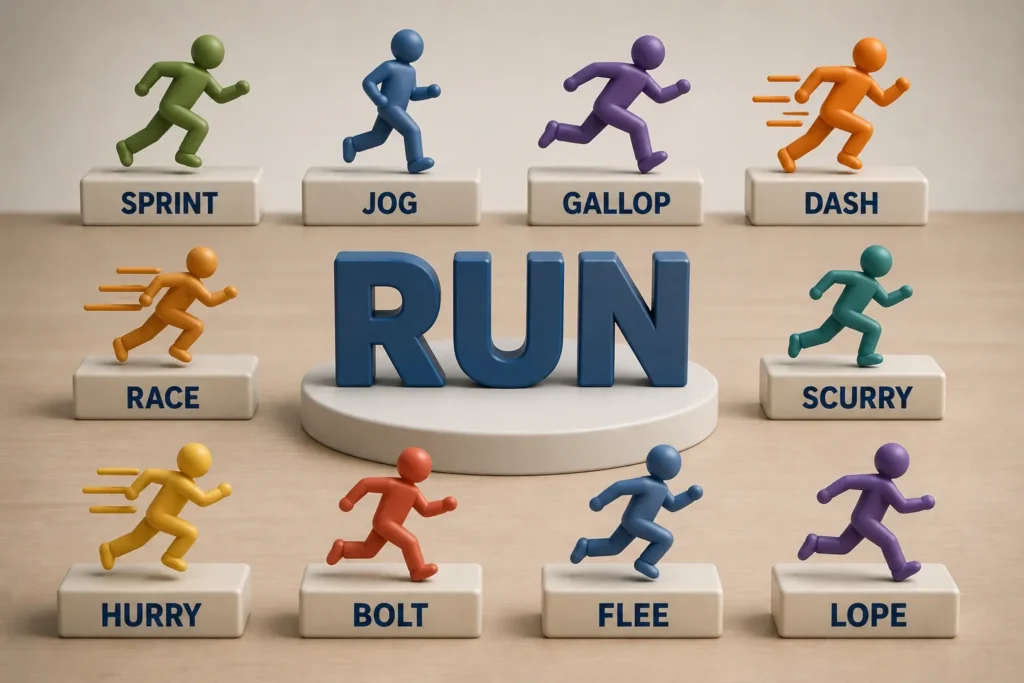
Synonyms for run help you describe the action of moving quickly on foot, operating something, managing an activity, or functioning properly. The word run is one of the most frequently used words in English because it has many meanings. For example, a child may run across a playground, a manager may run a business, or a machine may run smoothly all day. Since run appears in everyday conversations, books, and professional writing, learning its synonyms helps you choose more precise words and avoid repetition.
Understanding synonyms for run is useful for English learners, students, bloggers, and content writers. A wider vocabulary improves writing, speaking, and communication skills. In this article, you’ll learn the meaning of run, its definition, pronunciation, history, grammar, and 30 useful synonyms with meanings and examples. You’ll also explore semantic categories, antonyms, and common questions to strengthen your English vocabulary.
Meaning of Synonyms for Run
Definition
Run (Verb):
Run means to move quickly on foot, operate something, manage an activity, or continue functioning.
Examples
- She runs every morning before work.
- He runs a successful restaurant.
Connotative Meaning
(Connotation: the emotional or cultural feeling a word suggests beyond its dictionary meaning.)
Positive tone: Suggests energy, progress, success, or efficiency.
Negative tone: Can describe escaping, avoiding responsibility, or losing control.
Neutral tone: Simply means moving quickly, operating, or managing.
Etymology
Old English (450–1100):
The word run comes from Old English rinnan and irnan, meaning “to flow” or “to move quickly.”
Middle English (1100–1500):
The spelling gradually became runnen and later run.
Modern English (1500–Present):
The word run developed many meanings, including moving quickly, operating machines, managing businesses, and flowing.
Read More:
Synonyms for Lead: 30 Powerful Alternatives
Pronunciation (IPA)
- IPA: /rʌn/
- Syllables: run
Affixation Pattern of Run
- Root: run
- Prefix: None
- Suffix: None
Word Formations
- Run (Verb) – to move quickly or operate
- Run (Noun) – a period or act of running
- Runner (Noun) – a person who runs
- Running (Verb/Adjective/Noun) – the act of running
- Overrun (Verb) – to spread beyond limits
- Outrun (Verb) – to run faster than
- Rerun (Noun/Verb) – to show or do again
- Run-down (Adjective) – tired or in poor condition
- Runaway (Noun/Adjective) – someone or something that escapes
30 Synonyms of Run With Meaning & Examples
1. Sprint (Verb)
Meaning: To run very fast for a short distance.
Examples:
- She sprinted to catch the bus.
- The athlete sprinted to the finish line.
2. Jog (Verb)
Meaning: To run slowly for exercise.
Examples:
- He jogs every morning.
- They jog around the park.
3. Race (Verb)
Meaning: To run very fast in a competition.
Examples:
- The children raced home.
- They raced each other.
4. Dash (Verb)
Meaning: To run quickly for a short time.
Examples:
- She dashed across the street.
- He dashed into the room.
5. Rush (Verb)
Meaning: To move very quickly.
Examples:
- We rushed to the airport.
- She rushed outside.
6. Hurry (Verb)
Meaning: To move or act quickly.
Examples:
- Hurry or we’ll be late.
- He hurried home.
7. Bolt (Verb)
Meaning: To run away suddenly.
Examples:
- The horse bolted.
- The rabbit bolted into the woods.
8. Flee (Verb)
Meaning: To escape from danger.
Examples:
- People fled the fire.
- They fled the city.
9. Escape (Verb)
Meaning: To get away from danger.
Examples:
- The prisoner escaped.
- The bird escaped its cage.
10. Charge (Verb)
Meaning: To run forward with force.
Examples:
- The players charged ahead.
- The bull charged the fence.
11. Gallop (Verb)
Meaning: For a horse to run fast.
Examples:
- The horse galloped across the field.
- They watched horses gallop.
12. Trot (Verb)
Meaning: To run at a steady pace, especially a horse.
Examples:
- The horse trotted slowly.
- The dog trotted beside us.
13. Scurry (Verb)
Meaning: To move quickly with short steps.
Examples:
- Mice scurried away.
- Children scurried indoors.
14. Scamper (Verb)
Meaning: To run with quick, playful steps.
Examples:
- The puppy scampered outside.
- The squirrels scampered up the tree.
15. Bound (Verb)
Meaning: To run with long jumps.
Examples:
- The deer bounded away.
- He bounded up the stairs.
16. Operate (Verb)
Meaning: To make something work.
Examples:
- She operates the machine.
- The company operates worldwide.
17. Manage (Verb)
Meaning: To control or direct.
Examples:
- He manages a hotel.
- She manages the office.
18. Administer (Verb)
Meaning: To manage officially.
Examples:
- She administers the program.
- He administers school policies.
19. Direct (Verb)
Meaning: To guide or control.
Examples:
- She directs the team.
- He directed the event.
20. Conduct (Verb)
Meaning: To organize or carry out.
Examples:
- They conducted the meeting.
- She conducted research.
21. Control (Verb)
Meaning: To have power over something.
Examples:
- He controls the business.
- She controlled the process.
22. Govern (Verb)
Meaning: To rule or manage.
Examples:
- Laws govern society.
- The mayor governs the city.
23. Supervise (Verb)
Meaning: To oversee work.
Examples:
- She supervises workers.
- Teachers supervise exams.
24. Oversee (Verb)
Meaning: To watch over and manage.
Examples:
- He oversees production.
- She oversees operations.
25. Function (Verb)
Meaning: To work properly.
Examples:
- The engine functions well.
- The system functions smoothly.
26. Flow (Verb)
Meaning: To move continuously.
Examples:
- Water flows downstream.
- Traffic flowed freely.
27. Proceed (Verb)
Meaning: To continue moving or acting.
Examples:
- Please proceed carefully.
- The meeting proceeded as planned.
28. Continue (Verb)
Meaning: To keep going.
Examples:
- They continued running.
- Work continued all day.
29. Advance (Verb)
Meaning: To move forward.
Examples:
- The soldiers advanced.
- Technology advances rapidly.
30. Travel (Verb)
Meaning: To move from one place to another.
Examples:
- We traveled by train.
- Light travels very fast.
Prototype Meaning
The most common meaning of run is to move quickly on foot. However, many people also think of running a business, operating a machine, or continuing to function, making it one of the most versatile verbs in English.
Prototype Categorization
The 30 synonyms can be grouped into meaningful semantic categories:
- Fast Movement: sprint, dash, rush, race, bolt, flee, escape, charge
- Steady Movement: jog, trot, gallop, scamper, scurry, bound
- Management and Control: manage, administer, direct, conduct, oversee, supervise, govern, control
- Operation and Function: operate, function, continue, proceed
- Movement and Progress: flow, advance, travel
These categories help writers choose the most accurate synonym depending on whether run means physical movement, management, operation, or progress.
Antonyms of Run
1. Walk (Verb)
Meaning: To move at a slower pace.
2. Stop (Verb)
Meaning: To cease moving or working.
3. Halt (Verb)
Meaning: To come to a stop.
4. Remain (Verb)
Meaning: To stay in one place.
5. Stay (Verb)
Meaning: To avoid moving away.
6. Rest (Verb)
Meaning: To stop working or moving.
7. Stand (Verb)
Meaning: To remain upright without moving.
8. Pause (Verb)
Meaning: To stop briefly before continuing.
Short Questions and Answers
What does run mean?
Run means to move quickly on foot, operate something, manage an activity, or continue functioning.
When should run be used?
Use run when talking about fast movement, operating machines, managing businesses, or describing something that continues to function.
Is run positive or negative?
Run is generally a neutral word. It can have a positive meaning when describing progress or success, or a negative meaning when referring to escaping danger or avoiding responsibility.
How is it different from similar words?
Run is a broad verb with many meanings. Sprint emphasizes speed, jog refers to slow exercise, manage relates to leadership, and operate focuses on making something work.
Conclusion
Learning synonyms for run helps you communicate more clearly and choose the right word for different situations. Instead of repeating run, you can use alternatives like sprint, jog, manage, operate, or advance depending on the context. Expanding your vocabulary makes your writing more engaging, improves your speaking skills, and helps you express ideas with greater precision. Whether you are an English learner, student, teacher, or content writer, practicing these synonyms regularly will strengthen your communication and build your confidence in English. Keep learning new words every day to become a more effective writer and speaker.

I’m an English language writer with over 10 years of experience specializing in synonyms, vocabulary, and English usage. My articles are thoroughly researched, SEO-optimized, and written to deliver accurate, trustworthy, and easy-to-understand information. I’m passionate about helping students, writers, professionals, and ESL learners expand their vocabulary and improve their communication skills. Every guide is designed to provide practical value, clear explanations, and reliable language insights readers can trust.