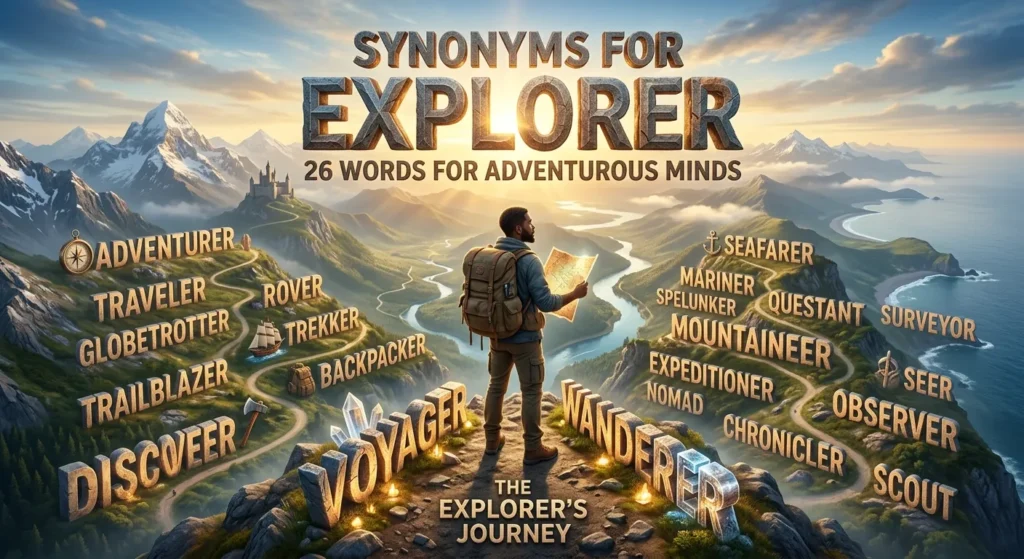
Adventurer, traveler, discoverer, pioneer, voyager, wanderer, tourist, seeker, scout, and trailblazer are useful synonyms for explorer.
Explorer means a person who travels to places to discover, study, or learn about them. Picture a traveler arriving in a small mountain village for the first time. Instead of staying near the main road, she follows an old trail, talks to local people, and records what she sees. She is not simply traveling; she is exploring. The word explorer is common because it can describe people who discover new places, study unfamiliar subjects, or search for new ideas. Learning its synonyms helps English learners express these different meanings more clearly. A writer may choose voyager for long-distance travel, pioneer for someone entering a new field, or adventurer for someone seeking exciting experiences. This article explains the meaning, grammar, history, pronunciation, and different shades of meaning of explorer, with useful examples and semantic categories.
Meaning of Explorer
Definition
Explorer (Noun): A person who travels through unfamiliar places or investigates something new to discover information or gain knowledge.
Examples
- The young explorer traveled deep into the rainforest.
- She is an explorer of new ideas in science and technology.
Connotative Meaning
Connotation: The feeling or idea that a word suggests beyond its basic meaning.
- Positive tone: Explorer often suggests courage, curiosity, independence, and discovery.
- Negative tone: In some historical contexts, exploration may be linked with invasion, exploitation, or colonial expansion.
- Neutral tone: It can simply describe someone who investigates an unfamiliar place, subject, or idea.
Etymology
Explorer comes from the Latin verb explorare, meaning “to investigate, examine, or search out.”
- Old English (450–1100): The modern word explorer was not part of Old English. English used other native words for people who searched, traveled, or investigated.
- Middle English (1100–1500): The Latin-based verb explore entered English through French and Latin influences.
- Modern English (1500–Present): Explorer developed as the noun for a person who explores. It became strongly associated with geographical discovery and later expanded to intellectual, scientific, and technological discovery.
Pronunciation (IPA)
- IPA: /ɪkˈsplɔːrər/
- Syllables: ex-plor-er
Affixation Pattern of Explorer
- Root: explore
- Prefix: None in modern English
- Suffix: -er, meaning a person who performs an action
- Word formations:
- Explore: verb
- Explored: verb
- Exploring: verb/noun
- Explorer: noun
- Exploration: noun
- Exploratory: adjective
- Explorative: adjective
- Exploratively: adverb
26 Synonyms of Explorer with Meaning & Examples
1. Adventurer (Noun)
Meaning: A person who seeks exciting, unusual, or risky experiences.
Examples:
- The adventurer crossed the desert alone.
- She has always dreamed of becoming an adventurer.
2. Traveler (Noun)
Meaning: A person who travels from one place to another.
Examples:
- The traveler visited several remote islands.
- Every traveler should respect local customs.
3. Discoverer (Noun)
Meaning: A person who finds or learns something that was previously unknown.
Examples:
- The discoverer documented the rare plant.
- He became known as the discoverer of the new species.
4. Voyager (Noun)
Meaning: A person who makes a long or difficult journey, especially by sea or through space.
Examples:
- The voyager spent months at sea.
- Ancient voyagers crossed vast oceans.
5. Pioneer (Noun)
Meaning: A person who is among the first to develop or enter a new area, field, or activity.
Examples:
- She was a pioneer in space research.
- The pioneer opened a new route through the mountains.
6. Trailblazer (Noun)
Meaning: A person who develops a new path, method, or area of activity.
Examples:
- She is a trailblazer in renewable energy.
- The scientist became a trailblazer in her field.
7. Wanderer (Noun)
Meaning: A person who moves from place to place without a fixed destination.
Examples:
- The wanderer traveled from village to village.
- He lived for years as a wanderer.
8. Roamer (Noun)
Meaning: A person who travels freely over a wide area.
Examples:
- The roamer spent weeks in the countryside.
- He was a natural roamer who loved open spaces.
9. Wayfarer (Noun)
Meaning: A person who travels from one place to another, often on foot.
Examples:
- The wayfarer stopped at a small inn.
- A lonely wayfarer walked along the old road.
10. Tourist (Noun)
Meaning: A person who travels to a place for pleasure or sightseeing.
Examples:
- The tourist explored the historic district.
- Thousands of tourists visit the island each year.
11. Sightseer (Noun)
Meaning: A person who travels to see interesting or famous places.
Examples:
- The sightseer visited every major landmark.
- The city offers many attractions for sightseers.
12. Scout (Noun)
Meaning: A person sent ahead to search an area and gather information.
Examples:
- The scout examined the trail before the group moved forward.
- The explorers sent a scout ahead.
13. Searcher (Noun)
Meaning: A person who looks carefully for something or tries to find information.
Examples:
- The searcher looked for a safer route.
- He was a persistent searcher of historical records.
14. Seeker (Noun)
Meaning: A person who actively looks for something such as knowledge, truth, or experience.
Examples:
- She is a seeker of new knowledge.
- The young seeker traveled to learn about other cultures.
15. Investigator (Noun)
Meaning: A person who carefully examines something to discover facts.
Examples:
- The investigator studied the unusual findings.
- She worked as an investigator of ancient artifacts.
16. Researcher (Noun)
Meaning: A person who studies a subject carefully to gain new knowledge.
Examples:
- The researcher explored the effects of climate change.
- Each researcher recorded detailed observations.
17. Naturalist (Noun)
Meaning: A person who studies plants, animals, and other parts of the natural world.
Examples:
- The naturalist spent years studying tropical birds.
- A famous naturalist explored the island’s wildlife.
18. Geographer (Noun)
Meaning: A person who studies the Earth’s places, people, environments, and landscapes.
Examples:
- The geographer mapped the remote region.
- She worked as a geographer in several countries.
19. Expeditioner (Noun)
Meaning: A person who takes part in an organized journey for exploration or research.
Examples:
- The expeditioners reached the mountain base.
- Every expeditioner’s equipment was checked carefully.
20. Pathfinder (Noun)
Meaning: A person who finds or creates a route through an unfamiliar area.
Examples:
- The pathfinder led the group through the forest.
- The expedition relied on an experienced pathfinder.
21. Trekker (Noun)
Meaning: A person who travels on a long and difficult walking journey.
Examples:
- The trekker reached the remote valley.
- Experienced trekkers prepared carefully for the climb.
22. Globetrotter (Noun)
Meaning: A person who travels widely around the world.
Examples:
- The globetrotter has visited more than fifty countries.
- As a young globetrotter, she collected stories from every trip.
23. Backpacker (Noun)
Meaning: A traveler who carries belongings in a backpack and often travels independently and economically.
Examples:
- The backpacker stayed in small hostels.
- Many backpackers explore Southeast Asia.
24. Nomad (Noun)
Meaning: A person who moves from place to place rather than living permanently in one location.
Examples:
- The nomad traveled with a small group.
- Digital nomads explore new countries while working online.
25. Delver (Noun)
Meaning: A person who searches deeply into a subject or hidden matter.
Examples:
- The historian was a careful delver into ancient records.
- She became a delver into forgotten traditions.
26. Inquirer (Noun)
Meaning: A person who seeks information by asking questions or investigating.
Examples:
- The curious inquirer asked about the area’s history.
- An active inquirer often discovers useful details.
Prototype Meaning
The most typical meaning of explorer is a person who travels into unfamiliar places to discover or study them. People often imagine someone crossing a remote forest, climbing a mountain, sailing across an unknown sea, or mapping a new region. However, explorer can also be used in a wider sense for someone who investigates ideas, science, technology, or other unfamiliar areas.
Prototype Categorization
The 26 synonyms fall into several useful semantic groups:
- Travel and adventure: adventurer, traveler, voyager, trekker, globetrotter, and backpacker focus on physical journeys and new experiences.
- Discovery: discoverer, pioneer, and trailblazer emphasize finding or developing something new.
- Free movement: wanderer, roamer, wayfarer, and nomad suggest movement from place to place, often without a fixed destination.
- Investigation and knowledge: searcher, seeker, investigator, researcher, and inquirer focus on finding information or understanding something.
- Scientific exploration: naturalist and geographer describe people who explore or study specific areas of knowledge.
- Navigation and organized exploration: scout, expeditioner, and pathfinder focus on finding routes, gathering information, or joining organized expeditions.
- Tourism: tourist and sightseer describe people who visit places mainly for pleasure and sightseeing.
This grouping helps writers select the closest word for the exact kind of exploration they want to describe.
Antonyms of Explorer
1. Settler (Noun)
A person who establishes a permanent home in a particular place rather than traveling to discover new places.
2. Homebody (Noun)
A person who prefers staying at home instead of going out or traveling.
3. Nontraveler (Noun)
A person who does not travel or explore different places.
4. Stay-at-home (Noun)
A person who remains at home rather than traveling or going out.
5. Avoider (Noun)
A person who deliberately stays away from something, including unfamiliar experiences.
Short Questions and Answers
Q: What does explorer mean?
An explorer is a person who travels through unfamiliar places or investigates something new to gain knowledge or make discoveries.
Q: When should explorer be used?
Use explorer for someone who discovers or studies unfamiliar places, subjects, ideas, or areas of knowledge.
Q: Is explorer positive or negative?
Explorer is usually positive because it suggests curiosity, courage, discovery, and a desire to learn. Its meaning can become negative in certain historical contexts.
Q: How is it different from similar words?
An adventurer seeks exciting experiences, while an explorer focuses more on discovery or investigation. A tourist usually travels for pleasure, while a researcher investigates a subject to gain knowledge.
Conclusion
Learning explorer and its synonyms can make your vocabulary more precise and interesting. Words such as adventurer, traveler, and voyager are useful for people who travel, while discoverer, pioneer, and trailblazer focus on finding or creating something new. Other words, such as researcher, investigator, and seeker, work better when exploration involves knowledge or ideas.
Understanding these differences helps you avoid repetition and choose words that match your meaning. It also improves both writing and speaking by giving you more ways to describe curiosity, travel, discovery, and research. Do not try to memorize all the synonyms at once. Pick two or three, write your own sentences, and use them in daily conversation. Regular vocabulary practice will help you remember these words and speak with greater confidence.
Synonyms for Rode: 22 Similar Words Explained

An English language writer with expertise in grammar, spelling, vocabulary, and word usage. Committed to publishing accurate, well-researched, and easy-to-understand content that helps readers improve their English with confidence.