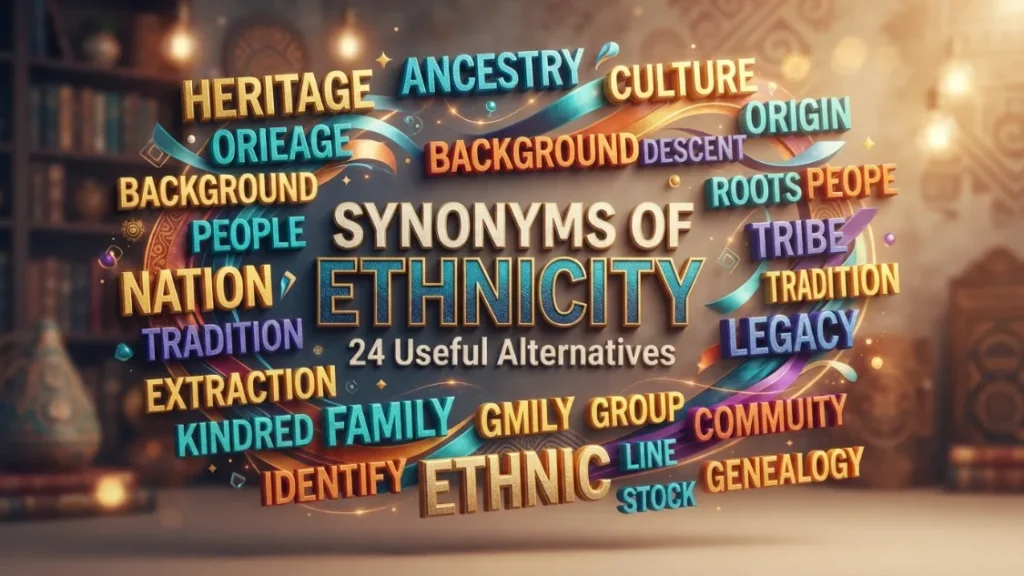
Quick Snippet: Synonyms and related terms for ethnicity include ethnic identity, cultural identity, heritage, ancestry, cultural background, ethnic background, and cultural heritage.
Ethnicity refers to the cultural identity of a person or group, often linked to shared traditions, language, ancestry, history, or customs. For example, at a school cultural event, students may talk about their ethnicity when sharing family traditions, food, clothing, or languages. The word is common in discussions about culture, identity, society, history, and demographics. Learning synonyms of ethnicity helps English learners express ideas with greater accuracy and variety. It is also useful for writers who need to avoid repeating the same word in articles, essays, reports, and social topics. However, not every related word has exactly the same meaning. This article explains the meaning of ethnicity, its useful synonyms and related terms, examples, grammar, history, pronunciation, and semantic categories so you can choose the right word for each context.
Meaning of Ethnicity
Definition
Ethnicity (noun): A person’s or group’s cultural identity based on shared traditions, language, ancestry, history, or cultural practices.
Examples
- Her ethnicity is an important part of her cultural identity.
- The survey asked participants about their ethnicity.
Connotative Meaning
Connotation: The feelings, ideas, or associations that a word suggests beyond its basic meaning.
- Positive tone: Ethnicity can suggest cultural pride, heritage, diversity, and belonging.
- Negative tone: It can sometimes be linked to prejudice, stereotyping, or discrimination when discussed in harmful contexts.
- Neutral tone: In surveys, research, and demographic studies, ethnicity is usually a neutral term for describing cultural or ancestral identity.
Etymology
The word ethnicity is built from ethnic + -ity. Its deeper origin comes from the Greek word ethnos, meaning “nation,” “people,” or “a group of people.”
- Old English (450–1100): Ethnicity was not used in Old English. The modern word entered English much later.
- Middle English (1100–1500): Related forms such as ethnic developed through French and Latin from Greek ethnos.
- Modern English (1500–Present): Ethnic became established in English, while ethnicity developed later as the noun describing ethnic identity or affiliation.
Pronunciation (IPA)
- IPA: /eθˈnɪsəti/
- Syllables: eth-nic-i-ty
Affixation Pattern of Ethnicity
- Root: ethnic relating to a particular cultural or social group
- Prefix: None
- Suffix: -ity — forms a noun expressing a state, quality, or condition
- Word formations:
- ethnic adjective
- ethnicity noun
- ethnically adverb
- ethnicities plural noun
Note: Ethnic is the base form related to ethnicity, rather than a separate prefix-root construction.
24 Synonyms of Ethnicity with Meaning & Examples
Not all of the following are exact dictionary synonyms. Some are close alternatives or context-specific terms. This distinction matters because ethnicity can describe a broad cultural identity, while words such as ancestry or heritage focus on particular parts of that identity.
1. Ethnic Identity (Noun Phrase)
Meaning: A person’s sense of belonging to a particular ethnic or cultural group.
Examples:
- Her ethnic identity is shaped by her family traditions.
- Many people express their ethnic identity through language and food.
2. Cultural Identity (Noun Phrase)
Meaning: The identity a person develops from shared culture, traditions, values, and customs.
Examples:
- Language can play an important role in cultural identity.
- The festival helped young people celebrate their cultural identity.
3. Heritage (Noun)
Meaning: The traditions, culture, history, and customs passed down through a family or community.
Examples:
- She is proud of her cultural heritage.
- The museum celebrates the region’s rich heritage.
4. Ancestry (Noun)
Meaning: A person’s family origins or the people from whom they are descended.
Examples:
- He researched his family’s ancestry.
- Her ancestry includes several different cultural backgrounds.
5. Cultural Heritage (Noun Phrase)
Meaning: The traditions, customs, beliefs, and practices inherited from earlier generations.
Examples:
- The community works hard to protect its cultural heritage.
- Traditional music is part of their cultural heritage.
6. Ethnic Background (Noun Phrase)
Meaning: The cultural or ancestral group a person comes from.
Examples:
- The form asked about the student’s ethnic background.
- People may have more than one ethnic background.
7. Cultural Background (Noun Phrase)
Meaning: The culture, traditions, and experiences that influence a person’s identity.
Examples:
- Students come from many different cultural backgrounds.
- Her cultural background influenced her love of traditional music.
8. Ethnic Origin (Noun Phrase)
Meaning: The ethnic group or cultural ancestry from which someone comes.
Examples:
- The study examined participants’ ethnic origins.
- He was interested in learning about his ethnic origin.
9. Cultural Origin (Noun Phrase)
Meaning: The cultural source or background from which a person or group comes.
Examples:
- The artwork reflects the artist’s cultural origin.
- Food can reveal a person’s cultural origins.
10. Ethnic Affiliation (Noun Phrase)
Meaning: A person’s connection or identification with an ethnic group.
Examples:
- People may identify with more than one ethnic affiliation.
- The survey recorded each participant’s ethnic affiliation.
11. Ethnic Group (Noun Phrase)
Meaning: A group of people who share cultural, historical, linguistic, or ancestral features.
Examples:
- The country is home to many ethnic groups.
- Each ethnic group has its own traditions.
12. Cultural Group (Noun Phrase)
Meaning: A group of people who share important cultural practices, beliefs, or traditions.
Examples:
- The city has many cultural groups.
- The festival brought several cultural groups together.
13. Ethnic Community (Noun Phrase)
Meaning: A community connected by a shared ethnic or cultural identity.
Examples:
- The ethnic community organized a cultural festival.
- Local organizations support the ethnic community.
14. Cultural Community (Noun Phrase)
Meaning: A group of people connected through shared cultural practices or traditions.
Examples:
- The cultural community holds an annual celebration.
- The center provides activities for the local cultural community.
15. National Origin (Noun Phrase)
Meaning: The country or national background from which a person or family originates.
Examples:
- The questionnaire included a question about national origin.
- Her family’s national origin is part of her personal history.
16. Lineage (Noun)
Meaning: A person’s line of descent from earlier family members.
Examples:
- He traced his lineage back several generations.
- Family records helped reveal her lineage.
17. Descent (Noun)
Meaning: A person’s family or ancestral origin.
Examples:
- She is of Irish descent.
- His family has mixed European descent.
18. Genealogy (Noun)
Meaning: The study or record of a person’s family history and ancestors.
Examples:
- She became interested in genealogy after finding old family records.
- Genealogy can help people understand their family history.
19. Ancestral Background (Noun Phrase)
Meaning: The family origins and ancestry passed down through previous generations.
Examples:
- His ancestral background includes several regions.
- She learned more about her ancestral background through family research.
20. Cultural Affiliation (Noun Phrase)
Meaning: A person’s connection with a particular culture or cultural group.
Examples:
- People may have more than one cultural affiliation.
- Her cultural affiliation influences the traditions she follows.
21. Cultural Roots (Noun Phrase)
Meaning: The historical and cultural origins that connect a person to a particular community.
Examples:
- He returned to his family’s cultural roots.
- Music helped her stay connected to her cultural roots.
22. Cultural Heritage Identity (Noun Phrase)
Meaning: A person’s identity connected to inherited cultural traditions and history.
Examples:
- Food can strengthen cultural heritage identity.
- Young people may explore their cultural heritage identity through family stories.
23. Ethnic Heritage (Noun Phrase)
Meaning: The cultural traditions and ancestry associated with a person’s ethnic group.
Examples:
- She enjoys learning about her ethnic heritage.
- The exhibition celebrates the region’s ethnic heritage.
24. Peoplehood (Noun)
Meaning: A shared sense of identity and belonging among a group of people.
Examples:
- Language helped preserve their sense of peoplehood.
- Shared history contributed to the community’s feeling of peoplehood.
Prototype Meaning
The prototype meaning of ethnicity is a shared cultural identity connected to a particular group of people. When people hear the word, they often think about shared traditions, language, ancestry, history, customs, and a sense of belonging. For example, a person’s ethnicity may be connected to the cultural community in which they were raised.
Prototype Categorization
The 24 terms above can be grouped by the part of meaning they emphasize:
- Identity and belonging ethnic identity, cultural identity, ethnic affiliation, cultural affiliation, peoplehood useful when discussing how people identify themselves or feel connected to a group.
- Heritage and tradition: heritage, cultural heritage, ethnic heritage, cultural roots best when focusing on traditions, customs, and inherited culture.
- Family and ancestry: ancestry, lineage, descent, genealogy, ancestral background useful when discussing family history and origins.
- Group and community: ethnic group, cultural group, ethnic community, cultural community appropriate when referring to groups of people rather than one person’s identity.
- Background and origin: ethnic background, cultural background, ethnic origin, cultural origin, national origin useful in demographic, historical, and descriptive contexts.
- Specialized cultural descriptions: cultural heritage identity useful when the focus is specifically on identity connected to inherited culture.
This categorization helps writers avoid using a related word that changes the intended meaning. For example, ancestry focuses on family descent, while cultural identity focuses more on a person’s sense of belonging.
Antonyms of Ethnicity
Ethnicity does not have one perfect opposite because it describes a type of identity. However, these terms can express contrasting ideas depending on context:
1. Cultural Universality (Noun Phrase)
A focus on qualities or experiences shared by people across cultures rather than differences between ethnic groups.
2. Cultural Homogeneity (Noun Phrase)
A state in which people in a society share similar cultural characteristics.
3. Non-Identification (Noun)
A lack of identification with a particular ethnic or cultural group.
4. Assimilation (Noun)
The process in which a person or group adopts the culture of another group and may lose some distinct cultural traits.
5. Cultural Neutrality (Noun Phrase)
An approach that does not emphasize or favor a particular cultural identity.
Short Questions and Answers
Q: What does ethnicity mean?
Ethnicity means a person’s or group’s cultural identity, often connected to shared traditions, language, ancestry, history, or customs.
Q: When should ethnicity be used?
Use ethnicity when discussing a person’s or group’s cultural or ethnic identity, especially in social, demographic, historical, or academic contexts.
Q: Is ethnicity positive or negative?
Ethnicity is normally a neutral word. Its emotional effect depends on the context in which it is used.
Q: How is it different from similar words?
Ethnicity covers cultural identity broadly. Ancestry focuses on family origins, heritage focuses on inherited culture and traditions, and nationality usually refers to a person’s connection to a nation or citizenship.
Conclusion
Learning ethnicity and its related terms can make your English more precise and flexible. Words such as ethnic identity, cultural identity, heritage, ancestry, and cultural background are useful, but they are not always interchangeable. Each term highlights a different part of cultural or ancestral identity. Understanding these small differences helps you choose the right word for essays, conversations, reports, and other forms of writing. It also prevents unnecessary repetition and makes your vocabulary stronger. For English learners, practicing these words in short sentences is a simple way to remember them. Try learning two or three terms each day and use them in your own examples. With regular practice, you can speak and write about culture and identity with greater clarity and confidence.
Synonyms for absence: 24 Useful Alternatives

An English language writer with expertise in grammar, spelling, vocabulary, and word usage. Committed to publishing accurate, well-researched, and easy-to-understand content that helps readers improve their English with confidence.