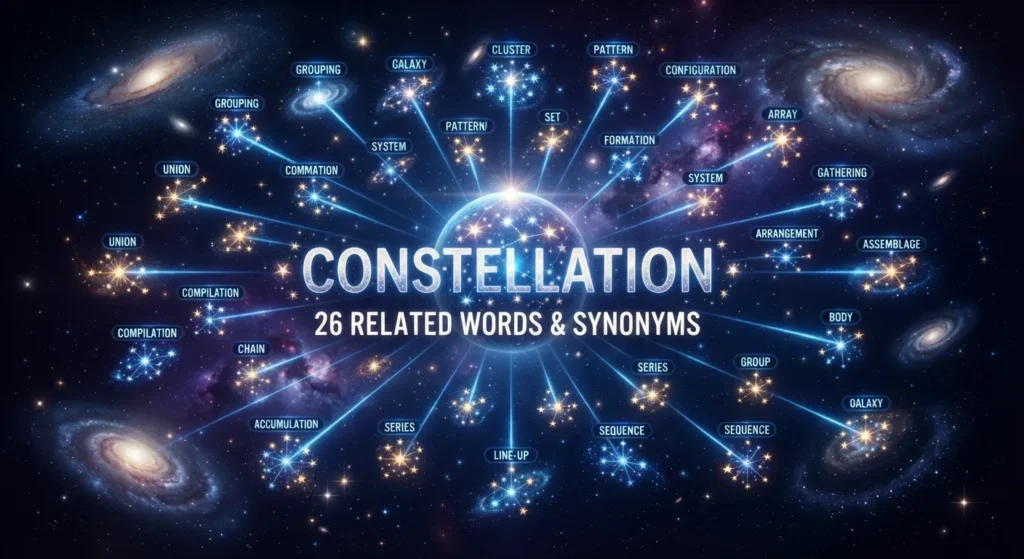
Star pattern, star group, cluster, grouping, arrangement, configuration, and collection are useful alternatives to constellation, depending on whether you mean stars in the sky or a group of related things.
Constellation is a word we often use when talking about stars that form a recognized pattern in the night sky. Imagine looking up on a clear evening and noticing several bright stars that seem to form a shape. That pattern may be part of a named constellation, such as Orion. The word is also used in a wider sense for a group of related people, ideas, or events. Because of these two meanings, constellation appears in astronomy, literature, science, and everyday writing.
Learning its synonyms helps English learners describe patterns and groups without repeating the same word. It also gives writers more precise choices for different contexts. In this article, we will explore the meaning, synonyms, examples, grammar, history, pronunciation, and semantic categories of constellation.
Meaning of Constellation
Definition
Constellation (noun): A recognized pattern of stars in the night sky, or a group of related things that appear together.
Examples
- Orion is one of the most recognizable constellations in the night sky.
- A constellation of social and economic factors contributed to the change.
Connotative Meaning
Connotation means the feeling or idea that a word suggests beyond its basic meaning.
- Positive tone: Can suggest beauty, order, connection, or wonder.
- Negative tone: In some contexts, it can suggest a complicated or confusing group of factors.
- Neutral tone: Simply describes a pattern of stars or a group of connected things.
Etymology
The word constellation comes from Latin constellatio, meaning a group or collection of stars. It is built from con- meaning “together” and stella meaning “star.”
- Old English (450–1100): English did not commonly use the modern word constellation. Ideas about star groups were described through native and borrowed astronomical terms.
- Middle English (1100–1500): The word entered English through Old French and Latin-influenced forms, referring to a group or arrangement of stars.
- Modern English (1500–Present): Constellation developed its modern astronomical meaning and later gained a figurative sense for a group or arrangement of related people, ideas, events, or conditions.
Pronunciation (IPA)
- IPA: /ˌkɒnstəˈleɪʃən/ (British), /ˌkɑːnstəˈleɪʃən/ (American)
- Syllables: con-stel-la-tion
Affixation Pattern of Constellation
- Root: stell / stella, meaning “star”
- Prefix: con-, meaning “together”
- Suffix: -ation, forming a noun related to an action, process, or result
- Word formations:
- constellate: verb
- constellation: noun
- constellated: adjective/past participle
- constellational: adjective, uncommon
- stellar: adjective
- stellate: adjective/verb
26 Synonyms of Constellation With Meaning & Examples
1. Star Pattern (Noun)
Meaning: A recognizable shape formed by several stars.
Examples:
- The children tried to identify the star pattern above them.
- The star pattern looked like a large animal.
2. Star Group (Noun)
Meaning: A group of stars seen together in the sky.
Examples:
- Ancient people gave names to many star groups.
- The astronomer pointed toward a distant star group.
3. Asterism (Noun)
Meaning: A noticeable pattern of stars that may form part of a constellation.
Examples:
- The Big Dipper is a famous asterism.
- We learned about a bright asterism during the lesson.
4. Star Cluster (Noun)
Meaning: A group of stars that are close together in space.
Examples:
- The telescope revealed a beautiful star cluster.
- Scientists studied the young star cluster.
Note: A star cluster is not the same as a constellation. A cluster consists of stars that are physically related, while a constellation is an apparent pattern in the sky.
5. Pattern (Noun)
Meaning: An arrangement of parts that creates a recognizable design.
Examples:
- The stars formed a strange pattern.
- She noticed a clear pattern in the sky.
6. Arrangement (Noun)
Meaning: The way things are placed or organized.
Examples:
- The arrangement of the stars was easy to recognize.
- The report describes an unusual arrangement of factors.
7. Configuration (Noun)
Meaning: The particular arrangement of parts or elements.
Examples:
- The stars have a distinctive configuration.
- This configuration of events created a difficult situation.
8. Formation (Noun)
Meaning: A particular shape or arrangement made by several things.
Examples:
- The stars appeared in a triangular formation.
- The aircraft moved into a tight formation.
9. Grouping (Noun)
Meaning: A collection of things placed or considered together.
Examples:
- The stars form a recognizable grouping.
- The data shows a clear grouping of related factors.
10. Collection (Noun)
Meaning: A group of things gathered or considered together.
Examples:
- The museum has a collection of astronomical charts.
- A collection of ideas shaped the final plan.
11. Cluster (Noun)
Meaning: A group of similar things located close together.
Examples:
- A cluster of stars appeared through the telescope.
- A cluster of problems delayed the project.
12. Assemblage (Noun)
Meaning: A group of things gathered together.
Examples:
- The painting shows an assemblage of symbolic figures.
- An assemblage of ideas appears throughout the book.
13. Array (Noun)
Meaning: An impressive or organized group or arrangement of things.
Examples:
- An array of stars filled the sky.
- The website offers an array of useful resources.
14. Group (Noun)
Meaning: Several people or things considered together.
Examples:
- The stars form a distinct group.
- A group of factors affected the result.
15. Set (Noun)
Meaning: A number of related things considered as a whole.
Examples:
- The stars belong to a familiar set.
- A set of conditions led to the decision.
16. Gathering (Noun)
Meaning: A collection of people or things brought together.
Examples:
- The telescope captured a gathering of distant stars.
- A gathering of ideas shaped the discussion.
17. Network (Noun)
Meaning: A connected group of people, things, or relationships.
Examples:
- The study examines a network of social relationships.
- The stars appeared connected like a network.
18. Web (Noun)
Meaning: A complex set of connected things or relationships.
Examples:
- The story explores a web of family relationships.
- A web of factors influenced the outcome.
19. Complex (Noun)
Meaning: A group of connected parts or elements.
Examples:
- The theory describes a complex of related ideas.
- A complex of social factors shaped the community.
20. System (Noun)
Meaning: A group of connected parts that work or exist together.
Examples:
- The stars can be studied as part of a larger system.
- The problem involves a system of connected factors.
21. Ensemble (Noun)
Meaning: A group of things that work or appear together as a whole.
Examples:
- The painting presents an ensemble of symbolic images.
- The actors formed a strong ensemble.
22. Coalition (Noun)
Meaning: A group of people or organizations that join for a shared purpose.
Examples:
- Several groups formed a coalition to support the project.
- The coalition included different community organizations.
23. Combination (Noun)
Meaning: A group of things brought together.
Examples:
- The result came from a combination of factors.
- This combination of events was unusual.
24. Convergence (Noun)
Meaning: The coming together of different things toward one point or result.
Examples:
- The event resulted from a convergence of several trends.
- A convergence of ideas changed the field.
25. Nexus (Noun)
Meaning: A connection or central link between different things.
Examples:
- The city became a nexus of trade and culture.
- The study examines the nexus between technology and education.
26. Configuration (Noun)
Meaning: A particular arrangement or combination of related elements.
Examples:
- The stars formed an unusual configuration.
- This configuration of circumstances created new challenges.
Usage note: Not all of these words are exact substitutes for constellation. In astronomy, asterism, star pattern, and star group may describe related ideas, while cluster has a specific scientific meaning. In figurative writing, words such as grouping, array, network, combination, and nexus may work depending on the sentence.
Prototype Meaning
The most typical meaning of constellation is a named or recognizable pattern of stars in the night sky. People usually imagine several bright stars that seem to form a shape, such as Orion or Leo. In broader writing, the same idea extends to a connected group of people, events, ideas, or conditions.
Prototype Categorization
The 26 related words can be grouped into useful semantic categories:
- Astronomical pattern: star pattern, star group, asterism, formation best when discussing visible patterns of stars.
- Astronomical group: star cluster, cluster useful for groups of stars, but scientific context matters because a star cluster is not simply another name for a constellation.
- General arrangement: pattern, arrangement, configuration, formation, grouping, array useful when describing how things are positioned or organized.
- General collection: collection, group, set, gathering, assemblage, combination useful when several things are considered together.
- Connected systems: network, web, complex, system, nexus best for figurative uses involving relationships or connected factors.
- People or organizations: ensemble, coalition useful when the “group” consists of people or organizations rather than stars.
This categorization helps writers select a word based on meaning. A scientific astronomy sentence may need asterism or star cluster, while a sentence about social factors may work better with combination, network, or complex.
Antonyms of Constellation
There is no single exact antonym for constellation because the word describes a group or arrangement rather than a simple quality.
1. Separation (Noun)
The state of being apart rather than together.
2. Disconnection (Noun)
A lack of connection between things.
3. Isolation (Noun)
The state of being separate from others.
4. Individual (Noun)
A single person or thing considered separately from a group.
5. Disorder (Noun)
A lack of organization or clear arrangement.
Short Questions and Answers
Q: What does constellation mean?
A: Constellation means a recognized pattern of stars in the sky or, more broadly, a group of related things.
Q: When should constellation be used?
A: Use constellation when describing a recognized star pattern or a connected group of people, ideas, events, or factors.
Q: Is constellation positive or negative?
A: Constellation is usually neutral. Its emotional effect depends on context. In astronomy, it can suggest beauty or wonder, while its figurative use may describe either helpful or difficult combinations of factors.
Q: How is it different from similar words?
A: A constellation is usually a recognized pattern or group. An asterism is a recognizable star pattern that may not be an official constellation. A star cluster contains stars that are physically related. In figurative use, grouping, combination, and network emphasize different types of relationships.
Conclusion
Learning the meaning and related words of constellation can make your English more precise and flexible. In astronomy, words such as asterism, star pattern, and star group can help explain different kinds of arrangements in the sky. In broader writing, alternatives such as grouping, configuration, combination, network, and array can describe connected people, ideas, events, or factors. However, these words are not always interchangeable, so context matters.
Understanding their small differences helps you avoid awkward word choices and makes your writing clearer. Regular vocabulary practice can also strengthen speaking and writing skills. Try learning a few related words each day and create your own sentences with them. Over time, this simple habit can build a stronger vocabulary and greater confidence in English.
Synonyms of Mirage: 24 Words and Their Meanings

Im Noah Bennett.I write practical synonym guides to help readers choose the right words. My goal is to make English vocabulary clear, accurate, and useful for everyday writing.