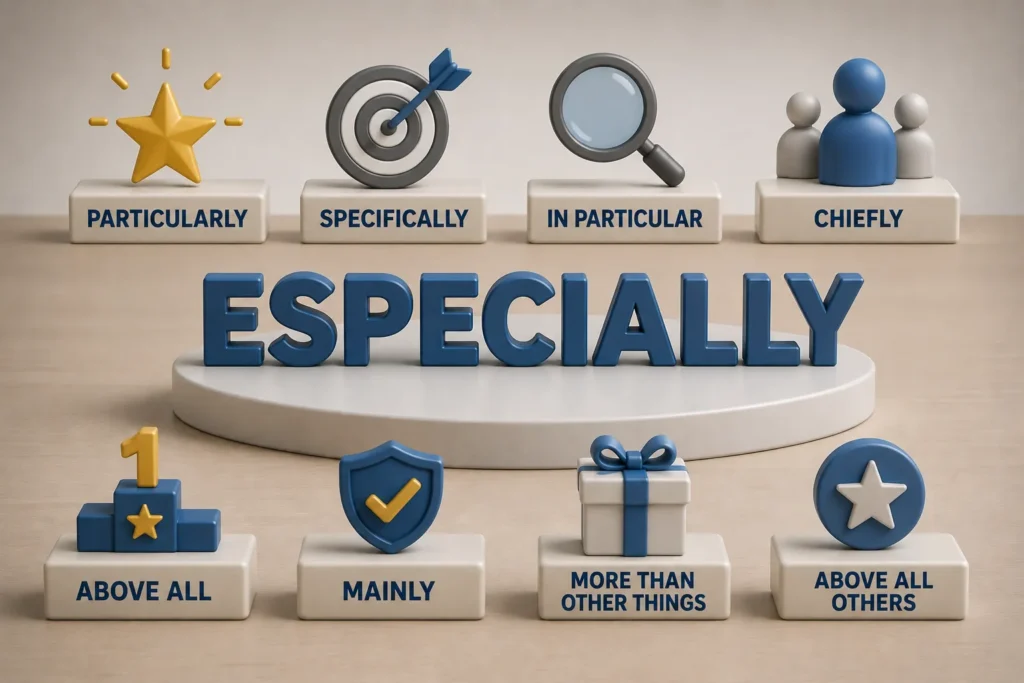
Synonyms for especially help you emphasize something that is more important, noticeable, or significant than others. The word especially is one of the most common adverbs in English and appears in everyday conversations, academic writing, business communication, and creative writing. For example, someone might say they enjoy all fruits, especially mangoes, or that exercise is especially important for good health. Since this word is used so frequently, learning its synonyms helps you avoid repetition and make your writing more natural and engaging.
Understanding synonyms for especially is valuable for English learners, students, bloggers, and content writers. A broader vocabulary improves writing and speaking while helping you choose the most suitable word for each context. In this article, you’ll learn the meaning of especially, its definition, pronunciation, history, grammar, and 30 useful synonyms with meanings and examples. You’ll also explore semantic categories, antonyms, and common questions to strengthen your English vocabulary.
Read More:
Synonyms for Run: 30 Useful Alternatives
Meaning of Synonyms for Especially
Definition
Especially (Adverb):
Especially means more than others, particularly, or for a special reason.
Examples
- I enjoy all kinds of music, especially jazz.
- Exercise is especially important for older adults.
Connotative Meaning
(Connotation: the emotional or cultural feeling a word suggests beyond its dictionary meaning.)
Positive tone: Highlights importance, preference, or appreciation.
Negative tone: May emphasize a particular problem or concern.
Neutral tone: Simply gives special attention to one thing over others.
Etymology
Old English (450–1100):
The exact word especially did not exist in Old English.
Middle English (1100–1500):
It developed from Old French and Latin influences.
Modern English (1500–Present):
Derived from the adjective special, which comes from Latin specialis, meaning “particular” or “individual.” The suffix -ly formed the adverb especially.
Pronunciation (IPA)
- IPA: /ɪˈspeʃ.ə.li/
- Syllables: es-pe-cial-ly
Affixation Pattern of Especially
- Root: special
- Prefix: e- (historical development, not a productive English prefix)
- Suffix: -ly
Word Formations
- Special (Adjective) – different or important
- Especially (Adverb) – more than others
- Specially (Adverb) – for a particular purpose
- Specialize (Verb) – to focus on one area
- Specialist (Noun) – an expert
- Specialization (Noun) – the process of focusing on one field
- Specialty (Noun) – a particular skill or product
30 Synonyms of Especially With Meaning & Examples
1. Particularly (Adverb)
Meaning: More than other things.
Examples:
- I particularly enjoy reading.
- She was particularly helpful.
2. Specifically (Adverb)
Meaning: In a clear or exact way.
Examples:
- I asked specifically about the price.
- The report specifically mentioned safety.
3. Notably (Adverb)
Meaning: In a way that deserves attention.
Examples:
- The city is notably clean.
- She performed notably well.
4. Chiefly (Adverb)
Meaning: Mainly or mostly.
Examples:
- The area is chiefly farmland.
- He writes chiefly about history.
5. Mainly (Adverb)
Meaning: For the most part.
Examples:
- We mainly travel by train.
- The event was mainly successful.
6. Primarily (Adverb)
Meaning: First in importance.
Examples:
- The book is primarily for beginners.
- She works primarily from home.
7. Principally (Adverb)
Meaning: Mostly or chiefly.
Examples:
- The company serves principally local customers.
- The problem is principally financial.
8. Predominantly (Adverb)
Meaning: Mostly or mainly.
Examples:
- The population is predominantly young.
- The area is predominantly rural.
9. Mostly (Adverb)
Meaning: Almost entirely.
Examples:
- The sky was mostly clear.
- She mostly works online.
10. Above All (Adverb Phrase)
Meaning: More than anything else.
Examples:
- Above all, be honest.
- Above all, stay safe.
11. In Particular (Adverb Phrase)
Meaning: More than others.
Examples:
- I liked one book in particular.
- She thanked one person in particular.
12. Exclusively (Adverb)
Meaning: Only or solely.
Examples:
- The club is exclusively for members.
- The store sells exclusively online.
13. Uniquely (Adverb)
Meaning: In a special way.
Examples:
- She is uniquely talented.
- The building is uniquely designed.
14. Exceptionally (Adverb)
Meaning: To an unusually high degree.
Examples:
- The food was exceptionally good.
- She is exceptionally skilled.
15. Remarkably (Adverb)
Meaning: In a surprising or impressive way.
Examples:
- He recovered remarkably fast.
- The results were remarkably accurate.
16. Significantly (Adverb)
Meaning: In an important way.
Examples:
- Costs increased significantly.
- The policy changed significantly.
17. Markedly (Adverb)
Meaning: Clearly or noticeably.
Examples:
- Sales improved markedly.
- Her health improved markedly.
18. Distinctly (Adverb)
Meaning: Clearly or noticeably.
Examples:
- I distinctly remember the event.
- The voices sounded distinctly different.
19. Eminently (Adverb)
Meaning: Very suitably or notably.
Examples:
- She is eminently qualified.
- The plan is eminently practical.
20. Truly (Adverb)
Meaning: In a genuine way.
Examples:
- It was truly inspiring.
- She is truly grateful.
21. Certainly (Adverb)
Meaning: Without doubt.
Examples:
- He certainly deserves praise.
- I will certainly help.
22. Indeed (Adverb)
Meaning: Used to emphasize a statement.
Examples:
- It was indeed surprising.
- She is indeed talented.
23. Really (Adverb)
Meaning: Very or actually.
Examples:
- I really enjoyed the movie.
- She really cares.
24. Truly Particularly (Adverb Phrase)
Meaning: In a very special way.
Examples:
- This gift is truly particularly meaningful.
- The moment was truly particularly memorable.
25. Most of All (Adverb Phrase)
Meaning: More than anything else.
Examples:
- Most of all, I value honesty.
- She loves her family most of all.
26. Specially (Adverb)
Meaning: For a particular purpose.
Examples:
- This cake was specially made.
- The room was specially prepared.
27. Singularly (Adverb)
Meaning: Exceptionally or uniquely.
Examples:
- He was singularly successful.
- She is singularly gifted.
28. Expressly (Adverb)
Meaning: Clearly or for a specific purpose.
Examples:
- The rule was expressly stated.
- This tool was expressly designed for beginners.
29. Namely (Adverb)
Meaning: That is to say.
Examples:
- One city, namely Paris, attracted tourists.
- Two students, namely Ali and Sara, won prizes.
30. To a Great Extent (Adverb Phrase)
Meaning: Largely or considerably.
Examples:
- Success depends to a great extent on effort.
- The outcome was influenced to a great extent by weather.
Prototype Meaning
The most common meaning of especially is more than others or in a way that gives special importance. When people hear the word especially, they usually think of highlighting one person, thing, or idea above the rest.
Prototype Categorization
The 30 synonyms can be grouped into meaningful semantic categories:
- Emphasis and Importance: particularly, notably, especially, indeed, certainly, truly, really
- Main Focus: mainly, chiefly, primarily, principally, predominantly, mostly
- Specific Attention: specifically, in particular, namely, expressly, specially
- Strong Degree: exceptionally, remarkably, significantly, markedly, distinctly, singularly
- Highest Priority: above all, most of all, to a great extent, uniquely, exclusively, eminently
These categories help writers choose the best synonym depending on whether they want to emphasize importance, specificity, or degree.
Antonyms of Especially
1. Generally (Adverb)
Meaning: In most cases.
2. Usually (Adverb)
Meaning: Most of the time.
3. Broadly (Adverb)
Meaning: In a general way.
4. Commonly (Adverb)
Meaning: Frequently or typically.
5. Equally (Adverb)
Meaning: To the same degree.
6. Uniformly (Adverb)
Meaning: In the same way throughout.
7. Evenly (Adverb)
Meaning: In equal amounts.
8. Ordinarily (Adverb)
Meaning: Under normal conditions.
Short Questions and Answers
What does especially mean?
Especially means more than others or with special importance.
When should especially be used?
Use especially when you want to emphasize one person, thing, or idea over others.
Is especially positive or negative?
Especially is a neutral word. It can be used in both positive and negative situations depending on the context.
How is it different from similar words?
Especially emphasizes one item above the rest. Particularly is very similar, while specifically focuses on exact details, and primarily refers to the main reason or purpose.
Conclusion
Learning synonyms for especially helps you emphasize ideas more clearly and avoid repeating the same word. Alternatives such as particularly, specifically, notably, primarily, and above all allow you to express emphasis with greater precision. A richer vocabulary improves your writing, speaking, and overall communication while making your sentences more engaging and natural. Whether you are an English learner, student, teacher, or content writer, practicing these synonyms regularly will strengthen your language skills and boost your confidence. Keep expanding your vocabulary every day to become a more effective English communicator.

I’m an English language writer with over 10 years of experience specializing in synonyms, vocabulary, and English usage. My articles are thoroughly researched, SEO-optimized, and written to deliver accurate, trustworthy, and easy-to-understand information. I’m passionate about helping students, writers, professionals, and ESL learners expand their vocabulary and improve their communication skills. Every guide is designed to provide practical value, clear explanations, and reliable language insights readers can trust.