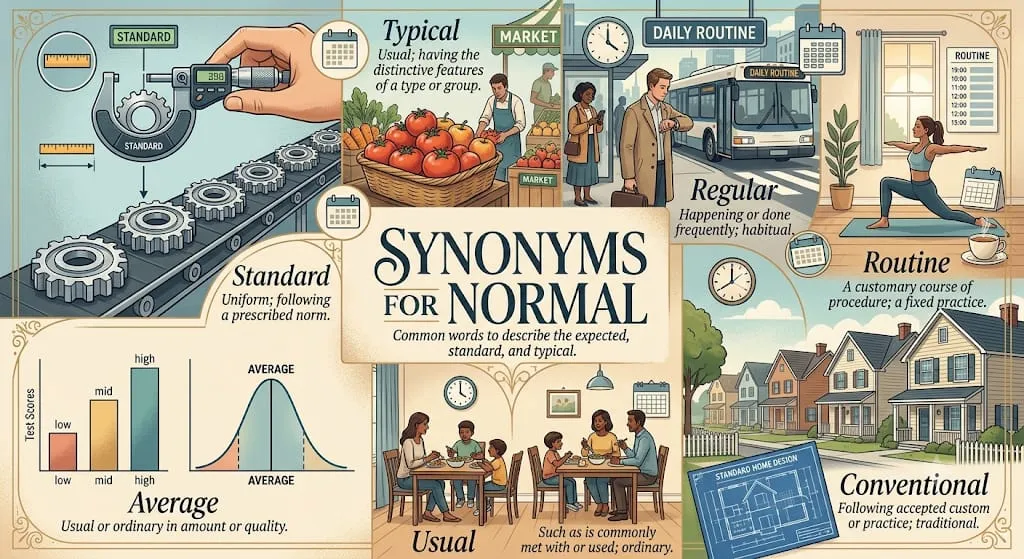
Synonyms for normal help you describe something that is usual, expected, or typical. The word normal is one of the most common words in English. People use it when talking about everyday life, health, behavior, weather, school, or work. For example, after recovering from an illness, someone may say they feel normal again. Because this word appears in many situations, knowing its synonyms helps you express yourself more clearly and naturally.
Learning synonyms for normal is valuable for English learners, students, bloggers, and content writers. It improves vocabulary, reduces repetition, and helps you choose the most accurate word for different contexts. In this article, you’ll learn the meaning of normal, its definition, pronunciation, history, grammar, and 30 useful synonyms with meanings and examples. You’ll also explore semantic categories, antonyms, and common questions to strengthen your English skills.
Meaning of Synonyms for Normal
Definition
Normal (Adjective):
Normal means usual, expected, regular, or happening in the way that is typical for a person, thing, or situation.
Examples
- It is normal to feel nervous before an exam.
- After a few days, life returned to normal.
Connotative Meaning
(Connotation: the emotional or cultural feeling a word suggests beyond its dictionary meaning.)
Positive tone: Healthy, balanced, ordinary, or functioning well.
Negative tone: Can sometimes suggest being average or lacking uniqueness.
Neutral tone: Simply describes what is usual or expected.
Etymology
Old English (450–1100):
The word normal did not exist in Old English.
Middle English (1100–1500):
It entered English through French and Latin influences.
Modern English (1500–Present):
The word comes from the Latin normalis, meaning “made according to a carpenter’s square” or “following a standard or rule.”
Read More:
Synonyms for Culture: 30 Powerful Alternatives
Pronunciation (IPA)
- IPA: /ˈnɔːr.məl/ (UK), /ˈnɔːr.məl/ or /ˈnɔr.məl/ (US)
- Syllables: nor-mal
Affixation Pattern of Normal
- Root: norm
- Prefix: None
- Suffix: -al
Word Formations
- Normal (Adjective) – usual or expected
- Normally (Adverb) – usually
- Normality (Noun) – the state of being normal
- Normalize (Verb) – to make normal
- Normalization (Noun) – the process of making something normal
- Abnormal (Adjective) – not normal
- Abnormally (Adverb) – in an unusual way
- Abnormality (Noun) – something that is not normal
30 Synonyms of Normal With Meaning & Examples
1. Usual (Adjective)
Meaning: Happening most of the time.
Examples:
- She arrived at her usual time.
- Everything went as usual.
2. Typical (Adjective)
Meaning: Showing common features.
Examples:
- That is a typical summer day.
- His answer was typical.
3. Ordinary (Adjective)
Meaning: Not special or unusual.
Examples:
- It was an ordinary morning.
- She wore ordinary clothes.
4. Regular (Adjective)
Meaning: Happening often or following a pattern.
Examples:
- He is a regular customer.
- Exercise is part of her regular routine.
5. Standard (Adjective)
Meaning: Following an accepted level.
Examples:
- The product meets standard quality.
- Standard procedures were followed.
6. Common (Adjective)
Meaning: Found or happening often.
Examples:
- Colds are common in winter.
- This is a common mistake.
7. Average (Adjective)
Meaning: Typical or ordinary compared to others.
Examples:
- The average score was 75.
- She has an average height.
8. Natural (Adjective)
Meaning: Existing in the usual way.
Examples:
- It is natural to feel tired.
- His reaction was natural.
9. Everyday (Adjective)
Meaning: Used or happening daily.
Examples:
- These are everyday activities.
- Stress is part of everyday life.
10. Familiar (Adjective)
Meaning: Well known or recognized.
Examples:
- Her voice sounded familiar.
- The place felt familiar.
11. Routine (Adjective)
Meaning: Done regularly.
Examples:
- The doctor performed a routine check.
- It became a routine task.
12. Conventional (Adjective)
Meaning: Following accepted customs.
Examples:
- They chose a conventional design.
- Conventional methods worked well.
13. Expected (Adjective)
Meaning: Likely to happen.
Examples:
- The results were expected.
- Rain is expected tomorrow.
14. Customary (Adjective)
Meaning: Done according to tradition.
Examples:
- It is customary to shake hands.
- They followed customary practices.
15. Traditional (Adjective)
Meaning: Based on long-established customs.
Examples:
- They prepared a traditional meal.
- Traditional music filled the room.
16. Typicality (Noun)
Meaning: The quality of being typical.
Examples:
- The study measured typicality.
- Typicality varies by region.
17. Accepted (Adjective)
Meaning: Approved by most people.
Examples:
- This is an accepted practice.
- Accepted rules help everyone.
18. Established (Adjective)
Meaning: Well known and accepted.
Examples:
- They followed established procedures.
- The company is well established.
19. Familiarized (Adjective)
Meaning: Made well known through experience.
Examples:
- Staff became familiarized with the system.
- Students were familiarized with the rules.
20. Predictable (Adjective)
Meaning: Easy to expect.
Examples:
- His reaction was predictable.
- The ending was predictable.
21. Balanced (Adjective)
Meaning: Stable and healthy.
Examples:
- She enjoys a balanced lifestyle.
- The meal was balanced.
22. Stable (Adjective)
Meaning: Not changing much.
Examples:
- Prices remained stable.
- His condition is stable.
23. Healthy (Adjective)
Meaning: In good physical or mental condition.
Examples:
- Her blood pressure is normal and healthy.
- Healthy habits improve life.
24. Moderate (Adjective)
Meaning: Not too much or too little.
Examples:
- Exercise at a moderate pace.
- The weather was moderate.
25. Plain (Adjective)
Meaning: Simple and ordinary.
Examples:
- She wore a plain dress.
- The room looked plain.
26. Simple (Adjective)
Meaning: Easy and uncomplicated.
Examples:
- It was a simple solution.
- Keep your language simple.
27. Unremarkable (Adjective)
Meaning: Not unusual or special.
Examples:
- It was an unremarkable day.
- The building looked unremarkable.
28. Generic (Adjective)
Meaning: General and not specific.
Examples:
- Use a generic example.
- The design looked generic.
29. Mainstream (Adjective)
Meaning: Accepted by most people.
Examples:
- The idea became mainstream.
- Mainstream fashion changes often.
30. Habitual (Adjective)
Meaning: Done regularly through habit.
Examples:
- Walking after dinner is habitual.
- His habitual smile made everyone comfortable.
Prototype Meaning
The most common meaning of normal is something that is usual, expected, or happens naturally. When people hear the word normal, they often think of everyday situations, healthy conditions, regular behavior, or things that match what is generally accepted.
Prototype Categorization
The 30 synonyms can be grouped into meaningful semantic categories:
- Usual and Everyday: usual, ordinary, everyday, routine, familiar, common
- Standards and Rules: standard, accepted, established, conventional, customary, traditional
- Typical and Expected: typical, average, expected, predictable, generic, mainstream
- Health and Balance: healthy, balanced, stable, moderate, natural
- Simplicity and Ordinariness: plain, simple, unremarkable, habitual
These categories help writers choose the most suitable synonym based on context, making writing clearer and more engaging.
Antonyms of Normal
1. Abnormal (Adjective)
Meaning: Not usual or expected.
2. Unusual (Adjective)
Meaning: Different from what is common.
3. Strange (Adjective)
Meaning: Odd or unfamiliar.
4. Odd (Adjective)
Meaning: Different or unexpected.
5. Rare (Adjective)
Meaning: Not common.
6. Extraordinary (Adjective)
Meaning: Very unusual or remarkable.
7. Exceptional (Adjective)
Meaning: Better or different than normal.
8. Irregular (Adjective)
Meaning: Not following a usual pattern.
Short Questions and Answers
What does normal mean?
Normal means usual, expected, regular, or typical for a person, thing, or situation.
When should normal be used?
Use normal when describing something that follows common patterns, expected behavior, or standard conditions.
Is normal positive or negative?
Normal is generally a neutral word. It can have a positive meaning when referring to health or stability, but it may sound limiting if used to compare people or ideas.
How is it different from similar words?
Normal is a broad term for something usual or expected. Words like typical, ordinary, and standard focus on slightly different aspects, such as common characteristics, simplicity, or accepted rules.
Conclusion
Learning synonyms for normal helps you express ideas more accurately and avoid repeating the same word. Alternatives such as usual, typical, ordinary, regular, and standard can make your writing and speaking more natural and engaging. A richer vocabulary also improves communication, boosts confidence, and helps you choose the right word for different situations. Whether you’re an English learner, student, teacher, or content writer, practicing these synonyms daily will strengthen your language skills. Keep expanding your vocabulary, and you’ll become a more confident and effective English communicator.

I’m an English language writer with over 10 years of experience specializing in synonyms, vocabulary, and English usage. My articles are thoroughly researched, SEO-optimized, and written to deliver accurate, trustworthy, and easy-to-understand information. I’m passionate about helping students, writers, professionals, and ESL learners expand their vocabulary and improve their communication skills. Every guide is designed to provide practical value, clear explanations, and reliable language insights readers can trust.