
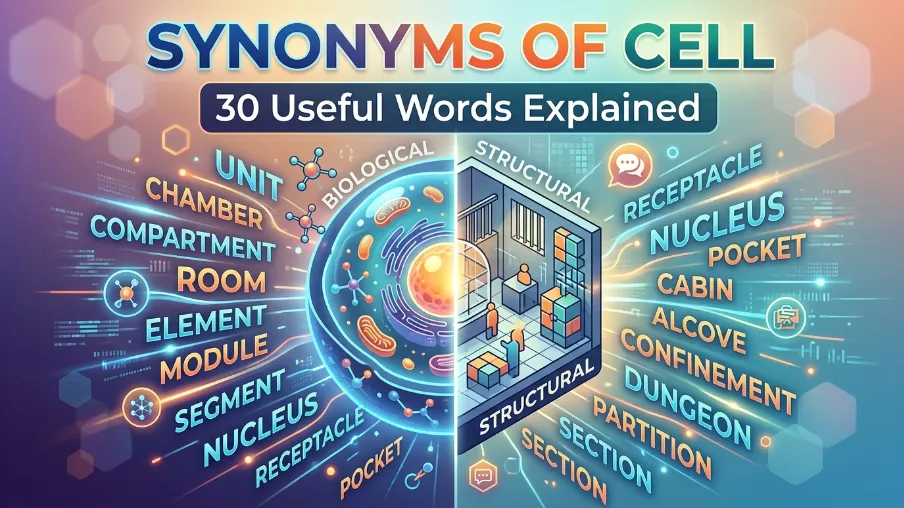
The word cell is used in many parts of daily life. A student may learn about cells in biology, a prisoner may stay in a prison cell, and people also use the word for a small phone called a cell phone. Because this word has many meanings, it is very common in English speaking and writing. For English learners, understanding the different meanings and synonyms of cell is important because the correct synonym changes with context. Writers also need strong vocabulary to avoid repeating the same word many times. Learning synonyms improves speaking, writing, reading, and confidence in English. In this article, you will learn the meaning of cell, its pronunciation, history, grammar use, and 30 useful synonyms with simple meanings and examples. You will also understand how different synonyms fit different situations in English communication.
Meaning of cell
Definition
Cell (Noun):
A cell is a small room, small unit, or the basic living structure in plants and animals.
Examples
- Scientists studied the human cell under a microscope.
- The prisoner sat quietly inside the cell.
Connotative Meaning
- Positive tone: Can suggest growth, life, and science
- Negative tone: May suggest imprisonment or isolation
- Neutral tone: Refers to a small unit or space
(Connotation: the emotional or implied meaning connected to a word)
Etymology
- Old English (450–1100): No direct Old English form
- Middle English (1100–1500): Borrowed from Old French celle
- Modern English (1500–Present): Came from Latin cella meaning “small room” or “storage chamber”
Pronunciation (IPA)
- IPA: /sel/
- Syllables: cell
Affixation Pattern of cell
- Root: cell
- Prefix: None
- Suffix: None
- Word formations:
- Cellular (adjective)
- Cellphone (noun)
- Cellblock (noun)
- Cellmate (noun)
- Cellar (noun)
30 Synonyms of Cell With Meaning & Examples
1. Chamber (Noun)
Meaning: A small enclosed room.
Examples:
- The king entered his private chamber.
- The prisoner stayed in the chamber.
2. Room (Noun)
Meaning: A space inside a building.
Examples:
- She cleaned her room.
- The guard checked every room.
3. Compartment (Noun)
Meaning: A separate section inside something.
Examples:
- The bag has a secret compartment.
- Each compartment held supplies.
4. Unit (Noun)
Meaning: A small part of a larger system.
Examples:
- The cell is the basic unit of life.
- The hospital opened a new unit.
5. Cubicle (Noun)
Meaning: A very small separated area.
Examples:
- He works in a cubicle.
- The office had many cubicles.
6. Dungeon (Noun)
Meaning: A dark prison room.
Examples:
- The prisoner was locked in a dungeon.
- The old castle had a dungeon.
7. Jailroom (Noun)
Meaning: A room used in jail.
Examples:
- The jailroom was cold and dark.
- Guards watched the jailroom closely.
8. Prison Room (Noun)
Meaning: A room for prisoners.
Examples:
- He stayed in a prison room.
- The prison room was empty.
9. Capsule (Noun)
Meaning: A small enclosed container or space.
Examples:
- The astronauts entered the capsule.
- The medicine came in a capsule.
10. Box (Noun)
Meaning: A small enclosed space.
Examples:
- The tools stayed in the box.
- He sat in a tiny box room.
11. Section (Noun)
Meaning: A part of something larger.
Examples:
- This section contains damaged cells.
- She works in the science section.
12. Pod (Noun)
Meaning: A small enclosed structure.
Examples:
- The sleeping pod looked modern.
- The prison used secure pods.
13. Enclosure (Noun)
Meaning: An enclosed space.
Examples:
- The animal stayed in an enclosure.
- The enclosure was very small.
14. Alcove (Noun)
Meaning: A small recessed space.
Examples:
- She sat in the alcove reading.
- The alcove held old books.
15. Cabin (Noun)
Meaning: A small room or shelter.
Examples:
- They rested in the cabin.
- The guard waited inside the cabin.
16. Closet (Noun)
Meaning: A very small storage room.
Examples:
- The closet was full of clothes.
- He hid inside the closet.
17. Vault (Noun)
Meaning: A secure enclosed room.
Examples:
- Gold stayed in the vault.
- The bank locked the vault.
18. Cage (Noun)
Meaning: A barred enclosure.
Examples:
- The bird stayed in the cage.
- The cage door was open.
19. Nucleus (Noun)
Meaning: The central part of a cell.
Examples:
- The nucleus controls the cell.
- Scientists observed the nucleus carefully.
20. Organism Unit (Noun)
Meaning: A living structural part.
Examples:
- Every organism unit has function.
- The organism unit carried energy.
21. Battery Cell (Noun)
Meaning: A single energy-producing unit.
Examples:
- The battery cell stopped working.
- He replaced the battery cell.
22. Detention Room (Noun)
Meaning: A room for confinement.
Examples:
- The suspect waited in detention room.
- The detention room stayed locked.
23. Lockup (Noun)
Meaning: A place for holding prisoners.
Examples:
- He spent the night in lockup.
- The lockup was crowded.
24. Cellblock (Noun)
Meaning: A group of prison cells.
Examples:
- Guards checked the cellblock.
- The cellblock became noisy.
25. Phone (Noun)
Meaning: A communication device.
Examples:
- She answered her phone quickly.
- My phone battery died.
26. Mobile (Noun)
Meaning: A portable phone.
Examples:
- He lost his mobile yesterday.
- The mobile rang loudly.
27. Chamberlet (Noun)
Meaning: A tiny room or chamber.
Examples:
- The monk lived in a chamberlet.
- The chamberlet had little light.
28. Booth (Noun)
Meaning: A small enclosed area.
Examples:
- She entered the phone booth.
- The booth stood near the road.
29. Hive Cell (Noun)
Meaning: A small section in a beehive.
Examples:
- Honey filled the hive cell.
- Bees cleaned every hive cell.
30. Living Unit (Noun)
Meaning: The smallest living structure.
Examples:
- The living unit carries nutrients.
- Every living unit has purpose.
Prototype Meaning
When people hear the word cell, they usually imagine a small biological structure inside the human body or a tiny prison room with bars and limited space.
Prototype Categorization
- Biology-related synonyms: unit, nucleus, organism unit, living unit
- Prison-related synonyms: dungeon, jailroom, detention room, lockup, cellblock
- Small spaces or rooms: chamber, cubicle, alcove, closet, booth
- Technology-related synonyms: phone, mobile, battery cell
- Container or enclosure words: compartment, pod, capsule, cage
This categorization helps writers choose the correct synonym depending on science, prison, technology, or room-related contexts.
Antonyms of cell
Open Space (Noun)
A large uncovered area.
Freedom (Noun)
The state of being free.
Hall (Noun)
A large room or open area.
Liberation (Noun)
Release from confinement.
Outside (Noun)
The outer or open area.
Short Questions and Answers
What does cell mean?
A cell is a small room, unit, or living structure.
When should cell be used?
It should be used in biology, prison, or technology contexts.
Is cell positive or negative?
It can be positive, neutral, or negative depending on context.
How is it different from similar words?
Cell usually describes a very small unit or enclosed space, unlike larger words like room or hall.
Conclusion
Learning the word cell and its synonyms helps improve vocabulary and understanding of English in many contexts. Since the word has different meanings in science, technology, and daily life, knowing its alternatives helps writers and speakers communicate more clearly. Using different synonyms also makes writing stronger and avoids repeating the same word too often. Whether you are learning English for school, work, or daily conversation, practicing synonyms builds confidence and fluency. Over time, these new words become easier to remember and use naturally. Try using a few synonyms every day in speaking or writing to improve your English skills faster and make your communication more effective.

Hello I am Emily Carter.I focus on English vocabulary, synonyms, and clear explanations. Writing helps me turn complex language rules into easy lessons for readers.