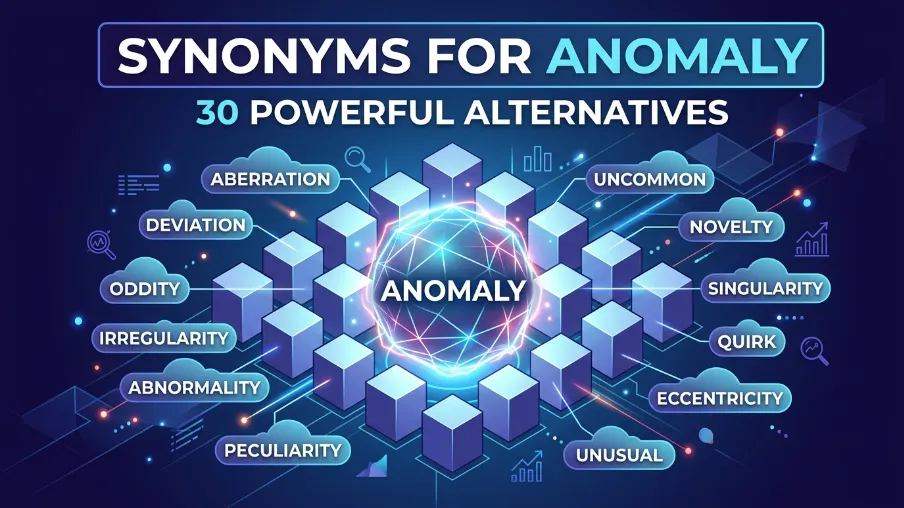
Anomaly means something unusual, different, or unexpected. Imagine a student who always gets average grades suddenly scoring 100% on every test. Teachers may call this result an anomaly because it does not match the normal pattern. People often use this word in science, business, technology, weather reports, and daily conversations when something seems strange or out of place.
Learning synonyms for anomaly helps English learners speak more naturally and avoid repeating the same word again and again. It also helps writers create stronger blog posts, essays, stories, and professional content. Understanding related words improves vocabulary, confidence, and communication skills. In this article, you will learn the meaning of anomaly, its pronunciation, history, grammar, connotation, and 30 powerful synonyms with simple meanings and example sentences that are easy to understand.
Meaning of Anomaly
Definition
Anomaly (Noun):
Something unusual, abnormal, or different from what is expected.
Examples
- The warm weather in winter was an anomaly.
- His sudden silence was an anomaly during the meeting.
Connotative Meaning
(Connotation means the emotional feeling or cultural idea connected with a word.)
- Positive tone: Something unique, rare, or interesting.
- Negative tone: Something strange, suspicious, or problematic.
- Neutral tone: Something simply different from the normal pattern.
Etymology
- The word anomaly comes from the Greek word anōmalos.
- It originally meant “uneven” or “irregular.”
- It later entered Latin and then French before becoming part of English.
Short History of the Keyword
- Old English (450–1100): The word was not commonly used in English.
- Middle English (1100–1500): Scholars borrowed similar forms from Latin and French.
- Modern English (1500–Present): The word became common in science, mathematics, and daily language.
Pronunciation (US & UK – IPA)
- US: /əˈnɑː.mə.li/
- UK: /əˈnɒm.ə.li/
Syllables
a-nom-a-ly
Affixation Pattern of Anomaly
- Root: nom
- Prefix: a-
- Suffix: -ly
Word Formation of the Keyword
- Anomaly (noun) – something unusual
- Anomalous (adjective) – irregular or strange
- Anomalously (adverb) – in an unusual way
Synonyms of Anomaly
1. Abnormality (Noun)
US: /ˌæb.nɔːrˈmæl.ə.t̬i/ | UK: /ˌæb.nɔːˈmæl.ə.ti/
Meaning: Something that is not normal.
Examples:
- The doctor noticed an abnormality in the report.
- The machine stopped because of an abnormality.
2. Irregularity (Noun)
US: /ɪˌreɡ.jəˈler.ə.t̬i/ | UK: /ɪˌreɡ.jəˈlær.ə.ti/
Meaning: Something that does not follow rules or patterns.
Examples:
- The audit found financial irregularities.
- Her heartbeat showed an irregularity.
3. Oddity (Noun)
US: /ˈɑː.də.t̬i/ | UK: /ˈɒd.ə.ti/
Meaning: A strange or unusual thing.
Examples:
- The old house was full of oddities.
- His behavior became an oddity in class.
4. Peculiarity (Noun)
US: /pɪˌkjuː.liˈer.ə.t̬i/ | UK: /pɪˌkjuː.liˈær.ə.ti/
Meaning: A special or strange quality.
Examples:
- Every culture has its own peculiarities.
- Her accent has a unique peculiarity.
5. Exception (Noun)
US: /ɪkˈsep.ʃən/ | UK: /ɪkˈsep.ʃən/
Meaning: Something different from the rule.
Examples:
- Everyone attended except Tom.
- This case is an exception to the policy.
6. Deviation (Noun)
US: /ˌdiː.viˈeɪ.ʃən/ | UK: /ˌdiː.viˈeɪ.ʃən/
Meaning: A change away from the normal path.
Examples:
- The driver made a sudden deviation.
- The graph showed a deviation in sales.
7. Outlier (Noun)
US: /ˈaʊtˌlaɪ.ɚ/ | UK: /ˈaʊtˌlaɪ.ə/
Meaning: Something very different from others.
Examples:
- One result was an outlier in the study.
- Her score was much higher than the rest.
8. Quirk (Noun)
US: /kwɝːk/ | UK: /kwɜːk/
Meaning: A strange habit or feature.
Examples:
- He has a funny little quirk.
- The design flaw became a quirk of the model.
9. Fluke (Noun)
US: /fluːk/ | UK: /fluːk/
Meaning: Something happening by chance.
Examples:
- Winning twice was not a fluke.
- The result looked like a fluke.
10. Aberration (Noun)
US: /ˌæb.əˈreɪ.ʃən/ | UK: /ˌæb.əˈreɪ.ʃən/
Meaning: A departure from what is normal.
Examples:
- The mistake was an aberration.
- Scientists studied the climate aberration.
11. Inconsistency (Noun)
US: /ˌɪn.kənˈsɪs.tən.si/ | UK: /ˌɪn.kənˈsɪs.tən.si/
Meaning: Lack of regular behavior or quality.
Examples:
- There was inconsistency in his story.
- The report showed data inconsistency.
12. Variation (Noun)
US: /ˌver.iˈeɪ.ʃən/ | UK: /ˌveə.riˈeɪ.ʃən/
Meaning: A difference from the standard form.
Examples:
- Weather variation is common.
- There is slight variation in color.
13. Divergence (Noun)
US: /daɪˈvɝː.dʒəns/ | UK: /daɪˈvɜː.dʒəns/
Meaning: Movement away from something usual.
Examples:
- The paths showed divergence.
- Their opinions had a clear divergence.
14. Mutation (Noun)
US: /mjuːˈteɪ.ʃən/ | UK: /mjuːˈteɪ.ʃən/
Meaning: A change in form or structure.
Examples:
- Scientists discovered a gene mutation.
- The virus developed a mutation.
15. Curiosity (Noun)
US: /ˌkjʊr.iˈɑː.sə.t̬i/ | UK: /ˌkjʊə.riˈɒs.ə.ti/
Meaning: Something unusual or interesting.
Examples:
- The object became a curiosity.
- Tourists admired the local curiosity.
16. Rarity (Noun)
US: /ˈrer.ə.t̬i/ | UK: /ˈreə.rə.ti/
Meaning: Something uncommon or rare.
Examples:
- Snow here is a rarity.
- The coin is a rarity today.
17. Novelty (Noun)
US: /ˈnɑː.vəl.t̬i/ | UK: /ˈnɒv.əl.ti/
Meaning: Something new or unusual.
Examples:
- The gadget quickly lost its novelty.
- The idea brought novelty to the project.
18. Eccentricity (Noun)
US: /ˌek.senˈtrɪs.ə.t̬i/ | UK: /ˌek.senˈtrɪs.ə.ti/
Meaning: Strange or unusual behavior.
Examples:
- His dress style showed eccentricity.
- The artist was famous for eccentricity.
19. Freak (Noun)
US: /friːk/ | UK: /friːk/
Meaning: Something very unusual.
Examples:
- The storm was a freak event.
- It was a freak accident.
20. Glitch (Noun)
US: /ɡlɪtʃ/ | UK: /ɡlɪtʃ/
Meaning: A small unexpected problem.
Examples:
- The app had a technical glitch.
- A glitch stopped the video.
21. Discrepancy (Noun)
US: /dɪˈskrep.ən.si/ | UK: /dɪˈskrep.ən.si/
Meaning: A difference between two things.
Examples:
- The accountant found a discrepancy.
- There was a discrepancy in numbers.
22. Distortion (Noun)
US: /dɪˈstɔːr.ʃən/ | UK: /dɪˈstɔː.ʃən/
Meaning: A change that makes something incorrect.
Examples:
- The mirror caused distortion.
- Noise created sound distortion.
23. Departure (Noun)
US: /dɪˈpɑːr.tʃɚ/ | UK: /dɪˈpɑː.tʃə/
Meaning: A move away from the usual way.
Examples:
- The rule was a departure from tradition.
- His style marked a departure.
24. Twist (Noun)
US: /twɪst/ | UK: /twɪst/
Meaning: An unexpected change.
Examples:
- The movie ended with a twist.
- The story had a strange twist.
25. Surprise (Noun)
US: /sɚˈpraɪz/ | UK: /səˈpraɪz/
Meaning: Something unexpected.
Examples:
- Her visit was a surprise.
- The result came as a surprise.
26. Exceptionality (Noun)
US: /ɪkˌsep.ʃəˈnæl.ə.t̬i/ | UK: /ɪkˌsep.ʃəˈnæl.ə.ti/
Meaning: The quality of being uncommon.
Examples:
- The athlete showed exceptionality.
- Her talent has real exceptionality.
27. Unusualness (Noun)
US: /ʌnˈjuː.ʒu.əl.nəs/ | UK: /ʌnˈjuː.ʒu.əl.nəs/
Meaning: The state of being uncommon.
Examples:
- The unusualness attracted attention.
- People noticed the unusualness immediately.
28. Singularity (Noun)
US: /ˌsɪŋ.ɡjəˈler.ə.t̬i/ | UK: /ˌsɪŋ.ɡjəˈlær.ə.ti/
Meaning: A unique or rare condition.
Examples:
- The event had great singularity.
- Scientists discussed the singularity.
29. Difference (Noun)
US: /ˈdɪf.ɚ.əns/ | UK: /ˈdɪf.ər.əns/
Meaning: A point that makes things unlike each other.
Examples:
- There is a difference in quality.
- I noticed a big difference.
30. Unpredictability (Noun)
US: /ˌʌn.prɪˌdɪk.təˈbɪl.ə.t̬i/ | UK: /ˌʌn.prɪˌdɪk.təˈbɪl.ə.ti/
Meaning: The quality of being impossible to expect.
Examples:
- Markets are known for unpredictability.
- Weather unpredictability worried farmers.
Prototype Meaning
The prototype meaning of anomaly is something that does not fit the normal pattern. Most people imagine an unusual event, strange behavior, or unexpected result when they hear this word. It often describes something rare that stands apart from what is regular or expected.
Prototype Categorization
- Scientific or technical synonyms: aberration, deviation, mutation, discrepancy
- Casual everyday synonyms: oddity, quirk, twist, surprise
- Positive or unique meanings: rarity, novelty, exceptionality
- Negative or problematic meanings: glitch, inconsistency, distortion
- Neutral descriptive meanings: variation, difference, divergence
Categorization helps writers choose the best synonym based on tone, audience, and situation. A scientist may use “aberration,” while a storyteller may prefer “twist” or “oddity.”
Antonyms of Anomaly
- Normality (Noun): The state of being normal
- Regularity (Noun): Following a fixed pattern
- Sameness (Noun): Lack of difference
- Consistency (Noun): Stable and repeated behavior
- Uniformity (Noun): The condition of being the same
- Predictability (Noun): Easy to expect or guess
- Standard (Noun): A usual level or quality
Short Questions and Answers
- What does anomaly mean?
Anomaly means something unusual or different from the normal pattern. - When should anomaly be used?
It should be used when describing strange, rare, or unexpected situations. - Is anomaly positive or negative?
It can be positive, negative, or neutral depending on context. - How is it different from similar words?
Anomaly often sounds more formal and is commonly used in science, research, and analysis.
Conclusion
Learning the word anomaly and its synonyms can greatly improve English vocabulary and communication skills. These words help writers and speakers express unusual situations in many different ways without repeating the same term. Understanding meanings, pronunciation, grammar, tone, and categories also makes English easier to use in real conversations and professional writing. Strong vocabulary improves confidence in speaking, reading, and content creation. Daily practice with synonyms helps learners sound more natural and fluent. By studying these 30 powerful synonyms for anomaly, English learners and writers can communicate ideas more clearly, creatively, and effectively in every situation.

Hello I am Emily Carter.I focus on English vocabulary, synonyms, and clear explanations. Writing helps me turn complex language rules into easy lessons for readers.