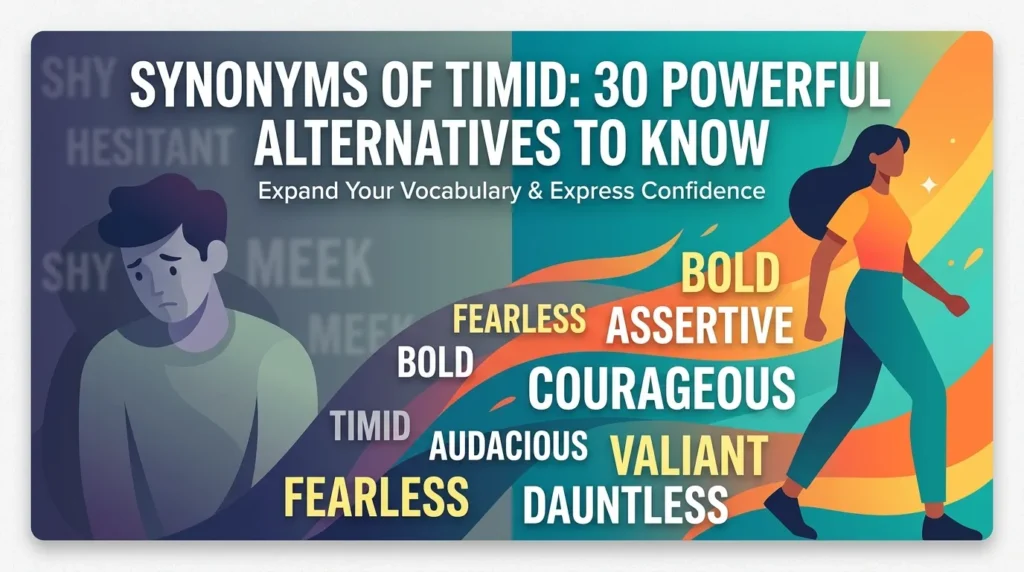
A timid person is someone who feels shy, nervous, or lacking in confidence, especially in unfamiliar situations. Imagine a student entering a new school for the first time. They may feel timid when meeting new classmates or speaking in front of the class. The word timid is commonly used in English to describe people, animals, and even behavior that appears cautious or fearful. Learning synonyms for timid is valuable because it helps English learners and writers express different levels of shyness, fear, and hesitation more accurately. A richer vocabulary improves writing, speaking, and reading skills while avoiding repetition. In this article, you will learn the meaning of timid, its pronunciation, history, grammar structure, and 30 useful synonyms with meanings and examples. You will also explore semantic categories, antonyms, and common questions about this important adjective.
Meaning of Timid
Definition
Timid (Adjective):
Timid means shy, lacking confidence, or easily frightened in social or challenging situations.
Examples
- The timid child hid behind her mother.
- He felt timid during his first presentation.
Connotative Meaning
- Positive tone: Can suggest humility, gentleness, or caution.
- Negative tone: May imply fearfulness or lack of confidence.
- Neutral tone: Describes a shy or reserved personality.
(Connotation: the emotional or implied meaning associated with a word beyond its dictionary definition)
Etymology
- Old English (450–1100): No direct Old English form.
- Middle English (1100–1500): Borrowed from Latin influences.
- Modern English (1500–Present): Derived from Latin timidus, meaning “fearful” or “afraid.”
Pronunciation (IPA)
- IPA: /ˈtɪm.ɪd/
- Syllables: tim-id
Affixation Pattern of Timid
- Root: tim
- Prefix: None
- Suffix: -id
- Word formations:
- Timidity (noun)
- Timidly (adverb)
- Timidness (noun)
- Intimidate (verb)
- Intimidating (adjective)
30 Synonyms of Timid With Meaning & Examples
1. Shy (Adjective)
Meaning: Nervous or uncomfortable around people.
Examples:
- She is shy around strangers.
- The shy boy avoided attention.
2. Bashful (Adjective)
Meaning: Easily embarrassed or shy.
Examples:
- He gave a bashful smile.
- The bashful girl looked away.
3. Reserved (Adjective)
Meaning: Quiet and not expressive.
Examples:
- She has a reserved personality.
- He remained reserved during the meeting.
4. Coy (Adjective)
Meaning: Pretending to be shy or modest.
Examples:
- She gave a coy response.
- His coy smile amused everyone.
5. Hesitant (Adjective)
Meaning: Unsure or slow to act.
Examples:
- He seemed hesitant to speak.
- She was hesitant about the decision.
6. Fearful (Adjective)
Meaning: Feeling afraid.
Examples:
- The fearful child cried.
- She looked fearful in the dark.
7. Nervous (Adjective)
Meaning: Worried or anxious.
Examples:
- He felt nervous before the exam.
- She sounded nervous.
8. Anxious (Adjective)
Meaning: Worried and uneasy.
Examples:
- The anxious student waited for results.
- He became anxious about the future.
9. Meek (Adjective)
Meaning: Quiet and gentle.
Examples:
- She has a meek nature.
- The meek employee rarely argued.
10. Diffident (Adjective)
Meaning: Lacking confidence.
Examples:
- He was diffident during the interview.
- The diffident speaker avoided eye contact.
11. Introverted (Adjective)
Meaning: Preferring solitude over social interaction.
Examples:
- She is introverted by nature.
- The introverted student enjoyed reading.
12. Apprehensive (Adjective)
Meaning: Worried that something bad may happen.
Examples:
- He felt apprehensive about traveling.
- She seemed apprehensive before surgery.
13. Timorous (Adjective)
Meaning: Easily frightened.
Examples:
- The timorous animal ran away.
- He gave a timorous reply.
14. Fainthearted (Adjective)
Meaning: Lacking courage.
Examples:
- The fainthearted soldier retreated.
- She was fainthearted about the challenge.
15. Insecure (Adjective)
Meaning: Not confident about oneself.
Examples:
- He felt insecure in the group.
- She appeared insecure about her abilities.
16. Quiet (Adjective)
Meaning: Not talkative or loud.
Examples:
- The quiet student listened carefully.
- He remained quiet throughout the event.
17. Retiring (Adjective)
Meaning: Shy and avoiding attention.
Examples:
- She has a retiring personality.
- The retiring actor avoided publicity.
18. Sheepish (Adjective)
Meaning: Embarrassed and shy.
Examples:
- He gave a sheepish grin.
- She looked sheepish after the mistake.
19. Cautious (Adjective)
Meaning: Careful to avoid danger.
Examples:
- He was cautious about investing.
- She took a cautious approach.
20. Reluctant (Adjective)
Meaning: Unwilling or hesitant.
Examples:
- He was reluctant to join.
- She seemed reluctant to answer.
21. Withdrawn (Adjective)
Meaning: Quiet and socially distant.
Examples:
- The child became withdrawn.
- He appeared withdrawn after the incident.
22. Modest (Adjective)
Meaning: Not seeking attention or praise.
Examples:
- She remained modest despite success.
- He is a modest person.
23. Unassertive (Adjective)
Meaning: Not confident in expressing opinions.
Examples:
- He was unassertive in meetings.
- The unassertive employee stayed silent.
24. Delicate (Adjective)
Meaning: Sensitive and easily affected.
Examples:
- She has a delicate temperament.
- The child seemed delicate and shy.
25. Frail (Adjective)
Meaning: Weak or lacking strength.
Examples:
- The frail boy avoided conflict.
- She looked frail and timid.
26. Soft-Spoken (Adjective)
Meaning: Speaking gently and quietly.
Examples:
- He is soft-spoken and polite.
- The teacher was soft-spoken.
27. Passive (Adjective)
Meaning: Not taking action or initiative.
Examples:
- He remained passive during discussions.
- She had a passive attitude.
28. Submissive (Adjective)
Meaning: Willing to obey others.
Examples:
- The submissive worker followed orders.
- She remained submissive in arguments.
29. Easily Intimidated (Adjective)
Meaning: Quickly frightened by others.
Examples:
- He is easily intimidated.
- The child was easily intimidated.
30. Self-Conscious (Adjective)
Meaning: Uncomfortable about oneself.
Examples:
- She felt self-conscious at the party.
- He became self-conscious while speaking.
Prototype Meaning
When people hear the word timid, they usually imagine someone who is shy, quiet, cautious, and lacking confidence when facing new people, situations, or challenges.
Prototype Categorization
- Shyness-related synonyms: shy, bashful, sheepish, retiring, self-conscious
- Fear-related synonyms: fearful, timorous, apprehensive, fainthearted
- Confidence-related synonyms: diffident, insecure, unassertive, hesitant
- Quiet personality synonyms: reserved, introverted, withdrawn, soft-spoken
- Cautious behavior synonyms: cautious, reluctant, passive, meek
This categorization helps writers choose the most appropriate synonym based on whether the focus is shyness, fear, caution, or lack of confidence.
Antonyms of Timid
Confident (Adjective)
Having strong belief in oneself.
Bold (Adjective)
Willing to take risks.
Courageous (Adjective)
Showing bravery.
Fearless (Adjective)
Without fear.
Assertive (Adjective)
Expressing opinions confidently.
Short Questions and Answers
What does timid mean?
Timid means shy, fearful, or lacking confidence.
When should timid be used?
It should be used when describing someone who is nervous, cautious, or uncomfortable in certain situations.
Is timid positive or negative?
It can be neutral, positive, or negative depending on context, though it often suggests a lack of confidence.
How is it different from similar words?
Timid generally combines shyness and fear, while words like reserved focus on quietness and fearful focuses on fear alone.
Conclusion
Learning the word timid and its synonyms can greatly improve your English vocabulary and communication skills. These alternatives help describe different shades of shyness, caution, fear, and lack of confidence. Instead of repeatedly using timid, you can choose words such as bashful, hesitant, diffident, reserved, or apprehensive depending on the situation.
This makes your writing more precise, natural, and engaging. A broader vocabulary also improves reading comprehension and speaking confidence. By practicing these synonyms regularly, you will become better at expressing personality traits and emotions. Continue learning and using new words every day to strengthen your English fluency and communicate more effectively.

I am Daniel Whitmore.I write about everyday English, common grammar mistakes, and word meanings. My goal is to make learning English simple, clear, and practical for everyone.