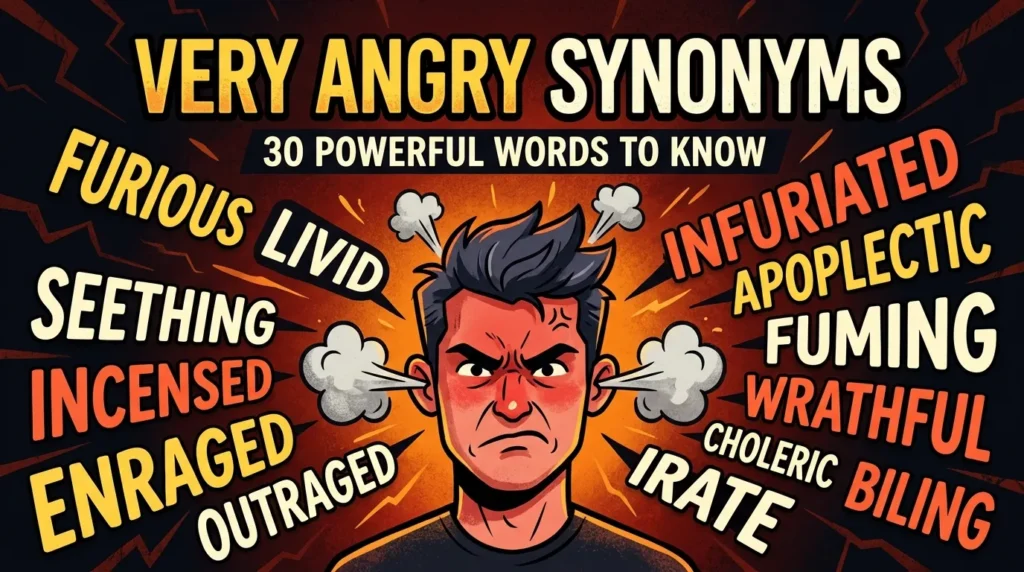
Being very angry means feeling intense frustration, irritation, or rage about a situation, person, or event. Imagine waiting for months for something important, only to have it ruined at the last moment. In such situations, people may feel very angry. This expression is commonly used in everyday English because anger is a natural human emotion. However, repeating “very angry” can make writing and speech sound repetitive. Learning synonyms helps English learners, students, and writers express emotions more accurately and powerfully. Some synonyms describe mild anger, while others express extreme fury. Understanding these differences improves vocabulary and communication skills. In this article, you will learn the meaning of very angry, its pronunciation, history, grammar structure, and 30 useful synonyms with meanings and examples. You will also explore semantic categories, antonyms, and frequently asked questions.
Meaning of Very Angry
Definition
Very Angry (Adjective Phrase):
Very angry means feeling extremely upset, annoyed, furious, or enraged.
Examples
- She was very angry when she discovered the mistake.
- He became very angry after hearing the unfair decision.
Connotative Meaning
- Positive tone: Rarely positive, but can show strong passion for justice.
- Negative tone: Suggests frustration, rage, or loss of patience.
- Neutral tone: Describes a strong emotional state.
(Connotation: the emotional or implied meaning associated with a word beyond its dictionary definition)
Etymology
- Old English (450–1100): Angry developed from Old Norse influences meaning grief or distress.
- Middle English (1100–1500): Used to describe strong displeasure.
- Modern English (1500–Present): Refers to feelings of annoyance, fury, or rage.
Pronunciation (IPA)
- IPA: /ˈver.i ˈæŋ.ɡri/
- Syllables: ver-y an-gry
Affixation Pattern of Very Angry
- Root: angry
- Prefix: None
- Suffix: -y (in angry)
- Word formations:
- Anger (noun)
- Angry (adjective)
- Angrily (adverb)
- Anger management (noun phrase)
- Angered (verb)
30 Synonyms of Very Angry With Meaning & Examples
1. Furious (Adjective)
Meaning: Extremely angry.
Examples:
- She was furious about the delay.
- He looked furious after the argument.
2. Enraged (Adjective)
Meaning: Filled with intense anger.
Examples:
- The customer became enraged.
- He was enraged by the accusation.
3. Irate (Adjective)
Meaning: Very angry and annoyed.
Examples:
- An irate passenger complained loudly.
- She wrote an irate letter.
4. Livid (Adjective)
Meaning: Extremely angry.
Examples:
- He was livid after the loss.
- She became livid at the news.
5. Incensed (Adjective)
Meaning: Deeply angry about something unfair.
Examples:
- The workers were incensed.
- She felt incensed by the decision.
6. Fuming (Adjective)
Meaning: Showing visible anger.
Examples:
- He was fuming after the meeting.
- She left the room fuming.
7. Seething (Adjective)
Meaning: Feeling intense anger internally.
Examples:
- He was seething with rage.
- She sat quietly, seething.
8. Wrathful (Adjective)
Meaning: Full of strong anger.
Examples:
- His wrathful voice scared everyone.
- She gave a wrathful look.
9. Mad (Adjective)
Meaning: Very angry.
Examples:
- He was mad about the mistake.
- She got mad quickly.
10. Outraged (Adjective)
Meaning: Angry because of something shocking.
Examples:
- Citizens were outraged.
- She felt outraged by the injustice.
11. Raging (Adjective)
Meaning: Showing violent anger.
Examples:
- A raging customer demanded answers.
- He was raging with anger.
12. Boiling (Adjective)
Meaning: Extremely angry.
Examples:
- She was boiling inside.
- He left while boiling with anger.
13. Explosive (Adjective)
Meaning: Likely to express anger suddenly.
Examples:
- He has an explosive temper.
- The situation became explosive.
14. Storming (Adjective)
Meaning: Moving angrily.
Examples:
- He came storming into the office.
- She left storming out.
15. Agitated (Adjective)
Meaning: Upset and disturbed.
Examples:
- He became agitated quickly.
- She looked agitated.
16. Cross (Adjective)
Meaning: Slightly to very angry.
Examples:
- She was cross with her brother.
- He sounded cross.
17. Annoyed (Adjective)
Meaning: Mildly angry.
Examples:
- She felt annoyed by the noise.
- He was annoyed with the delay.
18. Resentful (Adjective)
Meaning: Angry because of unfair treatment.
Examples:
- He felt resentful for years.
- She became resentful of the decision.
19. Bitter (Adjective)
Meaning: Angry and unhappy for a long time.
Examples:
- He remained bitter after the event.
- She sounded bitter.
20. Hostile (Adjective)
Meaning: Showing anger and opposition.
Examples:
- The crowd became hostile.
- He gave a hostile response.
21. Indignant (Adjective)
Meaning: Angry because something is unfair.
Examples:
- She felt indignant about the accusation.
- He gave an indignant reply.
22. Exasperated (Adjective)
Meaning: Extremely annoyed and frustrated.
Examples:
- She was exasperated by the problem.
- He sounded exasperated.
23. Frustrated (Adjective)
Meaning: Angry because something is difficult.
Examples:
- He felt frustrated at work.
- She became frustrated with the delay.
24. Vexed (Adjective)
Meaning: Annoyed and irritated.
Examples:
- He looked vexed.
- She felt vexed by the issue.
25. Infuriated (Adjective)
Meaning: Made extremely angry.
Examples:
- The mistake infuriated him.
- She was infuriated by the comment.
26. Hot-Tempered (Adjective)
Meaning: Easily becoming angry.
Examples:
- He is hot-tempered.
- The manager seemed hot-tempered.
27. Ferocious (Adjective)
Meaning: Extremely fierce and angry.
Examples:
- He gave a ferocious response.
- Her ferocious anger shocked everyone.
28. Savage (Adjective)
Meaning: Very intense and aggressive.
Examples:
- He was savage with anger.
- The reaction was savage.
29. Tempestuous (Adjective)
Meaning: Full of strong emotions and anger.
Examples:
- They had a tempestuous argument.
- His temper was tempestuous.
30. Apoplectic (Adjective)
Meaning: Extremely angry and furious.
Examples:
- He was apoplectic with rage.
- She became apoplectic after hearing the news.
Prototype Meaning
When people hear very angry, they usually imagine a person whose patience has completely run out and who feels intense frustration, fury, or rage.
Prototype Categorization
- Extreme rage: furious, enraged, infuriated, apoplectic, livid
- Visible anger: fuming, raging, storming, boiling
- Anger from unfairness: outraged, indignant, incensed, resentful
- Frustration-based anger: exasperated, frustrated, vexed, agitated
- Aggressive anger: hostile, ferocious, savage, wrathful
This categorization helps writers choose the best synonym depending on the type and intensity of anger being described.
Antonyms of Very Angry
Calm (Adjective)
Free from anger or stress.
Peaceful (Adjective)
Feeling quiet and relaxed.
Content (Adjective)
Satisfied and happy.
Pleasant (Adjective)
Friendly and agreeable.
Cheerful (Adjective)
Happy and positive.
Short Questions and Answers
What does very angry mean?
It means feeling extremely upset, furious, or enraged.
When should very angry be used?
It should be used when describing strong feelings of anger or frustration.
Is very angry positive or negative?
It is usually negative because it describes intense displeasure.
How is it different from similar words?
Very angry is a general expression, while words like furious, livid, and enraged describe specific levels of intense anger.
Conclusion
Learning very angry synonyms can greatly improve your English vocabulary and communication skills. Instead of repeating the phrase very angry, you can use alternatives such as furious, enraged, outraged, or livid to express emotions more precisely. Different situations require different words, and understanding these shades of meaning helps make your writing and speaking more natural and powerful.
A richer vocabulary also improves reading comprehension and confidence in communication. By practicing these synonyms regularly, you will become better at describing emotions and expressing yourself clearly. Keep learning new words every day to strengthen your English fluency and make your language more vivid and engaging.

I am Daniel Whitmore.I write about everyday English, common grammar mistakes, and word meanings. My goal is to make learning English simple, clear, and practical for everyone.