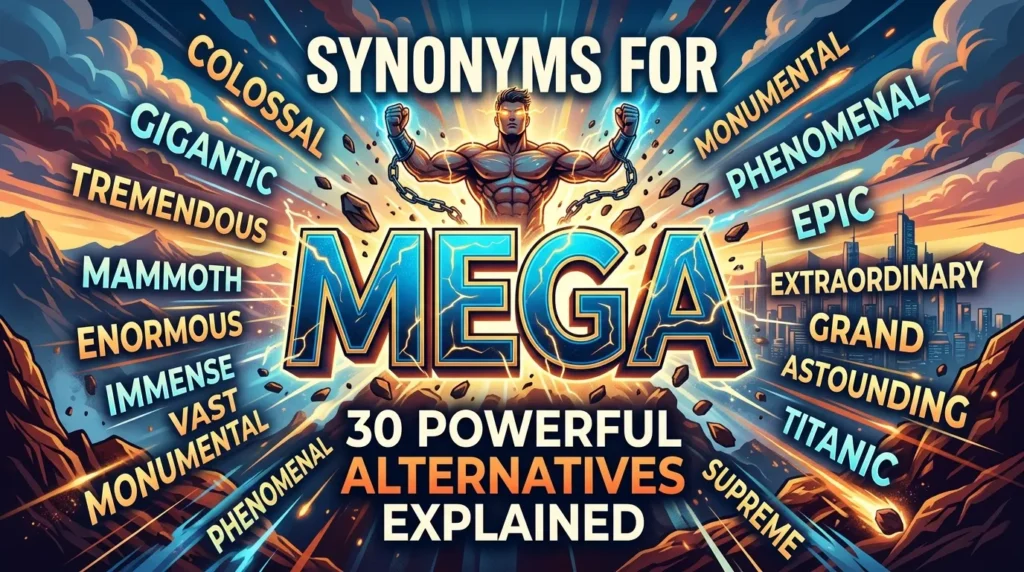
The word mega is often used to describe something extremely large, impressive, important, or successful. People commonly say things like “mega project,” “mega event,” or “mega star” to emphasize size, scale, or significance. In modern English, mega appears frequently in business, entertainment, technology, marketing, and everyday conversations. Because it is such a popular word, writers and speakers can benefit from learning its synonyms to avoid repetition and make their language more engaging. A wider vocabulary helps English learners express ideas more precisely and confidently. Understanding alternative words for mega also improves reading comprehension and communication skills. In this article, you will learn the meaning of mega, its pronunciation, history, grammar structure, and 30 useful synonyms with meanings and examples. You will also explore its semantic categories, antonyms, and common questions.
Meaning of mega
Definition
Mega (Adjective):
Mega means extremely large, powerful, important, successful, or impressive.
Examples
- The city launched a mega construction project.
- She became a mega star after the movie’s success.
Connotative Meaning
- Positive tone: Suggests greatness, success, power, and importance.
- Negative tone: Can imply excessive size or influence.
- Neutral tone: Refers to something very large or significant.
(Connotation: the emotional or implied meaning associated with a word beyond its dictionary definition)
Etymology
- Old English (450–1100): No direct Old English form.
- Middle English (1100–1500): Not commonly used during this period.
- Modern English (1500–Present): Derived from Greek megas, meaning “great” or “large.”
Pronunciation (IPA)
- IPA: /ˈmeɡ.ə/
- Syllables: me-ga
Affixation Pattern of mega
- Root: mega
- Prefix: mega- (meaning large or great)
- Suffix: None
- Word formations:
- Megastar (noun)
- Megacity (noun)
- Megaproject (noun)
- Megastore (noun)
- Megabyte (noun)
- Megalithic (adjective)
30 Synonyms of Mega With Meaning & Examples
1. Huge (Adjective)
Meaning: Extremely large in size.
Examples:
- They built a huge stadium.
- The company made a huge profit.
2. Massive (Adjective)
Meaning: Very large and heavy.
Examples:
- A massive crowd attended the event.
- The project required massive funding.
3. Enormous (Adjective)
Meaning: Extremely large or great.
Examples:
- The building is enormous.
- She faced enormous challenges.
4. Giant (Adjective)
Meaning: Very large or powerful.
Examples:
- It became a giant corporation.
- A giant wave hit the shore.
5. Immense (Adjective)
Meaning: Extremely great in size or degree.
Examples:
- The task required immense effort.
- They own an immense property.
6. Colossal (Adjective)
Meaning: Exceptionally large.
Examples:
- The statue was colossal.
- The company suffered colossal losses.
7. Gigantic (Adjective)
Meaning: Extremely big.
Examples:
- They discovered a gigantic structure.
- A gigantic storm approached.
8. Monumental (Adjective)
Meaning: Very important or massive.
Examples:
- It was a monumental achievement.
- The decision had monumental effects.
9. Tremendous (Adjective)
Meaning: Extremely great in amount or quality.
Examples:
- The team showed tremendous effort.
- She received tremendous support.
10. Vast (Adjective)
Meaning: Very large in extent or area.
Examples:
- The desert is vast.
- They have vast experience.
11. Grand (Adjective)
Meaning: Large and impressive.
Examples:
- The hotel has a grand entrance.
- It was a grand celebration.
12. Mammoth (Adjective)
Meaning: Huge in size or scope.
Examples:
- The company launched a mammoth campaign.
- It was a mammoth undertaking.
13. Titanic (Adjective)
Meaning: Enormously large or powerful.
Examples:
- They faced titanic challenges.
- The project required titanic effort.
14. Gargantuan (Adjective)
Meaning: Extremely large.
Examples:
- The meal was gargantuan.
- They built a gargantuan factory.
15. Jumbo (Adjective)
Meaning: Larger than usual.
Examples:
- He ordered a jumbo burger.
- The store sold jumbo packages.
16. Oversized (Adjective)
Meaning: Larger than normal.
Examples:
- She wore an oversized jacket.
- The package was oversized.
17. Expansive (Adjective)
Meaning: Covering a wide area.
Examples:
- The park is expansive.
- They own expansive farmland.
18. Large-Scale (Adjective)
Meaning: Involving a large amount or area.
Examples:
- The company started a large-scale operation.
- It became a large-scale event.
19. Powerful (Adjective)
Meaning: Having great strength or influence.
Examples:
- He is a powerful leader.
- The machine is powerful.
20. Influential (Adjective)
Meaning: Having great impact on others.
Examples:
- She is an influential figure.
- The company remains influential.
21. Significant (Adjective)
Meaning: Important and meaningful.
Examples:
- It was a significant discovery.
- The change had significant effects.
22. Major (Adjective)
Meaning: Very important or large.
Examples:
- They announced a major investment.
- It was a major success.
23. Extraordinary (Adjective)
Meaning: Beyond what is usual.
Examples:
- She showed extraordinary talent.
- The event was extraordinary.
24. Remarkable (Adjective)
Meaning: Worth attention and admiration.
Examples:
- His progress was remarkable.
- The building is remarkable.
25. Exceptional (Adjective)
Meaning: Unusually excellent or large.
Examples:
- She has exceptional skills.
- The results were exceptional.
26. Superb (Adjective)
Meaning: Extremely good or impressive.
Examples:
- The performance was superb.
- They provided superb service.
27. Outstanding (Adjective)
Meaning: Clearly better than others.
Examples:
- He gave an outstanding presentation.
- The school achieved outstanding results.
28. Phenomenal (Adjective)
Meaning: Extremely impressive or remarkable.
Examples:
- The athlete had a phenomenal season.
- Sales showed phenomenal growth.
29. Magnificent (Adjective)
Meaning: Grand and impressive.
Examples:
- The palace was magnificent.
- It was a magnificent achievement.
30. Supreme (Adjective)
Meaning: Highest in rank, importance, or quality.
Examples:
- She has supreme confidence.
- The court holds supreme authority.
Prototype Meaning
When people hear the word mega, they usually imagine something extremely large, powerful, successful, or impressive that stands out far above the ordinary.
Prototype Categorization
- Size-related synonyms: huge, massive, enormous, gigantic, colossal
- Importance-related synonyms: significant, major, monumental, supreme
- Success-related synonyms: outstanding, exceptional, phenomenal, remarkable
- Power-related synonyms: powerful, influential, titanic
- Grandeur-related synonyms: magnificent, grand, superb, mammoth
This categorization helps writers choose the best synonym based on whether the focus is size, importance, power, success, or impressiveness.
Antonyms of mega
Tiny (Adjective)
Very small in size.
Minor (Adjective)
Less important or smaller.
Small (Adjective)
Not large.
Insignificant (Adjective)
Not important or meaningful.
Modest (Adjective)
Limited in size or scale.
Short Questions and Answers
What does mega mean?
Mega means extremely large, important, impressive, or powerful.
When should mega be used?
It should be used when emphasizing great size, significance, success, or influence.
Is mega positive or negative?
It is usually positive but can sometimes suggest excessive size or power.
How is it different from similar words?
Mega is often an informal intensifier, while words like massive or significant are more specific in meaning.
Conclusion
Learning the word mega and its synonyms can greatly improve your English vocabulary and communication skills. These alternatives allow you to describe large, important, impressive, and powerful things with greater accuracy. Instead of repeatedly using mega, you can choose words such as massive, colossal, phenomenal, outstanding, or magnificent depending on the context. This makes writing more varied, engaging, and professional.
A strong vocabulary also helps improve speaking confidence and reading comprehension. By practicing these synonyms regularly, you will become more effective at expressing ideas in both formal and informal situations. Continue exploring new words every day to build stronger English skills and communicate with clarity and confidence.

I am Daniel Whitmore.I write about everyday English, common grammar mistakes, and word meanings. My goal is to make learning English simple, clear, and practical for everyone.