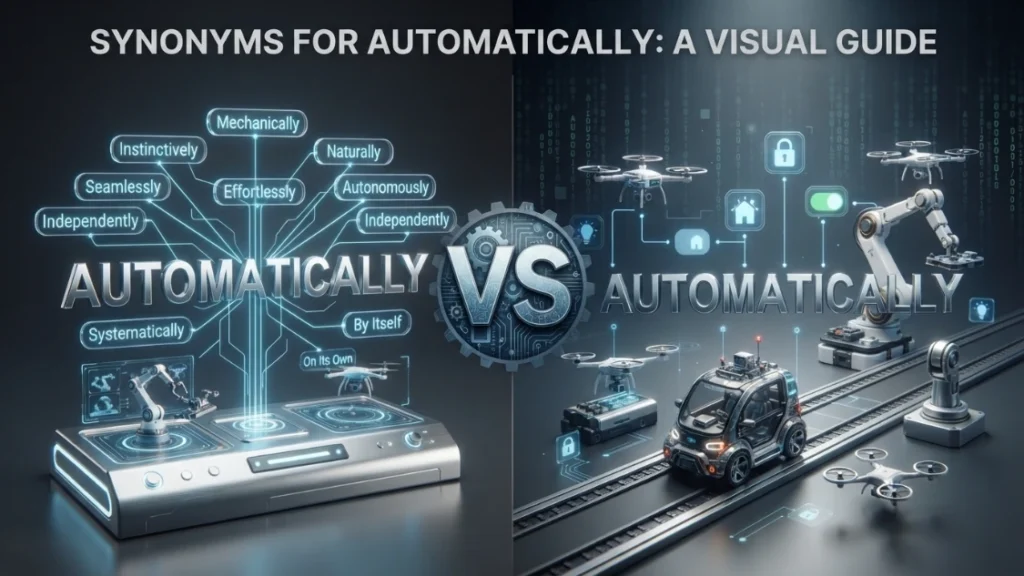
Automatically means something happens by itself without a person controlling every step.
Imagine your phone saving your photos to the cloud without you pressing a button. It happens automatically. This word is common in daily conversations, technology, business, science, and writing because many actions today are completed by machines, software, or natural processes.
Learning synonyms for automatically helps English learners, students, and content writers avoid repeating the same word. It also makes writing more accurate because different situations need different words. In this article, you’ll learn the meaning of automatically, its pronunciation, grammar, history, word formation, and 30 useful synonyms with simple meanings and examples. You’ll also discover antonyms, semantic categories, and practical tips to choose the best synonym in different contexts.
Meaning of automatically
Definition
Automatically (Adverb):
In a way that happens by itself, without direct human control or extra effort.
Examples
- The doors open automatically when someone walks near them.
- Your phone automatically updates its apps overnight.
Connotative Meaning
(Connotation: the emotional or implied feeling that a word suggests beyond its basic meaning.)
Positive tone:
Shows efficiency, convenience, or smooth operation.
Negative tone:
May suggest acting without thinking or reacting out of habit.
Neutral tone:
Simply describes something happening without manual action.
Etymology
- Old English (450–1100): No direct form existed, but words describing self-action were used.
- Middle English (1100–1500): The idea developed through Latin and French influences.
- Modern English (1500–Present): Derived from automatic, which comes from Greek automatos, meaning “self-moving” or “acting by itself.” The suffix -ally forms the adverb automatically.
Pronunciation (IPA)
- IPA: /ˌɔː.təˈmæt.ɪ.kəl.i/
- Syllables: au-to-mat-i-cal-ly
Affixation Pattern of automatically
- Root: auto (self)
- Prefix: auto-
- Suffix: -ally
Word Formations
- automatic (adjective)
- automatically (adverb)
- automation (noun)
- automate (verb)
- automated (adjective)
- automating (verb)
- automatable (adjective)
- automaton (noun)
30 Synonyms of automatically With Meaning & Examples
1. Automatically (Adverb)
Meaning: By itself without human control.
Examples:
- The lights turn on automatically at sunset.
- The software saves your work automatically.
2. Instinctively (Adverb)
Meaning: In a way guided by natural instinct rather than conscious thought.
Examples:
- She instinctively moved away from the fire.
- He instinctively knew something was wrong.
3. Mechanically (Adverb)
Meaning: In a machine-like or repetitive manner.
Examples:
- The robot moved mechanically across the floor.
- He mechanically signed the papers.
4. Naturally (Adverb)
Meaning: In a normal or expected way.
Examples:
- The leaves naturally fell from the tree.
- Children naturally learn through play.
5. Spontaneously (Adverb)
Meaning: Without planning or outside influence.
Examples:
- The audience spontaneously applauded.
- She spontaneously offered to help.
6. Effortlessly (Adverb)
Meaning: Without difficulty or hard work.
Examples:
- She effortlessly solved the puzzle.
- The bird effortlessly flew across the lake.
7. Unconsciously (Adverb)
Meaning: Without being aware of it.
Examples:
- He unconsciously tapped his foot.
- She unconsciously smiled during the song.
8. Involuntarily (Adverb)
Meaning: Without choosing or intending to.
Examples:
- He involuntarily blinked at the bright light.
- She involuntarily stepped back.
9. Habitually (Adverb)
Meaning: As a regular habit.
Examples:
- He habitually wakes up early.
- She habitually checks her email before work.
10. Routinely (Adverb)
Meaning: As part of a regular routine.
Examples:
- The equipment is routinely inspected.
- Doctors routinely monitor patients.
11. Systematically (Adverb)
Meaning: In an organized and methodical way.
Examples:
- The files were systematically arranged.
- Scientists systematically tested the theory.
12. Seamlessly (Adverb)
Meaning: Smoothly without interruption.
Examples:
- The devices worked seamlessly together.
- The transition happened seamlessly.
13. Effort-free (Adverbial Use)
Meaning: Without requiring effort.
Examples:
- The setup became almost effort-free.
- Modern tools make learning effort-free.
14. Independently (Adverb)
Meaning: Without relying on others.
Examples:
- The drone operated independently.
- She completed the task independently.
15. Self-operating (Adjective/Adverbial Use)
Meaning: Able to work by itself.
Examples:
- The factory uses self-operating machines.
- A self-operating system reduced costs.
16. Self-acting (Adjective)
Meaning: Acting without outside control.
Examples:
- The device has a self-acting valve.
- Engineers installed a self-acting mechanism.
17. Self-moving (Adjective)
Meaning: Able to move by itself.
Examples:
- The self-moving robot impressed visitors.
- Researchers built a self-moving vehicle.
18. Self-driven (Adjective)
Meaning: Controlled without human intervention.
Examples:
- The company tested self-driven buses.
- A self-driven machine improved production.
19. Self-regulating (Adjective)
Meaning: Able to control itself automatically.
Examples:
- The heating system is self-regulating.
- Nature has many self-regulating processes.
20. Self-governing (Adjective)
Meaning: Able to manage itself.
Examples:
- The system became self-governing.
- Some online platforms are self-governing.
21. Reflexively (Adverb)
Meaning: As an immediate automatic reaction.
Examples:
- She reflexively caught the falling glass.
- He reflexively covered his face.
22. Inevitably (Adverb)
Meaning: In a way that cannot be avoided.
Examples:
- Prices inevitably increased.
- Change inevitably comes with time.
23. By default (Phrase)
Meaning: Happening because it is the preset option.
Examples:
- The feature is enabled by default.
- Notifications are turned on by default.
24. Without intervention (Phrase)
Meaning: Without anyone stepping in.
Examples:
- The program runs without intervention.
- The machine finished the task without intervention.
25. On its own (Phrase)
Meaning: By itself.
Examples:
- The printer restarted on its own.
- The child learned to read on his own.
26. By itself (Phrase)
Meaning: Without outside help.
Examples:
- The gate closed by itself.
- The engine stopped by itself.
27. Of its own accord (Phrase)
Meaning: Without being forced or directed.
Examples:
- The horse stopped of its own accord.
- The problem disappeared of its own accord.
28. Autonomously (Adverb)
Meaning: Independently and without direct control.
Examples:
- The robot navigated autonomously.
- The vehicle operated autonomously.
29. Programmatically (Adverb)
Meaning: Controlled by a computer program.
Examples:
- The data was updated programmatically.
- Developers created the files programmatically.
30. Automatically by design (Phrase)
Meaning: Intended to happen automatically because of the system’s design.
Examples:
- The backup runs automatically by design.
- The software updates automatically by design.
Prototype Meaning
The most common meaning of automatically is something happening by itself without a person controlling or starting every action. Most people think of machines, computers, doors, alarms, or software that perform a task on their own. The word also describes natural or habitual human actions, such as reacting instinctively or doing something without conscious thought.
Prototype Categorization
The 30 synonyms of automatically can be grouped into meaningful semantic categories. Understanding these groups helps writers choose the most accurate word for different situations.
1. Self-Operating Actions
These words describe something working by itself without human control.
- Automatically
- Self-operating
- Self-acting
- Self-moving
- Self-driven
- Autonomously
Best used for: Machines, robots, technology, vehicles, and devices.
2. Habit and Unconscious Behavior
These synonyms describe actions people perform without thinking.
- Instinctively
- Unconsciously
- Habitually
- Reflexively
- Involuntarily
Best used for: Human behavior, emotions, psychology, and natural reactions.
3. Natural Processes
These words describe events that happen as part of nature or normal life.
- Naturally
- Spontaneously
- Inevitably
Best used for: Nature, personal growth, relationships, and everyday events.
4. Organized or System-Controlled Processes
These synonyms emphasize order, planning, or programmed operation.
- Mechanically
- Systematically
- Routinely
- Programmatically
- By default
Best used for: Computers, business, engineering, software, and manufacturing.
5. Smooth and Easy Actions
These words highlight actions that happen with little or no effort.
- Effortlessly
- Seamlessly
- Effort-free
Best used for: Marketing, technology, learning, sports, and product descriptions.
6. Independent Operation
These words describe something acting without outside assistance.
- Independently
- Self-regulating
- Self-governing
Best used for: Organizations, systems, artificial intelligence, and automation.
7. Actions Without Human Intervention
These phrases focus on tasks completed without anyone stepping in.
- Without intervention
- On its own
- By itself
- Of its own accord
- Automatically by design
Best used for: Technical writing, user manuals, science, and engineering.
Why Does This Categorization Matter?
Grouping synonyms by meaning makes it easier to choose the right word for your sentence. For example, autonomously fits robotics and artificial intelligence, while instinctively suits human reactions. Programmatically is ideal for software development, whereas naturally works best for everyday events or nature. Using the correct synonym improves clarity, strengthens your writing, and helps you communicate more precisely.
Antonyms of automatically
Manually (Adverb)
Meaning: Done by a person rather than by a machine or system.
Deliberately (Adverb)
Meaning: Done on purpose after careful thought.
Intentionally (Adverb)
Meaning: Done with a clear intention or plan.
Consciously (Adverb)
Meaning: Done with full awareness.
Purposely (Adverb)
Meaning: Done for a specific reason.
Voluntarily (Adverb)
Meaning: Done by free choice.
Knowingly (Adverb)
Meaning: Done with knowledge of the action.
Carefully (Adverb)
Meaning: Done with attention and caution.
Thoughtfully (Adverb)
Meaning: Done after careful consideration.
By hand (Phrase)
Meaning: Done manually without automatic equipment.
Short Questions and Answers
What does automatically mean?
It means something happens by itself without direct human control or extra effort.
When should automatically be used?
Use automatically when describing actions performed by machines, software, systems, or natural processes without manual input.
Is automatically positive or negative?
It is usually neutral. Depending on the context, it can have a positive meaning (efficient) or a negative meaning (done without thinking).
How is it different from similar words?
Automatically emphasizes self-operation or automation, while words like instinctively describe natural human reactions, programmatically refers to computer-controlled actions, and naturally refers to normal or expected events.
Conclusion
Learning synonyms for automatically helps you express ideas more clearly and naturally. Instead of repeating the same word, you can choose alternatives like instinctively, autonomously, seamlessly, or programmatically based on the situation. A richer vocabulary makes your writing more engaging, improves speaking confidence, and helps readers understand your meaning more easily. Whether you’re an English learner, student, teacher, or content writer, practicing these synonyms every day will strengthen your communication skills. Keep reading, writing, and using new words in real conversations to build lasting vocabulary and become a more confident English user.

An English language writer with expertise in grammar, spelling, vocabulary, and word usage. Committed to publishing accurate, well-researched, and easy-to-understand content that helps readers improve their English with confidence.