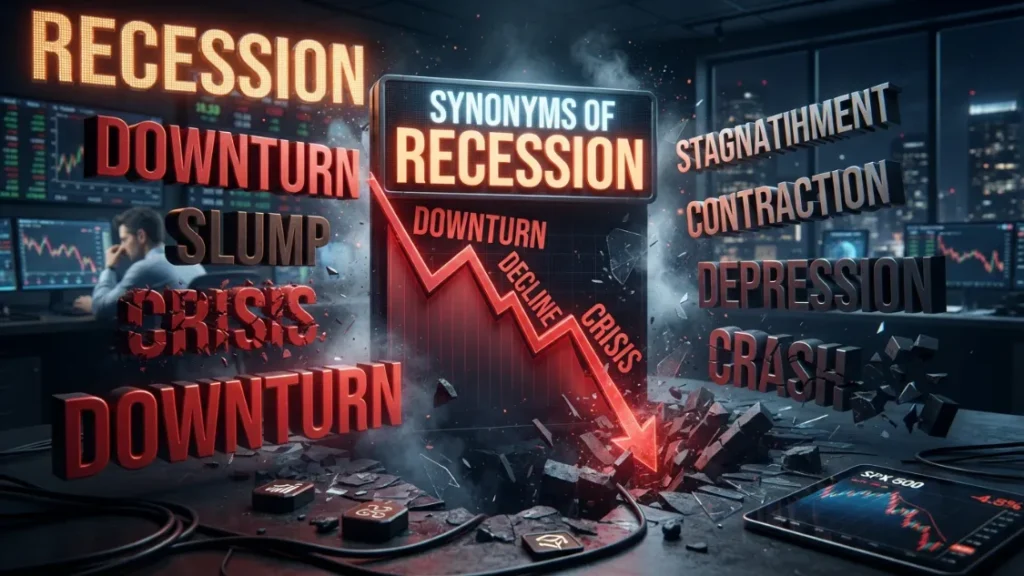
Recession (noun): A period when economic activity declines, leading to lower production, spending, business activity, and often employment.
Quick Answer
Recession means a period when a country’s economy becomes weaker. For example, a company may reduce hiring, people may spend less money, and businesses may see lower sales during a recession. The word is commonly used in news reports, business discussions, economics, and everyday conversations about financial conditions. Learning synonyms for recession helps English learners understand different ways to describe economic decline. It also helps content writers avoid repeating the same word in articles and reports. However, not every synonym has exactly the same meaning or level of seriousness. Some words describe a general decline, while others refer to a severe economic crisis or a temporary slowdown. This article explains the meaning of recession, its synonyms, examples, grammar, history, pronunciation, word formation, and semantic categories so you can choose the right word for each context.
Meaning of Recession
Definition
Recession (noun): A period when economic activity declines, usually causing lower production, spending, income, and employment.
Examples
- The country entered a recession after several months of falling economic activity.
- Many businesses struggled during the recession.
Connotative Meaning
(Connotation: the feeling or idea that a word suggests beyond its basic meaning.)
- Positive tone: Usually none, because recession describes economic weakness.
- Negative tone: Financial hardship, unemployment, uncertainty, and declining business activity.
- Neutral tone: A factual term used to describe a period of economic decline.
Etymology
The word recession comes from Latin recessio, meaning “a going back” or “withdrawal.” It comes from recedere, meaning “to go back” or “withdraw.” Its economic sense developed later in English.
- Old English (450–1100): Recession was not used in Old English.
- Middle English (1100–1500): The word entered English near the end of this period, based on Latin recessio.
- Modern English (1500–Present): Recession developed several meanings, including withdrawal, decline, and eventually the modern economic meaning of a period of reduced economic activity.
Pronunciation (IPA)
- IPA: /rɪˈseʃən/
- Syllables: re-ces-sion
Affixation Pattern of Recession
- Root: cede / cess — related to the idea of going or moving
- Prefix: re- — meaning “back” or “again”
- Suffix: -ion — forms a noun describing an action, process, or result
- Word formations:
- recession — noun
- recessional — adjective/noun
- recessionary — adjective
- recessionally — adverb
- recede — verb
- recess — noun/verb
30 Synonyms of Recession With Meaning & Examples
1. Economic downturn (Noun Phrase)
Meaning: A period when economic activity becomes weaker.
Examples:
- The country faced a serious economic downturn.
- Businesses reduced spending during the economic downturn.
2. Economic decline (Noun Phrase)
Meaning: A fall in the strength or performance of an economy.
Examples:
- The region experienced a period of economic decline.
- High unemployment followed the economic decline.
3. Economic slowdown (Noun Phrase)
Meaning: A period when economic growth becomes slower.
Examples:
- The government is trying to prevent an economic slowdown.
- An economic slowdown affected consumer spending.
4. Slump (Noun)
Meaning: A sudden or prolonged period of poor economic performance.
Examples:
- The housing market suffered a major slump.
- The economic slump affected small businesses.
5. Downturn (Noun)
Meaning: A period when economic or business conditions become worse.
Examples:
- The industry experienced a sharp downturn.
- Companies prepared for a possible downturn.
6. Contraction (Noun)
Meaning: A reduction in economic activity or output.
Examples:
- The economy recorded a contraction last quarter.
- Industrial production fell during the contraction.
7. Economic contraction (Noun Phrase)
Meaning: A measurable reduction in the size or activity of an economy.
Examples:
- The country reported an economic contraction.
- An economic contraction can affect employment.
8. Depression (Noun)
Meaning: A very severe and prolonged period of economic decline.
Examples:
- The country suffered a deep economic depression.
- The depression caused widespread unemployment.
Note: Depression is much stronger than recession and should not normally be used as a direct replacement.
9. Crisis (Noun)
Meaning: A serious situation involving major economic problems or instability.
Examples:
- The financial crisis affected several industries.
- The government introduced new measures during the economic crisis.
10. Financial crisis (Noun Phrase)
Meaning: A severe period of financial instability.
Examples:
- The financial crisis damaged banks and businesses.
- Many families struggled during the financial crisis.
11. Economic crisis (Noun Phrase)
Meaning: A serious period of economic difficulty.
Examples:
- The country entered an economic crisis.
- The economic crisis reduced investment.
12. Economic distress (Noun Phrase)
Meaning: Serious financial difficulty affecting an economy or its people.
Examples:
- Many families faced economic distress.
- The region remained in economic distress for years.
13. Economic hardship (Noun Phrase)
Meaning: Difficult financial conditions faced by people or businesses.
Examples:
- Many workers experienced economic hardship.
- The government offered support to families facing economic hardship.
14. Financial downturn (Noun Phrase)
Meaning: A period when financial conditions become weaker.
Examples:
- Investors became cautious during the financial downturn.
- The financial downturn affected market confidence.
15. Market decline (Noun Phrase)
Meaning: A fall in the value or performance of a market.
Examples:
- The market decline worried investors.
- Businesses reacted to the sudden market decline.
16. Market slump (Noun Phrase)
Meaning: A significant fall in market activity or values.
Examples:
- The stock market suffered a market slump.
- The market slump reduced investor confidence.
17. Business downturn (Noun Phrase)
Meaning: A period when business activity and performance become weaker.
Examples:
- The company survived the business downturn.
- Sales fell during the business downturn.
18. Business slump (Noun Phrase)
Meaning: A period of weak business activity or sales.
Examples:
- Retailers experienced a business slump.
- The business slump lasted several months.
19. Decline (Noun)
Meaning: A gradual or noticeable fall in strength, value, or activity.
Examples:
- The industry suffered a long decline.
- The decline in production affected workers.
20. Deterioration (Noun)
Meaning: The process of becoming worse in quality or condition.
Examples:
- The economy showed signs of deterioration.
- Continued deterioration worried business leaders.
21. Weakening (Noun)
Meaning: The process of becoming less strong or effective.
Examples:
- The economy showed signs of weakening.
- Economic weakening can reduce business investment.
22. Retreat (Noun)
Meaning: A movement backward or reduction in activity, strength, or value.
Examples:
- The market began a sharp retreat.
- Consumer demand went into retreat.
23. Dip (Noun)
Meaning: A small or temporary fall in activity, value, or performance.
Examples:
- The economy experienced a slight dip.
- Consumer spending took a temporary dip.
24. Setback (Noun)
Meaning: A problem that delays progress or causes a situation to become worse.
Examples:
- The economy suffered a major setback.
- Rising prices created another setback for businesses.
25. Chill (Noun)
Meaning: A period of reduced activity or confidence, especially in markets or business.
Examples:
- Higher interest rates created a chill in the housing market.
- The policy caused a chill in business investment.
26. Stagnation (Noun)
Meaning: A period when economic growth or activity stops increasing.
Examples:
- The economy suffered from prolonged stagnation.
- Low investment contributed to economic stagnation.
27. Deflation (Noun)
Meaning: A sustained fall in the general prices of goods and services.
Examples:
- The country experienced a period of deflation.
- Deflation can create problems for businesses and borrowers.
Note: Deflation is not the same as recession, although the two can occur together.
28. Depressed economy (Noun Phrase)
Meaning: An economy that has remained weak for a significant period.
Examples:
- The region has a depressed economy.
- Investment is difficult in a depressed economy.
29. Economic malaise (Noun Phrase)
Meaning: A prolonged condition of economic weakness or poor performance.
Examples:
- The government struggled to overcome economic malaise.
- Low investment contributed to widespread economic malaise.
30. Economic distress period (Noun Phrase)
Meaning: A period marked by serious economic difficulty and financial pressure.
Examples:
- Businesses faced uncertainty during the economic distress period.
- Government support was important during the economic distress period.
Prototype Meaning
The most typical meaning of recession is a period of significant economic decline. When people hear the word, they usually think of falling business activity, lower consumer spending, job losses, reduced investment, and financial uncertainty. In economics, recession is more specific than general words such as decline or setback. It usually refers to a broad weakening of economic activity rather than a problem affecting only one company or industry.
Prototype Categorization
The 30 synonyms can be grouped by their closest meaning and typical use:
- General economic decline: economic downturn, economic decline, downturn, decline, weakening, deterioration useful for describing a broad fall in economic performance.
- Slower economic activity: economic slowdown, contraction, economic contraction, stagnation best when growth or output becomes slower or falls.
- Severe economic problems: depression, crisis, financial crisis, economic crisis, economic distress, economic hardship suitable for serious financial conditions. Some are stronger than recession.
- Business and market weakness: slump, market decline, market slump, business downturn, business slump, financial downturn useful when discussing particular markets, industries, or businesses.
- Temporary or smaller falls: dip, setback, retreat, chill better when the decline is limited, temporary, or less severe.
- Related economic conditions: deflation, depressed economy, economic malaise these describe related conditions but are not exact synonyms of recession.
- Broader financial difficulty: economic distress period useful for describing a period of financial pressure but less common than recession.
This categorization helps writers choose a word based on severity, duration, context, and meaning instead of replacing recession with any word that simply suggests a decline.
Antonyms of Recession
1. Economic growth (Noun Phrase)
An increase in economic activity, production, and income.
2. Expansion (Noun)
A period when economic activity increases.
3. Boom (Noun)
A period of rapid economic growth or strong business activity.
4. Recovery (Noun)
The process of improving after an economic decline.
5. Prosperity (Noun)
A state of strong economic success and financial well-being.
6. Growth (Noun)
An increase in economic activity, production, or wealth.
Short Questions and Answers
Q: What does recession mean?
A: Recession means a period of significant economic decline when overall business and economic activity becomes weaker.
Q: When should recession be used?
A: Use recession when discussing a broad decline in economic activity, such as falling production, spending, investment, or employment.
Q: Is recession positive or negative?
A: Recession has a negative connotation because it is linked with economic weakness, financial uncertainty, and possible job losses.
Q: How is it different from similar words?
A: Recession specifically describes broad economic weakness. Words such as dip suggest a smaller fall, while depression describes a much more severe and prolonged economic decline. Slowdown usually suggests slower growth rather than an overall contraction.
Conclusion
Learning recession and its synonyms can make your English more precise and flexible. The word recession is useful when discussing a broad period of economic decline, but related words such as downturn, slump, contraction, and economic slowdown can describe different aspects of that decline. Strong vocabulary helps you avoid repetition and choose words that match the exact situation. This is especially useful for English learners, students, journalists, business writers, and content creators. Remember that some related terms, such as depression and deflation, have more specific meanings and should not be used as exact replacements. Try learning a few synonyms each day and use them in your own sentences. Regular practice will strengthen your vocabulary, improve your writing and speaking, and build confidence in English.

An English language writer with expertise in grammar, spelling, vocabulary, and word usage. Committed to publishing accurate, well-researched, and easy-to-understand content that helps readers improve their English with confidence.