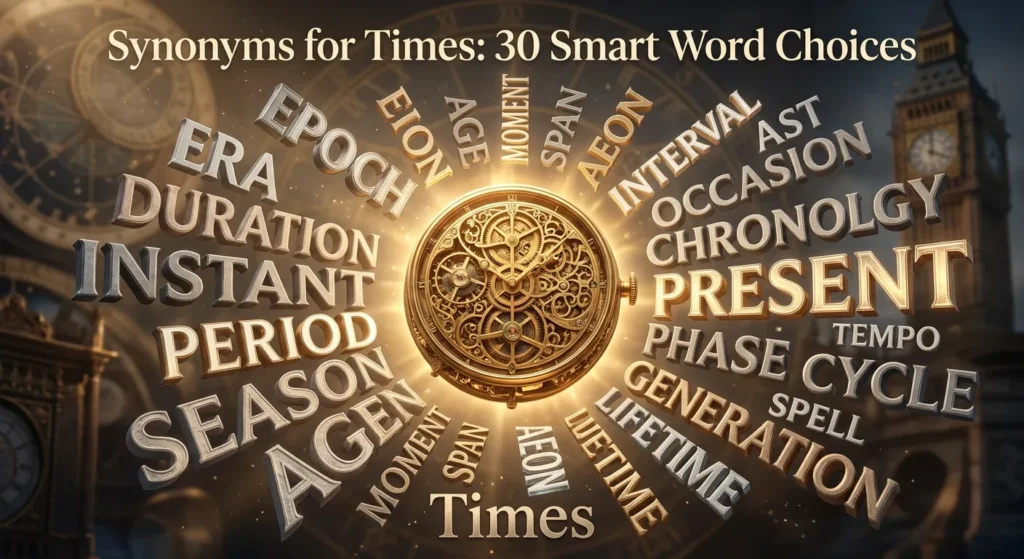
Times means occasions, instances, periods, moments, or events when something happens or exists.
Times is a common English word with several meanings. You may use it when talking about repeated events, periods, or occasions. For example, you might say, “I have visited that city three times,” or “There were difficult times in her life.” Because times can describe different ideas, choosing the right synonym depends on the context.
Learning synonyms helps English learners express ideas more clearly and gives content writers more ways to avoid repetition. In this article, we explore the meaning of times and 30 useful synonyms with simple examples. We also look at its grammar, etymology, pronunciation, word formation, and semantic categories. These categories make it easier to select the best alternative for everyday, formal, historical, and literary writing.
Meaning of Times
Definition
Times (Noun):
Times is the plural of time and can mean occasions, repeated events, periods, or particular stages in life or history.
Examples
- I have called you several times today.
- People lived through difficult times during the war.
Connotative Meaning
Connotation: the feeling or idea that a word suggests beyond its basic meaning.
- Positive tone: times can suggest happy periods or memorable occasions.
- Negative tone: times can suggest hardship, trouble, or difficult periods.
- Neutral tone: times can simply refer to repeated occasions or periods.
Etymology
The word times comes from the noun time, with the plural ending -s.
- Old English (450–1100): Time appeared as tīma, meaning a period, season, or a suitable point or occasion.
- Middle English (1100–1500): The word developed into forms such as time and gained wider meanings related to duration, occasions, and periods.
- Modern English (1500–Present): Time developed its many modern meanings, while times became widely used for repeated occasions, historical periods, and stages of life.
Pronunciation (IPA)
- IPA: /taɪmz/
- Syllables: one syllable — times
Affixation Pattern of Times
- Root: time
- Prefix: None
- Suffix: -s — plural marker
- Word formations:
- time : noun
- times : plural noun
- timely : adjective/adverb
- timeliness : noun
- timeless : adjective
- timelessness : noun
- timing : noun
- timed : adjective/verb form
- timelessly : adverb
30 Synonyms of Times With Meaning & Examples
1. Occasions (Noun)
Meaning: Particular events or instances when something happens.
Examples:
- We met on several occasions.
- She has helped me on many occasions.
2. Instances (Noun)
Meaning: Individual examples or cases of something happening.
Examples:
- There were several instances of poor communication.
- I remember two instances when he helped us.
3. Events (Noun)
Meaning: Things that happen, especially important or planned happenings.
Examples:
- The school held several special events.
- These events changed the course of history.
4. Periods (Noun)
Meaning: Lengths or sections of time.
Examples:
- The country experienced long periods of peace.
- We worked through difficult periods together.
5. Eras (Noun)
Meaning: Long and distinct periods in history.
Examples:
- The invention changed the way people lived for eras to come.
- Historians study different eras of human history.
6. Ages (Noun)
Meaning: Long periods of history or stages of time.
Examples:
- The castle has stood there for ages.
- People have told this story for ages.
7. Moments (Noun)
Meaning: Very short periods or particular points in time.
Examples:
- There were several beautiful moments during the trip.
- I will remember those moments forever.
8. Instances (Noun)
Meaning: Specific cases in which something occurs.
Examples:
- We found several instances of the error.
- Such instances are uncommon.
9. Occurrences (Noun)
Meaning: Events or things that happen.
Examples:
- These occurrences are rare.
- The report records unusual occurrences.
10. Episodes (Noun)
Meaning: Individual events or periods within a larger situation.
Examples:
- He described several difficult episodes from his career.
- The illness caused repeated episodes of pain.
11. Phases (Noun)
Meaning: Distinct stages in a process or period.
Examples:
- The project went through several phases.
- Children pass through different phases as they grow.
12. Stages (Noun)
Meaning: Particular points or periods in a development or process.
Examples:
- The business has passed through several stages.
- Different stages of life bring different challenges.
13. Seasons (Noun)
Meaning: Periods of time marked by particular conditions or experiences.
Examples:
- Life has its difficult seasons.
- They went through several seasons of change.
14. Spans (Noun)
Meaning: Lengths or periods of time.
Examples:
- The project was completed over short spans of time.
- Several generations lived within these spans of history.
15. Durations (Noun)
Meaning: Lengths of time during which something continues.
Examples:
- The study measured different durations.
- The courses have different durations.
16. Intervals (Noun)
Meaning: Periods between events or activities.
Examples:
- The lights flashed at regular intervals.
- There were short intervals between the meetings.
17. Occasions (Noun)
Meaning: Particular situations or events.
Examples:
- On several occasions, she offered advice.
- We celebrate special occasions together.
18. Cycles (Noun)
Meaning: Repeated sequences of events or periods.
Examples:
- Economic cycles can affect businesses.
- The machine operates in repeated cycles.
19. Rounds (Noun)
Meaning: Repeated stages or occurrences of an activity.
Examples:
- The team completed several rounds of testing.
- We had three rounds of interviews.
20. Repetitions (Noun)
Meaning: Acts or instances of doing something again.
Examples:
- The exercise requires several repetitions.
- Repeated repetitions can make the task easier to remember.
21. Recurrences (Noun)
Meaning: Events or situations that happen again.
Examples:
- Doctors monitored the patient for possible recurrences.
- The story contains several recurrences of the same theme.
22. Frequencies (Noun)
Meaning: Rates or numbers showing how often something happens.
Examples:
- The survey measured the frequencies of different responses.
- High frequencies of errors may indicate a problem.
23. Instances (Noun)
Meaning: Specific examples of an event or situation.
Examples:
- The report lists several instances of success.
- There were few instances of failure.
24. Experiences (Noun)
Meaning: Events or situations that someone lives through.
Examples:
- She remembers many happy experiences from childhood.
- Difficult experiences can teach valuable lessons.
25. Circumstances (Noun)
Meaning: Conditions or situations surrounding an event.
Examples:
- They faced difficult circumstances.
- Under different circumstances, the result might change.
26. Situations (Noun)
Meaning: Particular sets of conditions at a given point.
Examples:
- We have faced similar situations before.
- Some situations require careful planning.
27. Periods (Noun)
Meaning: Distinct sections or stretches of time.
Examples:
- The company had successful periods.
- Some historical periods are difficult to understand.
28. Generations (Noun)
Meaning: Groups of people born around the same period or successive periods of people.
Examples:
- The tradition has continued for generations.
- Several generations have lived in the house.
29. Histories (Noun)
Meaning: Records or accounts of past events and experiences.
Examples:
- The two countries have long histories.
- Their family histories are fascinating.
30. Chapters (Noun)
Meaning: Distinct periods or stages in someone’s life or an experience.
Examples:
- She is beginning a new chapter in her life.
- Difficult chapters can lead to better days.
Prototype Meaning
The most typical meaning of times is occasions when something happens or periods in which people experience something. When people hear times, they often think of repeated events, such as “three times,” or periods of life, such as “good times” and “hard times.” The exact meaning depends strongly on the sentence.
Prototype Categorization
The 30 alternatives can be grouped by their main semantic use:
- Repeated occasions: occasions, instances, events, occurrences, repetitions, recurrences, experiences. These work well when something happens more than once.
- Periods of time: periods, eras, ages, phases, stages, seasons, spans, durations, intervals. These are useful when times refers to a stretch or stage of time.
- Repeated processes: cycles, rounds, repetitions, recurrences, frequencies. These are useful for patterns or activities that happen again.
- Life and personal experience: experiences, situations, circumstances, chapters, seasons. These work well when discussing stages or events in someone’s life.
- Historical contexts: eras, ages, generations, histories, periods, chapters. These are useful for history and long-term change.
This categorization helps writers choose a synonym based on meaning instead of simply replacing times with any word that looks similar.
Antonyms of Times
1. Never (Adverb)
Meaning: Not at any time or on any occasion.
2. Permanence (Noun)
Meaning: A state of continuing without a temporary period.
3. Continuity (Noun)
Meaning: An uninterrupted state or connection.
4. Eternity (Noun)
Meaning: Infinite or endless time.
Short Questions and Answers
Q: What does timesmean?
A: Times is the plural of time and can refer to occasions, repeated events, or periods of time.
Q: When should times be used?
A: Use times when you are talking about more than one occasion, event, or period, depending on the context.
Q: Is times positive or negative?
A: Times is neutral. Its tone depends on the words around it, such as happy times, difficult times, or challenging times.
Q: How is it different from similar words?
A: Times is broad and flexible. Words such as occasions, instances, periods, and eras are more specific and should be chosen according to the intended meaning.
Conclusion
Learning times and its synonyms can make your English more flexible and precise. Words such as occasions and instances are useful for repeated events, while periods, eras, and phases work better for stretches of time. Other choices, such as chapters, seasons, and experiences, can add a more personal or expressive tone. Understanding these differences helps you avoid repetition in writing and choose words that fit the exact meaning you want.
It also strengthens everyday speaking and improves your vocabulary. English learners can build confidence by studying a few synonyms each day and using them in original sentences. With regular practice, you will find it easier to select the right word naturally and communicate your ideas with greater clarity.
Synonyms for devious: 30 Powerful Alternatives

An English language writer with expertise in grammar, spelling, vocabulary, and word usage. Committed to publishing accurate, well-researched, and easy-to-understand content that helps readers improve their English with confidence.