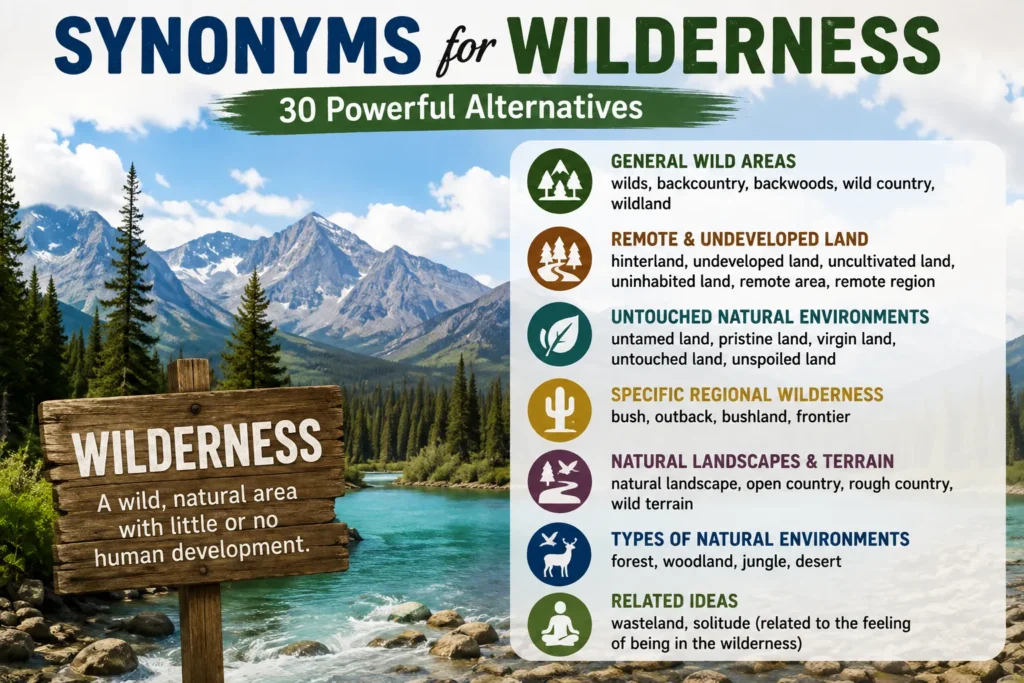
Wilderness: A wild, natural area with little or no human development.
Quick Answer
Wilderness means a wild, natural area where people have made little or no change to the land. Imagine hiking through a remote forest where there are no roads, buildings, or busy streets. You see trees, rivers, mountains, and wildlife instead of houses and shops. That untouched place can be called a wilderness. The word is commonly used when talking about nature, travel, wildlife, conservation, and outdoor adventures. Learning synonyms for wilderness helps English learners describe natural places with greater detail and accuracy. It also helps content writers avoid repeating the same word when writing about landscapes and remote areas. However, words such as backcountry, wilds, and outback can describe slightly different types of wild or remote places. This article explains the meaning of wilderness with 30 synonyms, examples, grammar, etymology, pronunciation, word formation, antonyms, and semantic categories.
Meaning of Wilderness
Definition
Wilderness (Noun): A wild and natural area that has little or no human development or control.
Examples
- They spent a week exploring the wilderness.
- The mountain range is surrounded by vast wilderness.
Connotative Meaning
(Connotation: the feeling or idea that a word suggests beyond its basic meaning.)
- Positive tone: Freedom, natural beauty, adventure, peace, and untouched nature.
- Negative tone: Isolation, danger, loneliness, or difficulty.
- Neutral tone: A natural area with little human development.
Etymology
The word wilderness comes from Old English wildēornes, meaning “wild place” or “land inhabited by wild animals.” It was formed from wildēor, meaning “wild animal,” and a noun-forming ending related to -ness. Over time, its meaning developed from a place associated with wild animals to a broad area of uncultivated or undeveloped land.
- Old English (450–1100): Wildēornes meant a wild place or a place inhabited by wild animals.
- Middle English (1100–1500): The form developed into wildernesse and was used for wild, uncultivated, or uninhabited land.
- Modern English (1500–Present): Wilderness came to describe remote natural areas with little human development and is now strongly linked with nature, conservation, and outdoor exploration.
Pronunciation (IPA)
- IPA: /ˈwɪldərnəs/
- Syllables: wil-der-ness
Affixation Pattern of Wilderness
- Root: wild — meaning living or existing in a natural state
- Prefix: None
- Suffix: -erness — part of the historical noun-forming ending in wilderness
- Word formations:
- wilderness — noun
- wildernesses — plural noun
- wilderness area — noun phrase
- wilderness-like — adjective
30 Synonyms of Wilderness With Meaning & Examples
1. Wilds (Noun)
Meaning: Large natural areas that are wild and have little human development.
Examples:
- They traveled deep into the wilds of Canada.
- Few people live in these remote wilds.
2. Backcountry (Noun)
Meaning: Remote natural land away from cities, roads, and developed areas.
Examples:
- The hikers spent three days in the backcountry.
- You need good equipment to travel through the backcountry.
3. Backwoods (Noun)
Meaning: A remote area far from towns and cities.
Examples:
- He grew up in the backwoods.
- The cabin is hidden deep in the backwoods.
4. Bush (Noun)
Meaning: Wild land covered with natural vegetation, especially in Australia and some other regions.
Examples:
- They spent several days walking through the bush.
- Wildlife is common in the Australian bush.
5. Outback (Noun)
Meaning: A large remote area of inland Australia with little development.
Examples:
- They traveled across the Australian outback.
- The outback is known for its vast landscapes.
6. Hinterland (Noun)
Meaning: A remote area beyond the main towns or developed regions.
Examples:
- The village lies in the mountain hinterland.
- Tourists rarely visit the remote hinterland.
7. Wildland (Noun)
Meaning: Natural land that has little human development.
Examples:
- The fire spread quickly through the wildland.
- Protecting wildland is important for wildlife.
8. Wild country (Noun Phrase)
Meaning: A natural area that is remote and not heavily developed.
Examples:
- They traveled through miles of wild country.
- The region contains beautiful wild country.
9. Untamed land (Noun Phrase)
Meaning: Land that remains in a natural state and has not been controlled or developed by people.
Examples:
- The explorers crossed vast areas of untamed land.
- Much of the island is still untamed land.
10. Undeveloped land (Noun Phrase)
Meaning: Land that has not been built on or significantly changed by people.
Examples:
- The region contains large areas of undeveloped land.
- Developers want to protect the remaining undeveloped land.
11. Uncultivated land (Noun Phrase)
Meaning: Land that is not used for farming or other regular cultivation.
Examples:
- Wild animals live on the uncultivated land.
- Much of the valley remains uncultivated land.
12. Uninhabited land (Noun Phrase)
Meaning: Land where no people live permanently.
Examples:
- The expedition crossed miles of uninhabited land.
- The island contains large areas of uninhabited land.
13. Remote area (Noun Phrase)
Meaning: A place that is far from towns, cities, or other populated areas.
Examples:
- The village is located in a remote area.
- They traveled to a remote area of the mountains.
14. Remote region (Noun Phrase)
Meaning: A distant area that is difficult to reach or far from populated places.
Examples:
- The expedition entered a remote region.
- Few roads connect the remote region to the city.
15. Pristine land (Noun Phrase)
Meaning: Natural land that remains clean and largely untouched by humans.
Examples:
- The park protects thousands of acres of pristine land.
- Visitors were amazed by the pristine land.
16. Virgin land (Noun Phrase)
Meaning: Land that has not been developed, cultivated, or significantly changed by people.
Examples:
- The explorers reached a stretch of virgin land.
- Conservationists work to protect the remaining virgin land.
17. Natural landscape (Noun Phrase)
Meaning: Land shaped mainly by natural processes rather than human development.
Examples:
- The region has a spectacular natural landscape.
- Roads have changed parts of the original natural landscape.
18. Open country (Noun Phrase)
Meaning: Broad areas of land with few buildings, trees, or other structures.
Examples:
- They rode their horses across the open country.
- The road continued through miles of open country.
19. Rough country (Noun Phrase)
Meaning: Wild or difficult land that is hard to travel through.
Examples:
- The hikers struggled across the rough country.
- Horses are useful in this rough country.
20. Wild terrain (Noun Phrase)
Meaning: Natural land that is rough, remote, or difficult to travel through.
Examples:
- The climbers faced dangerous wild terrain.
- Good boots are essential on wild terrain.
21. Untouched land (Noun Phrase)
Meaning: Land that has remained largely unchanged by human activity.
Examples:
- The reserve protects large areas of untouched land.
- They discovered a beautiful stretch of untouched land.
22. Unspoiled land (Noun Phrase)
Meaning: Natural land that has not been damaged or changed much by human activity.
Examples:
- The island is famous for its unspoiled land.
- Tourists come to enjoy the area’s unspoiled land.
23. Forest (Noun)
Meaning: A large area covered mainly by trees and other natural vegetation.
Examples:
- They walked through a dense forest.
- The forest provides shelter for many animals.
24. Woodland (Noun)
Meaning: Land covered mainly with trees and natural vegetation.
Examples:
- Deer were seen moving through the woodland.
- The trail passes through peaceful woodland.
25. Jungle (Noun)
Meaning: A dense tropical forest with thick vegetation.
Examples:
- The explorers traveled through the jungle.
- Many rare animals live in the jungle.
26. Desert (Noun)
Meaning: A very dry natural region with little rainfall and limited vegetation.
Examples:
- They crossed the vast desert.
- The desert is home to specially adapted animals.
27. Bushland (Noun)
Meaning: Natural land covered mainly with bushes, shrubs, and native vegetation.
Examples:
- The fire spread through the dry bushland.
- Native animals live throughout the bushland.
28. Wasteland (Noun)
Meaning: An area of land that is barren, damaged, or not useful for normal development.
Examples:
- The abandoned site had become a wasteland.
- Plants slowly returned to the former wasteland.
29. Frontier (Noun)
Meaning: A remote region at the edge of a settled or developed area.
Examples:
- The settlers moved toward the western frontier.
- Life on the frontier was difficult and isolated.
30. Solitude (Noun)
Meaning: A state of being alone, especially in a peaceful or remote natural setting.
Examples:
- She went into the mountains to enjoy the solitude.
- The solitude of the wilderness gave him peace.
Note: Solitude is not a direct synonym for wilderness. It describes the experience of being alone, which is often associated with wilderness.
Prototype Meaning
The most typical meaning of wilderness is a large, wild, natural area with little human development. When people hear this word, they often imagine forests, mountains, deserts, rivers, wildlife, and remote landscapes far from cities and roads. The word often suggests a place where nature is stronger than human influence. It can also create ideas of adventure, freedom, beauty, isolation, and discovery.
Prototype Categorization
The 30 synonyms can be grouped into meaningful semantic categories:
- General wild areas: wilds, backcountry, backwoods, wild country, wildland — useful for broad descriptions of remote natural places.
- Remote and undeveloped land: hinterland, undeveloped land, uncultivated land, uninhabited land, remote area, remote region — best when distance from human settlements is important.
- Untouched natural environments: untamed land, pristine land, virgin land, untouched land, unspoiled land — emphasize the lack of human development or damage.
- Specific regional wilderness: bush, outback, bushland, frontier — useful for particular geographic or historical settings.
- Natural landscapes and terrain: natural landscape, open country, rough country, wild terrain — focus on the physical character of the land.
- Types of natural environments: forest, woodland, jungle, desert — describe specific kinds of wild environments rather than wilderness in general.
- Related ideas: wasteland, solitude — connected to wilderness but not exact synonyms. Wasteland focuses on barren or damaged land, while solitude focuses on being alone.
This categorization helps writers choose the best term based on location, landscape, human influence, climate, and the feeling they want to create.
Antonyms of Wilderness
1. Civilization (Noun)
A developed society with organized communities, infrastructure, and institutions.
2. Urban area (Noun Phrase)
A developed area containing towns or cities and many people.
3. City (Noun)
A large and developed human settlement.
4. Settlement (Noun)
A place where people live and build communities.
5. Developed land (Noun Phrase)
Land that has been changed for buildings, roads, businesses, or other human uses.
6. Cultivated land (Noun Phrase)
Land that is prepared and used for farming or growing crops.
7. Populated area (Noun Phrase)
A place where many people live.
8. Built-up area (Noun Phrase)
An area containing many buildings, roads, and other structures.
Short Questions and Answers
Q: What does wilderness mean?
A: Wilderness means a wild and natural area with little or no human development.
Q: When should wilderness be used?
A: Use wilderness when describing remote natural land that has remained largely untouched or undeveloped by people.
Q: Is wilderness positive or negative?
A: Wilderness is usually neutral or positive. It can suggest natural beauty, freedom, and adventure, although it may also suggest isolation or danger depending on the context.
Q: How is it different from similar words?
A: Wilderness is a broad term for wild, undeveloped natural areas. Backcountry usually refers to remote areas away from developed places, while outback specifically refers to remote inland Australia. Forest, jungle, and desert describe particular types of natural environments.
Conclusion
Learning wilderness and its synonyms gives English learners more ways to describe wild and natural places. Words such as wilds, backcountry, backwoods, and wildland can describe broad remote areas, while terms such as forest, jungle, and desert identify specific types of natural environments. Other expressions, such as pristine land and untouched land, highlight the lack of human development. Understanding these differences helps you avoid repetition and choose words that fit your exact meaning. This is especially useful for travel writers, nature writers, students, and content creators. Try learning a few synonyms each day and use them in your own sentences. Regular vocabulary practice can strengthen your writing and speaking, improve word choice, and build confidence in English.

An English language writer with expertise in grammar, spelling, vocabulary, and word usage. Committed to publishing accurate, well-researched, and easy-to-understand content that helps readers improve their English with confidence.