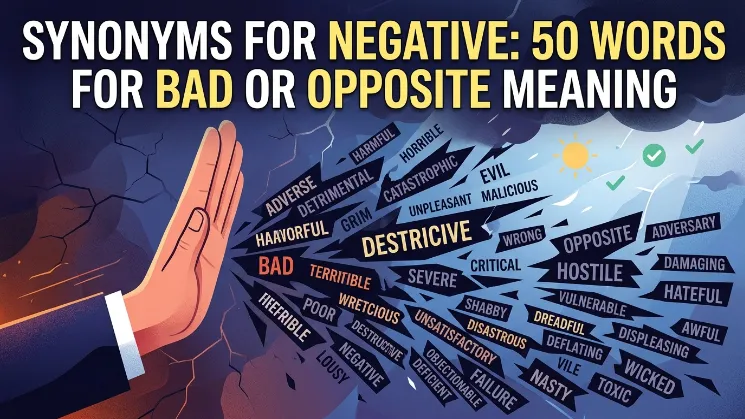
Negative means something bad, not good, harmful, or saying “no” or the opposite of something positive.
Have you ever had a day when everything felt wrong—bad mood, bad news, and negative thoughts? I remember a student who failed a test and kept saying, “I can’t do anything right.” His thinking became negative, and it affected his confidence. But once he changed his mindset, things slowly improved.
The word negative means something not good, harmful, or expressing “no” or the opposite of something positive. It can describe thoughts, behavior, results, or reactions.
For students, bloggers, content writers, and everyday English users, learning synonyms for negative is very useful. It helps you express emotions, situations, and ideas more clearly. Using different words instead of repeating “negative” makes your writing more natural, powerful, and engaging.
Bad
Meaning: Not good.
Examples:
He had a bad day.
The result was bad.
Poor
Meaning: Low quality or weak.
Examples:
She gave a poor performance.
The condition is poor.
Harmful
Meaning: Causing damage.
Examples:
Smoking is harmful.
Negative thoughts are harmful.
Damaging
Meaning: Causing harm or loss.
Examples:
His words were damaging.
The news had a damaging effect.
Unfavorable
Meaning: Not helpful or supportive.
Examples:
The conditions were unfavorable.
He got an unfavorable response.
Adverse
Meaning: Having a bad effect.
Examples:
Weather had an adverse impact.
She faced adverse conditions.
Detrimental
Meaning: Causing harm.
Examples:
Stress is detrimental to health.
It had a detrimental effect.
Pessimistic
Meaning: Expecting bad results.
Examples:
He is pessimistic about life.
She gave a pessimistic view.
Gloomy
Meaning: Sad and dark.
Examples:
He felt gloomy all day.
The mood was gloomy.
Depressing
Meaning: Making you feel sad.
Examples:
The news was depressing.
It was a depressing day.
Hopeless
Meaning: Without hope.
Examples:
He felt hopeless.
The situation seemed hopeless.
Discouraging
Meaning: Reducing confidence.
Examples:
The result was discouraging.
Her words were discouraging.
Critical
Meaning: Showing disapproval.
Examples:
He was critical of the work.
She gave a critical review.
Cynical
Meaning: Believing people are selfish.
Examples:
He has a cynical attitude.
She sounded cynical.
Doubtful
Meaning: Not sure or uncertain.
Examples:
I am doubtful about success.
His answer was doubtful.
Opposing
Meaning: Against something.
Examples:
He has opposing views.
They showed opposing ideas.
Contrary
Meaning: Opposite in nature.
Examples:
Her opinion was contrary.
The results were contrary.
Resistant
Meaning: Not accepting change.
Examples:
He was resistant to advice.
The system is resistant.
Unpleasant
Meaning: Not enjoyable.
Examples:
It was an unpleasant experience.
The smell was unpleasant.
Unhappy
Meaning: Not happy.
Examples:
She felt unhappy.
He looked unhappy.
Sad
Meaning: Feeling sorrow.
Examples:
He was sad.
The story was sad.
Angry
Meaning: Feeling strong displeasure.
Examples:
She felt angry.
He spoke in an angry tone.
Hostile
Meaning: Showing anger or opposition.
Examples:
The crowd was hostile.
He gave a hostile response.
Harsh
Meaning: Rough or strict.
Examples:
She gave harsh feedback.
The weather was harsh.
Severe
Meaning: Very serious.
Examples:
The damage was severe.
He faced severe problems.
Unlucky
Meaning: Having bad luck.
Examples:
It was an unlucky day.
He felt unlucky.
Unsuccessful
Meaning: Not achieving success.
Examples:
The attempt was unsuccessful.
She had an unsuccessful try.
Failing
Meaning: Not working properly.
Examples:
The plan is failing.
He is failing in exams.
Weak
Meaning: Not strong.
Examples:
His argument was weak.
She felt weak.
Low
Meaning: Not high or good.
Examples:
The score was low.
Energy levels were low.
Negative-minded
Meaning: Thinking badly.
Examples:
He is negative-minded.
Avoid negative-minded people.
Downbeat
Meaning: Feeling low or sad.
Examples:
She sounded downbeat.
The mood was downbeat.
Blue
Meaning: Feeling sad.
Examples:
He felt blue.
She looked blue today.
Dark
Meaning: Without hope.
Examples:
He had dark thoughts.
The future looked dark.
Bleak
Meaning: Without hope or good.
Examples:
The future seemed bleak.
It was a bleak day.
Grim
Meaning: Serious and worrying.
Examples:
The situation was grim.
He gave grim news.
Sour
Meaning: Not pleasant in attitude.
Examples:
He had a sour mood.
She gave a sour reply.
Bitter
Meaning: Full of anger or hurt.
Examples:
He felt bitter.
She gave a bitter comment.
Critical-minded
Meaning: Always finding faults.
Examples:
He is critical-minded.
She stays critical-minded.
Doubting
Meaning: Not believing easily.
Examples:
He is doubting.
She kept doubting results.
Rejecting
Meaning: Not accepting.
Examples:
He is rejecting ideas.
She kept rejecting offers.
Disapproving
Meaning: Not agreeing.
Examples:
He gave a disapproving look.
She was disapproving.
Opposite
Meaning: Completely different.
Examples:
This is the opposite result.
His view was opposite.
Anti
Meaning: Against something.
Examples:
He is anti-smoking.
They are anti-rules.
Unkind
Meaning: Not nice.
Examples:
His words were unkind.
She gave an unkind reply.
Mean
Meaning: Not kind.
Examples:
He was mean.
She gave a mean comment.
Rough
Meaning: Not smooth or gentle.
Examples:
He had a rough tone.
The day was rough.
Tough
Meaning: Difficult or hard.
Examples:
It was a tough time.
He faced a tough situation.
Problematic
Meaning: Causing problems.
Examples:
This plan is problematic.
The situation is problematic.
Risky
Meaning: Having danger.
Examples:
It is a risky move.
That decision was risky.
Conclusion
Learning synonyms for negative helps you express thoughts, feelings, and situations more clearly and effectively. These words improve writing, speaking, and communication by adding variety and depth. Students, writers, and professionals can use these synonyms in essays, blogs, and daily conversations. Practice these words regularly to make your English more natural, confident, and engaging.

I am Daniel Whitmore.I write about everyday English, common grammar mistakes, and word meanings. My goal is to make learning English simple, clear, and practical for everyone.