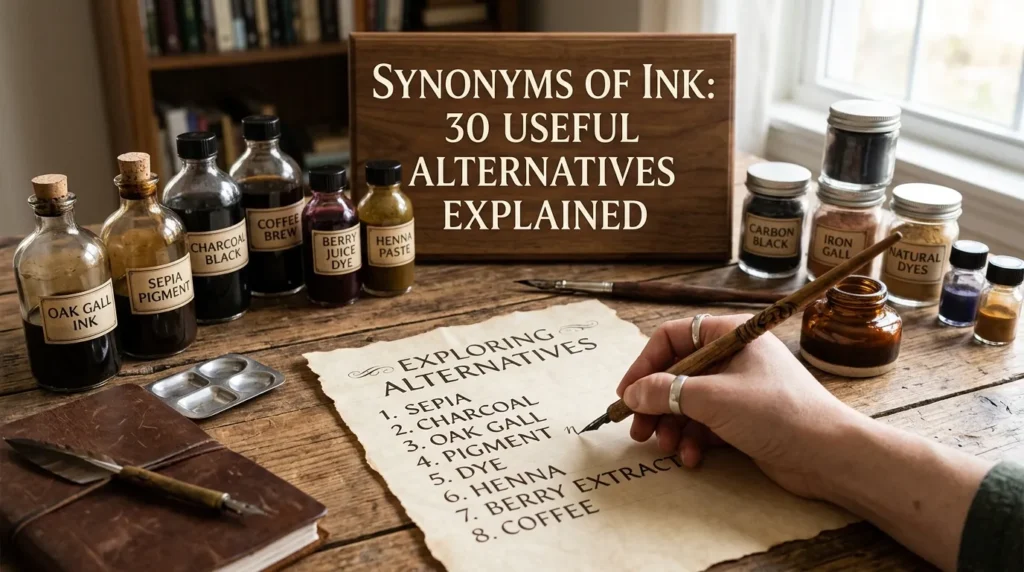
The word ink is commonly used when talking about writing, printing, drawing, and even tattoos. A student uses ink to write notes, an artist uses it to create beautiful illustrations, and a printer relies on ink to produce documents. Because this word appears in many areas of daily life, it is important for English learners to understand its meaning and related vocabulary. Learning synonyms helps writers avoid repetition and express ideas more accurately. It also improves speaking, reading, and writing skills. Whether you are a student, content writer, or language learner, knowing alternative words for ink can enrich your vocabulary. In this article, you will learn the meaning of ink, its pronunciation, history, grammar structure, and 30 useful synonyms with simple meanings and examples. You will also discover semantic categories, antonyms, and frequently asked questions about this widely used word.
Meaning of ink
Definition
Ink (Noun):
Ink is a colored liquid or paste used for writing, printing, drawing, or marking surfaces.
Examples
- She filled her pen with blue ink.
- The printer ran out of ink yesterday.
Connotative Meaning
- Positive tone: Suggests creativity, communication, and expression
- Negative tone: May suggest stains or permanent marks
- Neutral tone: Refers to a writing or printing substance
(Connotation: the emotional or implied meaning associated with a word beyond its dictionary definition)
Etymology
- Old English (450–1100): Derived from Old French and Latin influences related to coloring substances
- Middle English (1100–1500): Appeared as inke referring to writing fluid
- Modern English (1500–Present): Became the standard term for writing and printing liquid
Pronunciation (IPA)
- IPA: /ɪŋk/
- Syllables: ink
Affixation Pattern of ink
- Root: ink
- Prefix: None
- Suffix: None
- Word formations:
- Inky (adjective)
- Inked (adjective/verb)
- Inking (verb/noun)
- Inkpot (noun)
- Inkstand (noun)
- Inkjet (noun)
30 Synonyms of Ink With Meaning & Examples
1. Pigment (Noun)
Meaning: A coloring substance used in paints and inks.
Examples:
- The pigment gave the artwork bright color.
- Artists mixed pigment carefully.
2. Dye (Noun)
Meaning: A substance used to add color.
Examples:
- The dye stained the fabric.
- She used natural dye for the design.
3. Colorant (Noun)
Meaning: A substance that gives color.
Examples:
- The colorant was added to the mixture.
- Manufacturers use safe colorants.
4. Coloring (Noun)
Meaning: Material used to produce color.
Examples:
- The coloring changed the appearance.
- Food coloring is widely used.
5. Stain (Noun)
Meaning: A colored mark or substance.
Examples:
- The stain remained on the paper.
- Ink left a dark stain.
6. Tint (Noun)
Meaning: A slight coloring.
Examples:
- The tint made the design softer.
- Blue tint covered the page.
7. Paint (Noun)
Meaning: Colored liquid used for coating surfaces.
Examples:
- The artist applied paint carefully.
- Fresh paint covered the wall.
8. Marking Fluid (Noun)
Meaning: A liquid used to make marks.
Examples:
- The marking fluid dried quickly.
- Workers used marking fluid on boxes.
9. Writing Fluid (Noun)
Meaning: Liquid used for writing.
Examples:
- Ancient writing fluid came from plants.
- The writing fluid flowed smoothly.
10. Printing Dye (Noun)
Meaning: Coloring substance used in printing.
Examples:
- The printing dye produced sharp images.
- The machine needed more printing dye.
11. Toner (Noun)
Meaning: Powder used in laser printers.
Examples:
- The toner cartridge was empty.
- New toner improved print quality.
12. Coloring Matter (Noun)
Meaning: Material that creates color.
Examples:
- The coloring matter was natural.
- Scientists studied the coloring matter.
13. Pigmentation (Noun)
Meaning: The process or result of coloring.
Examples:
- The pigmentation looked rich.
- Good pigmentation improves artwork.
14. Wash (Noun)
Meaning: A thin layer of color.
Examples:
- The artist added a wash of color.
- A blue wash covered the drawing.
15. Blackening (Noun)
Meaning: A substance that makes something dark.
Examples:
- The blackening stained the paper.
- Traditional blackening was made from soot.
16. Coloring Agent (Noun)
Meaning: A substance that adds color.
Examples:
- The coloring agent was harmless.
- Manufacturers tested the coloring agent.
17. Soot Ink (Noun)
Meaning: Ink made from soot particles.
Examples:
- Ancient texts used soot ink.
- The soot ink lasted for years.
18. India Ink (Noun)
Meaning: A deep black writing ink.
Examples:
- The artist preferred India ink.
- India ink created bold lines.
19. Printer Ink (Noun)
Meaning: Ink designed for printers.
Examples:
- The printer ink was expensive.
- She replaced the printer ink.
20. Tattoo Ink (Noun)
Meaning: Ink used for tattoos.
Examples:
- The tattoo ink was safe.
- Artists choose quality tattoo ink.
21. Calligraphy Ink (Noun)
Meaning: Ink used for decorative writing.
Examples:
- The calligraphy ink flowed smoothly.
- He bought black calligraphy ink.
22. Drawing Ink (Noun)
Meaning: Ink used by artists.
Examples:
- Drawing ink created fine details.
- The artist used waterproof drawing ink.
23. Mark (Noun)
Meaning: A visible line or impression.
Examples:
- The mark remained on the page.
- Ink left a permanent mark.
24. Imprint (Noun)
Meaning: A mark left on a surface.
Examples:
- The imprint was clear.
- The stamp left an imprint.
25. Smudge (Noun)
Meaning: A blurred mark of ink.
Examples:
- The smudge ruined the letter.
- He cleaned the smudge quickly.
26. Scribble Medium (Noun)
Meaning: A substance used for casual writing.
Examples:
- The scribble medium dried fast.
- Children used the scribble medium.
27. Writing Medium (Noun)
Meaning: A material used for writing.
Examples:
- Ink is a common writing medium.
- Different writing mediums exist.
28. Graphic Medium (Noun)
Meaning: Material used for visual art.
Examples:
- Ink is a popular graphic medium.
- Artists experiment with graphic mediums.
29. Recording Fluid (Noun)
Meaning: Liquid used to record information.
Examples:
- The recording fluid was dark blue.
- Ancient cultures used recording fluids.
30. Manuscript Ink (Noun)
Meaning: Ink used for handwritten documents.
Examples:
- The manuscript ink remained visible.
- Historians studied the manuscript ink.
Prototype Meaning
When people hear the word ink, they usually imagine a dark liquid inside a pen that is used for writing words, drawing pictures, or printing documents.
Prototype Categorization
- Writing-related synonyms: writing fluid, calligraphy ink, manuscript ink, writing medium
- Printing-related synonyms: printer ink, toner, printing dye
- Art-related synonyms: pigment, paint, drawing ink, graphic medium
- Coloring substances: dye, colorant, coloring agent, coloring matter
- Marks and effects: stain, mark, imprint, smudge
This categorization helps writers choose the most suitable synonym depending on whether the context involves writing, printing, art, or coloring.
Antonyms of ink
Eraser (Noun)
A tool used to remove marks.
Cleaner (Noun)
A substance that removes stains.
Bleach (Noun)
A chemical used to remove color.
Solvent (Noun)
A liquid that dissolves substances.
Blankness (Noun)
The state of having no writing or marks.
Short Questions and Answers
What does ink mean?
Ink is a colored liquid or paste used for writing, printing, or drawing.
When should ink be used?
It should be used when referring to writing, printing, marking, or artistic coloring substances.
Is ink positive or negative?
It is generally neutral, though it can have positive or negative meanings depending on context.
How is it different from similar words?
Ink is specifically made for writing and printing, while words like paint or dye are used for broader coloring purposes.
Conclusion
Learning the word ink and its synonyms can greatly improve your English vocabulary. These alternatives help you describe writing materials, artistic tools, printing substances, and coloring agents with greater accuracy. Instead of repeating the word ink, you can choose more specific terms such as pigment, toner, calligraphy ink, or drawing ink depending on the situation. This makes communication more precise and engaging.
Expanding your vocabulary also improves reading comprehension, writing quality, and speaking confidence. By practicing these synonyms regularly, you will become more comfortable using varied and expressive language. Keep learning new words every day to strengthen your English skills and communicate more effectively.

I am Daniel Whitmore.I write about everyday English, common grammar mistakes, and word meanings. My goal is to make learning English simple, clear, and practical for everyone.