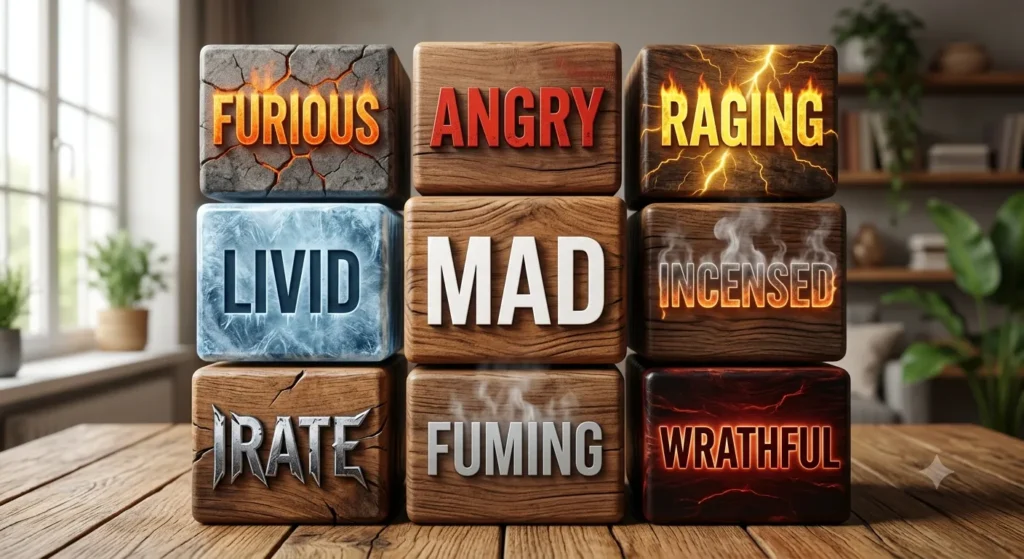
The word mad is a common English adjective with several meanings. It can describe someone who feels angry, behaves in a mentally unstable way, or is extremely enthusiastic about something. Imagine waiting in traffic for an hour and missing an important meeting. You might say, “I’m so mad!” Because this word has different meanings, it appears often in daily conversations, books, movies, and online writing.
Learning synonyms for mad helps English learners speak more naturally and helps writers avoid repeating the same word. It also allows you to choose the best word for different situations. In this guide, you will learn the meaning of mad, its pronunciation, grammar, history, word formation, and 30 useful synonyms with meanings and examples. You will also explore semantic categories, antonyms, and common questions to improve your vocabulary.
Meaning of Synonyms for mad
Definition
Mad (Adjective): Feeling very angry, mentally ill, or extremely enthusiastic about someone or something, depending on the context.
Examples
- She was mad because someone broke her favorite mug.
- My brother is mad about football.
Connotative Meaning
(Connotation: the emotional or cultural feeling a word carries in addition to its dictionary meaning.)
- Positive tone: Extremely enthusiastic or passionate.
- Negative tone: Very angry or mentally unstable.
- Neutral tone: Describing someone’s emotional state without judgment.
Etymology
The word mad has changed in meaning over time.
- Old English (450–1100): gemǣd meaning foolish, insane, or out of one’s mind.
- Middle English (1100–1500): Used mainly to describe insanity or irrational behavior.
- Modern English (1500–Present): Expanded to include meanings such as angry and extremely enthusiastic.
Pronunciation (IPA)
- IPA: /mæd/
- Syllables: mad
Affixation Pattern of Mad
- Root: mad
- Prefix: None
- Suffix: None
Word Formations
- mad (adjective)
- madly (adverb)
- madness (noun)
- madden (verb)
- maddening (adjective)
- maddeningly (adverb)
30 Synonyms of Mad With Meaning & Examples
1. Angry (Adjective)
Meaning: Feeling strong displeasure.
Examples:
- She became angry after hearing the news.
- He looked angry but stayed quiet.
2. Furious (Adjective)
Meaning: Extremely angry.
Examples:
- Dad was furious about the broken window.
- She gave him a furious look.
3. Enraged (Adjective)
Meaning: Filled with intense anger.
Examples:
- The customer was enraged by the poor service.
- He became enraged after the argument.
4. Annoyed (Adjective)
Meaning: Slightly angry or bothered.
Examples:
- I felt annoyed by the loud music.
- She looked annoyed during the meeting.
5. Irritated (Adjective)
Meaning: Feeling impatient or mildly angry.
Examples:
- He was irritated by the delay.
- The buzzing fly irritated her.
6. Upset (Adjective)
Meaning: Emotionally disturbed or unhappy.
Examples:
- She was upset after losing her keys.
- He looked upset all day.
7. Cross (Adjective)
Meaning: Slightly angry.
Examples:
- Mom was cross with us.
- Don’t be cross over a small mistake.
8. Heated (Adjective)
Meaning: Full of strong emotion or anger.
Examples:
- They had a heated discussion.
- The debate became heated.
9. Agitated (Adjective)
Meaning: Nervous and angry.
Examples:
- The crowd became agitated.
- She felt agitated before speaking.
10. Outraged (Adjective)
Meaning: Very shocked and angry.
Examples:
- People were outraged by the decision.
- She felt outraged by the unfair rule.
11. Indignant (Adjective)
Meaning: Angry because something is unfair.
Examples:
- He felt indignant about the accusation.
- She gave an indignant reply.
12. Resentful (Adjective)
Meaning: Feeling lasting anger.
Examples:
- He remained resentful for years.
- She sounded resentful.
13. Frustrated (Adjective)
Meaning: Angry because something cannot be achieved.
Examples:
- I felt frustrated with the slow computer.
- Students became frustrated.
14. Exasperated (Adjective)
Meaning: Extremely annoyed.
Examples:
- She sounded exasperated.
- His behavior exasperated everyone.
15. Infuriated (Adjective)
Meaning: Made extremely angry.
Examples:
- The lie infuriated her.
- He was infuriated by the mistake.
16. Livid (Adjective)
Meaning: Extremely angry.
Examples:
- She was livid after the accident.
- He looked absolutely livid.
17. Wrathful (Adjective)
Meaning: Full of great anger.
Examples:
- The king became wrathful.
- His wrathful voice frightened everyone.
18. Irate (Adjective)
Meaning: Very angry.
Examples:
- An irate customer complained.
- The coach became irate.
19. Fuming (Adjective)
Meaning: Showing intense anger.
Examples:
- She was fuming after work.
- He left the room fuming.
20. Seething (Adjective)
Meaning: Filled with hidden anger.
Examples:
- She was seething inside.
- He remained seething all day.
21. Crazy (Adjective)
Meaning: Mentally unstable or unusual.
Examples:
- That’s a crazy idea.
- He acted crazy.
22. Insane (Adjective)
Meaning: Mentally ill or extremely unreasonable.
Examples:
- The plan sounded insane.
- Doctors treated the insane patient.
23. Unbalanced (Adjective)
Meaning: Mentally unstable.
Examples:
- The man appeared unbalanced.
- She seemed emotionally unbalanced.
24. Deranged (Adjective)
Meaning: Seriously mentally disturbed.
Examples:
- The story involved a deranged character.
- Police arrested the deranged attacker.
25. Delirious (Adjective)
Meaning: Confused because of illness or excitement.
Examples:
- He became delirious with fever.
- Fans were delirious with joy.
26. Passionate (Adjective)
Meaning: Having strong enthusiasm.
Examples:
- She is passionate about art.
- He is passionate about teaching.
27. Enthusiastic (Adjective)
Meaning: Very interested and excited.
Examples:
- Students were enthusiastic.
- She gave an enthusiastic speech.
28. Obsessed (Adjective)
Meaning: Thinking constantly about something.
Examples:
- He’s obsessed with cars.
- She’s obsessed with fashion.
29. Fanatical (Adjective)
Meaning: Showing extreme enthusiasm.
Examples:
- He is fanatical about cricket.
- They are fanatical supporters.
30. Wild (Adjective)
Meaning: Extremely excited or uncontrolled.
Examples:
- The crowd went wild.
- Children became wild with excitement.
Prototype Meaning
The most common meaning of mad is very angry. When people hear this word, they usually imagine someone who is upset because of something unfair, disappointing, or frustrating. In everyday American English, mad most often means angry, while in some forms of British English it may also mean mentally ill or insane.
Read More:
Synonyms for Sexy: 30 Attractive Alternatives to Know
Prototype Categorization
The 30 synonyms can be grouped into meaningful semantic categories.
- Strong anger: Furious, Enraged, Infuriated, Livid, Wrathful, Irate, Fuming, Seething.
- Mild anger: Angry, Annoyed, Irritated, Cross, Upset, Heated, Agitated.
- Anger from unfairness: Outraged, Indignant, Resentful, Frustrated, Exasperated.
- Mental instability: Crazy, Insane, Unbalanced, Deranged, Delirious.
- Strong enthusiasm: Passionate, Enthusiastic, Obsessed, Fanatical, Wild.
These categories help writers and speakers choose the most accurate synonym for different emotions and situations.
Antonyms of Mad
Calm (Adjective)
- Free from anger or excitement.
Peaceful (Adjective)
- Quiet and relaxed.
Happy (Adjective)
- Feeling joy and pleasure.
Pleased (Adjective)
- Feeling satisfied.
Rational (Adjective)
- Thinking clearly and logically.
Sane (Adjective)
- Mentally healthy.
Composed (Adjective)
- Calm and self-controlled.
Short Questions and Answers
What does mad mean?
Mad means very angry, mentally unstable, or extremely enthusiastic, depending on the context.
When should mad be used?
Use mad when describing anger, strong excitement, or, in some contexts, mental instability.
Is mad positive or negative?
It can be both. It is negative when describing anger or mental illness, but positive when it means being enthusiastic about something.
How is it different from similar words?
Mad is a broad word with several meanings, while words like furious, crazy, and passionate each express one specific meaning.
Conclusion
Learning synonyms for mad helps you express emotions more clearly and naturally. Instead of repeating the same word, you can choose from many alternatives that match the exact feeling or situation. This improves your writing, makes your speaking more interesting, and helps readers understand your message better. Knowing the different meanings of mad, along with its pronunciation, history, grammar, and semantic categories, also strengthens your overall English skills. Whether you are an English learner, student, teacher, or content writer, expanding your vocabulary builds confidence and improves communication. Practice using one or two new synonyms every day in sentences and conversations to make them part of your active vocabulary.

I’m an English language writer with over 10 years of experience specializing in synonyms, vocabulary, and English usage. My articles are thoroughly researched, SEO-optimized, and written to deliver accurate, trustworthy, and easy-to-understand information. I’m passionate about helping students, writers, professionals, and ESL learners expand their vocabulary and improve their communication skills. Every guide is designed to provide practical value, clear explanations, and reliable language insights readers can trust.