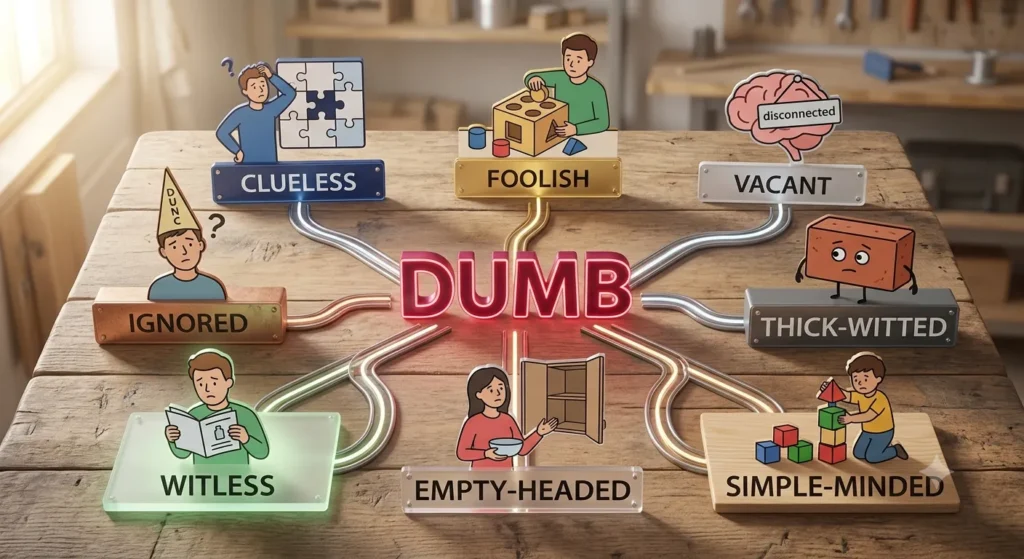
The word dumb is a common English adjective with several meanings. Traditionally, it meant unable to speak, but today it is more often used to describe someone or something as lacking intelligence or showing poor judgment. For example, someone might say, “That was a dumb mistake,” after forgetting an important appointment. Because this word can sound rude or offensive when used to describe a person, choosing a more suitable synonym is often a better option. Learning synonyms for dumb helps English learners improve their vocabulary and helps writers avoid repeating the same word. It also makes communication more accurate and respectful. In this guide, you will learn the meaning of dumb, its pronunciation, grammar, history, word formation, and 30 useful synonyms with meanings and examples. You will also explore semantic categories, antonyms, and common questions to strengthen your English skills.
Meaning of Dumb
Definition
Dumb (Adjective): Lacking intelligence or good judgment; traditionally, unable to speak.
Examples
- That was a dumb mistake.
- He made a dumb decision without thinking.
Connotative Meaning
(Connotation: the emotional or cultural feeling a word carries in addition to its dictionary meaning.)
- Positive tone: Rarely positive; sometimes used humorously among friends.
- Negative tone: Insulting, disrespectful, or critical.
- Neutral tone: Historically meant unable to speak, though this meaning is now less common.
Etymology
The word dumb has changed in meaning over time.
- Old English (450–1100): dumb, meaning silent or unable to speak.
- Middle English (1100–1500): Continued to mean speechless or mute.
- Modern English (1500–Present): Expanded to describe someone as unintelligent or showing poor judgment, especially in informal English.
Pronunciation (IPA)
- IPA: /dʌm/
- Syllables: dumb
Affixation Pattern of Dumb
- Root: dumb
- Prefix: None
- Suffix: None
Word Formations
- dumb (adjective)
- dumbly (adverb)
- dumbness (noun)
- dumbfound (verb)
- dumbfounded (adjective)
- dumbfounding (adjective)
30 Synonyms of Dumb With Meaning & Examples
1. Stupid (Adjective)
Meaning: Lacking intelligence or good judgment.
Examples:
- That was a stupid mistake.
- Don’t ask stupid questions.
2. Foolish (Adjective)
Meaning: Showing poor judgment.
Examples:
- It was a foolish decision.
- He felt foolish afterward.
3. Silly (Adjective)
Meaning: Lacking good sense in a playful or careless way.
Examples:
- The joke was silly.
- Stop making silly excuses.
4. Unwise (Adjective)
Meaning: Not showing good judgment.
Examples:
- It was unwise to ignore the warning.
- She made an unwise choice.
5. Ignorant (Adjective)
Meaning: Lacking knowledge about something.
Examples:
- He was ignorant of the rules.
- Don’t remain ignorant of the facts.
6. Naive (Adjective)
Meaning: Too trusting because of little experience.
Examples:
- She was naive about business.
- His naive attitude caused problems.
7. Simple-minded (Adjective)
Meaning: Not thinking in a complex way.
Examples:
- The explanation was simple-minded.
- He seemed simple-minded.
8. Witless (Adjective)
Meaning: Without intelligence or good sense.
Examples:
- The plan was witless.
- Everyone criticized the witless idea.
9. Brainless (Adjective)
Meaning: Very foolish or thoughtless.
Examples:
- That was a brainless move.
- He made a brainless comment.
10. Mindless (Adjective)
Meaning: Done without careful thought.
Examples:
- Mindless violence hurts everyone.
- It was a mindless mistake.
11. Dense (Adjective)
Meaning: Slow to understand.
Examples:
- He felt dense during the lesson.
- Don’t be so dense.
12. Slow-witted (Adjective)
Meaning: Slow to understand ideas.
Examples:
- The character was slow-witted.
- He appeared slow-witted.
13. Obtuse (Adjective)
Meaning: Slow to understand or notice.
Examples:
- Don’t be obtuse.
- She seemed obtuse about the problem.
14. Clueless (Adjective)
Meaning: Having no understanding.
Examples:
- I’m clueless about coding.
- He looked completely clueless.
15. Dim (Adjective)
Meaning: Not very intelligent.
Examples:
- The movie portrayed him as dim.
- She isn’t dim, just inexperienced.
16. Idiotic (Adjective)
Meaning: Extremely foolish.
Examples:
- That was an idiotic decision.
- He made an idiotic remark.
17. Absurd (Adjective)
Meaning: Completely unreasonable.
Examples:
- The claim was absurd.
- That’s an absurd idea.
18. Ridiculous (Adjective)
Meaning: Extremely silly or unreasonable.
Examples:
- The price is ridiculous.
- His excuse sounded ridiculous.
19. Inane (Adjective)
Meaning: Lacking meaning or intelligence.
Examples:
- They had an inane conversation.
- The comment was inane.
20. Vacuous (Adjective)
Meaning: Showing little intelligence or thought.
Examples:
- She gave a vacuous smile.
- His answer sounded vacuous.
21. Empty-headed (Adjective)
Meaning: Not thinking carefully.
Examples:
- The character seemed empty-headed.
- It was an empty-headed remark.
22. Half-baked (Adjective)
Meaning: Poorly planned or thought out.
Examples:
- That was a half-baked idea.
- The proposal was half-baked.
23. Reckless (Adjective)
Meaning: Acting without thinking about danger.
Examples:
- Reckless driving is dangerous.
- His reckless actions caused trouble.
24. Careless (Adjective)
Meaning: Not paying enough attention.
Examples:
- She was careless with her homework.
- A careless mistake cost the game.
25. Thoughtless (Adjective)
Meaning: Not considering others or the results.
Examples:
- His thoughtless words hurt her.
- It was a thoughtless action.
26. Unthinking (Adjective)
Meaning: Acting without careful thought.
Examples:
- He made an unthinking decision.
- The response was unthinking.
27. Unintelligent (Adjective)
Meaning: Not showing intelligence.
Examples:
- The statement sounded unintelligent.
- He appeared unintelligent.
28. Gullible (Adjective)
Meaning: Easily fooled.
Examples:
- Gullible people believe fake stories.
- She was too gullible.
29. Childish (Adjective)
Meaning: Acting in an immature way.
Examples:
- His behavior was childish.
- Stop making childish jokes.
30. Immature (Adjective)
Meaning: Not fully developed in judgment.
Examples:
- He made an immature choice.
- Her response was immature.
Prototype Meaning
The most common meaning of dumb is lacking intelligence or showing poor judgment. When people hear this word today, they usually imagine someone making an obvious mistake or acting without thinking. However, because the word can be offensive, many speakers prefer more specific and respectful alternatives such as careless, unwise, or inexperienced, depending on the situation.
Prototype Categorization
The 30 synonyms can be grouped into meaningful semantic categories.
- Low intelligence: Stupid, Witless, Brainless, Dense, Dim, Unintelligent, Obtuse.
- Poor judgment: Foolish, Unwise, Reckless, Careless, Thoughtless, Unthinking, Half-baked.
- Lack of knowledge: Ignorant, Naive, Clueless, Gullible.
- Immature behavior: Silly, Childish, Immature.
- Extreme foolishness: Idiotic, Ridiculous, Absurd, Inane, Vacuous, Empty-headed, Mindless, Slow-witted, Simple-minded.
These categories help writers choose the most appropriate synonym based on whether they mean lack of knowledge, poor judgment, or low intelligence.
Antonyms of Dumb
Intelligent (Adjective)
- Having a high level of intelligence.
Smart (Adjective)
- Quick to understand and learn.
Wise (Adjective)
- Showing good judgment.
Clever (Adjective)
- Quick at thinking and solving problems.
Bright (Adjective)
- Intelligent and quick to learn.
Knowledgeable (Adjective)
- Well informed and educated.
Sensible (Adjective)
- Showing good judgment and practical thinking.
Short Questions and Answers
What does dumb mean?
Dumb usually means lacking intelligence or showing poor judgment. Historically, it also meant unable to speak.
When should dumb be used?
Use dumb mainly in informal situations. Be careful when describing people because it can sound rude or offensive.
Is dumb positive or negative?
It is generally negative, especially when describing a person’s intelligence or decisions.
How is it different from similar words?
Dumb is a broad informal word. More specific words like careless, naive, ignorant, or unwise explain the exact reason for the mistake or behavior.
Conclusion
Learning synonyms for dumb helps you communicate more accurately and respectfully. Instead of using one broad word repeatedly, you can choose alternatives that better describe poor judgment, lack of knowledge, or immature behavior. This makes your writing clearer, your speaking more natural, and your vocabulary stronger. Understanding the meaning, pronunciation, history, grammar, and semantic categories of dumb also helps you use the word appropriately in different contexts. Whether you are an English learner, student, or writer, practicing these synonyms every day will improve your confidence and make your communication more effective. Expanding your vocabulary is one of the best ways to become a better English speaker and writer.

I’m an English language writer with over 10 years of experience specializing in synonyms, vocabulary, and English usage. My articles are thoroughly researched, SEO-optimized, and written to deliver accurate, trustworthy, and easy-to-understand information. I’m passionate about helping students, writers, professionals, and ESL learners expand their vocabulary and improve their communication skills. Every guide is designed to provide practical value, clear explanations, and reliable language insights readers can trust.