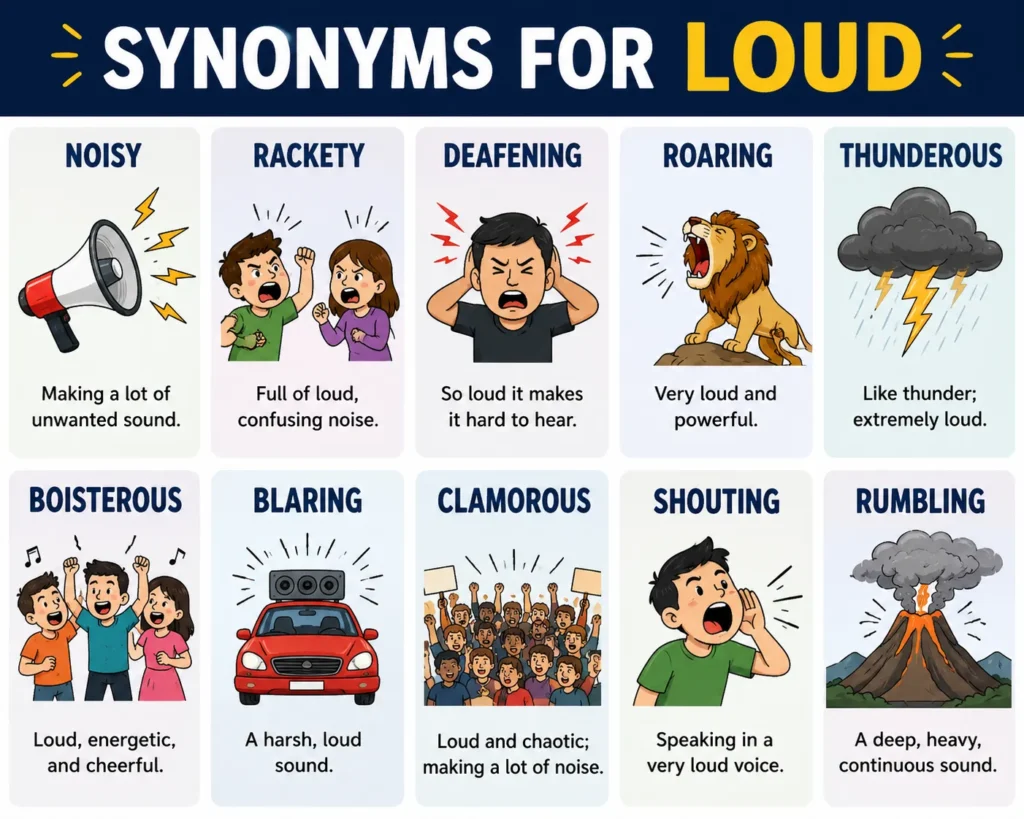
The word loud describes something that makes a strong, high level of sound or attracts attention because it is bright, bold, or noticeable. Imagine sitting in a quiet library when someone suddenly speaks in a loud voice. Everyone quickly looks up because the sound is impossible to ignore. We use this word every day when talking about music, voices, traffic, colors, or behavior.
Learning the synonyms of loud helps English learners, students, writers, and content creators avoid repeating the same word. It also makes speaking and writing more natural and interesting. In this article, you will learn the meaning of loud, its pronunciation, grammar, history, word formation, and 30 useful synonyms with meanings and examples. You will also discover antonyms, semantic categories, and common questions to improve your English vocabulary.
Meaning of Loud
Definition
Loud (Adjective):
Producing a strong, high, or easily heard sound, or being very noticeable.
Examples
- The children were loud during the school break.
- Please turn the loud music down.
Connotative Meaning
(Connotation: the emotional or cultural feeling that a word suggests beyond its dictionary meaning.)
Positive tone: Loud applause showed great support.
Negative tone: The loud noise disturbed everyone.
Neutral tone: The loud bell rang at noon.
Etymology
Old English (450–1100):
The word loud comes from Old English hlūd, meaning “making a strong sound” or “audible.”
Middle English (1100–1500):
The spelling changed from hlūd to loud, while the meaning remained almost the same.
Modern English (1500–Present):
Today, loud describes strong sounds, bright colors, bold clothing, or attention-grabbing behavior.
Pronunciation (IPA)
- IPA: /laʊd/
- Syllables: loud (1 syllable)
Affixation Pattern of Loud
- Root: loud
- Prefix: None
- Suffix: None
Word Formations
- Loud (Adjective)
- Loudly (Adverb)
- Loudness (Noun)
- Outloud / Aloud (Adverb – related forms)
30 Synonyms of Loud With Meaning & Examples
1. Noisy (Adjective)
Meaning: Making a lot of sound.
Examples:
- The market was noisy all day.
- My neighbors are very noisy.
2. Deafening (Adjective)
Meaning: Extremely loud.
Examples:
- The explosion was deafening.
- The crowd gave a deafening cheer.
3. Thunderous (Adjective)
Meaning: Very powerful and booming.
Examples:
- Thunderous applause filled the hall.
- A thunderous crash woke us.
4. Booming (Adjective)
Meaning: Deep and loud.
Examples:
- He has a booming voice.
- The drums sounded booming.
5. Blaring (Adjective)
Meaning: Loud and unpleasant.
Examples:
- The alarm kept blaring.
- Loud music was blaring outside.
6. Piercing (Adjective)
Meaning: Sharp and painfully loud.
Examples:
- A piercing scream echoed.
- The whistle was piercing.
7. Raucous (Adjective)
Meaning: Loud, rough, and noisy.
Examples:
- The fans became raucous.
- We heard raucous laughter.
8. Roaring (Adjective)
Meaning: Very loud like a lion or engine.
Examples:
- The crowd was roaring.
- We heard roaring waves.
9. Resounding (Adjective)
Meaning: Loud and echoing.
Examples:
- A resounding clap followed.
- The bell gave a resounding ring.
10. Shrill (Adjective)
Meaning: High-pitched and loud.
Examples:
- She gave a shrill cry.
- The phone made a shrill sound.
11. Ear-splitting (Adjective)
Meaning: Extremely loud and painful.
Examples:
- Ear-splitting fireworks exploded.
- The siren was ear-splitting.
12. Clamorous (Adjective)
Meaning: Loud with many voices.
Examples:
- The crowd became clamorous.
- Children were clamorous.
13. Vociferous (Adjective)
Meaning: Very loud in expressing opinions.
Examples:
- The audience was vociferous.
- He gave a vociferous reply.
14. Obstreperous (Adjective)
Meaning: Loud and difficult to control.
Examples:
- The students became obstreperous.
- The crowd grew obstreperous.
15. Uproarious (Adjective)
Meaning: Extremely noisy and lively.
Examples:
- Everyone enjoyed uproarious laughter.
- The party became uproarious.
16. Stentorian (Adjective)
Meaning: Exceptionally powerful voice.
Examples:
- The teacher had a stentorian voice.
- His stentorian call reached everyone.
17. Resonant (Adjective)
Meaning: Deep, rich, and loud.
Examples:
- His resonant voice impressed us.
- The bell sounded resonant.
18. Sonorous (Adjective)
Meaning: Full, rich, and pleasant.
Examples:
- She spoke in a sonorous voice.
- The choir sounded sonorous.
19. Strident (Adjective)
Meaning: Loud, harsh, and unpleasant.
Examples:
- The argument became strident.
- Strident voices filled the room.
20. Barking (Adjective)
Meaning: Spoken loudly and sharply.
Examples:
- He gave barking orders.
- The officer used a barking voice.
21. Explosive (Adjective)
Meaning: Sudden and very loud.
Examples:
- An explosive sound startled us.
- The applause was explosive.
22. Echoing (Adjective)
Meaning: Loud enough to repeat in an area.
Examples:
- Echoing footsteps filled the hall.
- We heard echoing laughter.
23. Tumultuous (Adjective)
Meaning: Very noisy and disorderly.
Examples:
- The meeting became tumultuous.
- Tumultuous cheers followed.
24. Clanging (Adjective)
Meaning: Making a loud metal sound.
Examples:
- Clanging bells rang.
- We heard clanging machines.
25. Thundering (Adjective)
Meaning: Extremely loud and powerful.
Examples:
- A thundering voice echoed.
- Thundering applause continued.
26. Hectic (Adjective)
Meaning: Very busy and noisy.
Examples:
- The office was hectic.
- It was a hectic street.
27. Bustling (Adjective)
Meaning: Full of busy activity and sound.
Examples:
- The bustling market was crowded.
- We walked through bustling streets.
28. Blusterous (Adjective)
Meaning: Loud and forceful.
Examples:
- His blusterous speech continued.
- They made blusterous claims.
29. Rowdy (Adjective)
Meaning: Noisy and disorderly.
Examples:
- The fans became rowdy.
- The children were rowdy.
30. Obnoxious (Adjective)
Meaning: Annoyingly loud or unpleasant.
Examples:
- The music was obnoxiously loud.
- His obnoxious shouting upset everyone.
Prototype Meaning
The typical meaning of loud is making a strong sound that is easy to hear from a distance. Most people imagine a person shouting, loud music, a ringing bell, thunder, or fireworks when they hear this word.
Prototype Categorization
The synonyms can be grouped into useful semantic categories.
- Very Loud Sounds: Deafening, Ear-splitting, Thunderous, Thundering, Explosive.
- Voices: Booming, Resonant, Sonorous, Stentorian, Barking.
- Harsh or Unpleasant Sounds: Shrill, Blaring, Strident, Piercing, Clanging.
- Crowds and Groups: Raucous, Vociferous, Clamorous, Tumultuous, Rowdy, Uproarious.
- Busy Places: Bustling, Hectic, Echoing.
- General Strong Sound: Noisy, Roaring, Resounding, Blusterous, Obnoxious, Obstreperous.
This categorization helps writers choose the most accurate synonym based on the situation instead of using loud repeatedly.
Antonyms of Loud
Quiet (Adjective)
Making very little sound.
Silent (Adjective)
Making no sound.
Soft (Adjective)
Low in volume.
Gentle (Adjective)
Calm and not harsh.
Faint (Adjective)
Difficult to hear.
Whispering (Adjective)
Speaking very quietly.
Muted (Adjective)
Reduced in sound.
Low (Adjective)
Not loud in volume.
Hushed (Adjective)
Very quiet.
Soundless (Adjective)
Without any sound.
Short Questions and Answers
What does loud mean?
It means making a strong or easily heard sound.
When should loud be used?
Use it when describing strong sounds, voices, music, or anything that attracts attention.
Is loud positive or negative?
It can be positive, negative, or neutral depending on the situation. Loud applause is positive, while loud noise at night is negative.
How is it different from similar words?
Loud is a general word. Synonyms like deafening, shrill, or booming describe specific kinds of loud sounds.
Conclusion
Learning synonyms of loud is an excellent way to improve your English vocabulary and communicate more effectively. Instead of repeating the same word, you can choose precise alternatives like booming, deafening, shrill, or resonant to match different situations. This makes your writing more interesting and your speaking more expressive. Understanding the meaning, pronunciation, history, and semantic categories of loud also helps you use the word correctly in everyday conversations, academic writing, and creative work. Keep practicing new vocabulary every day, use these synonyms in your own sentences, and review them regularly. Small daily efforts will build stronger English skills and greater confidence over time.
Read More:
Synonyms of Your: 30 Common Alternatives & Related Words

I’m an English language writer with over 10 years of experience specializing in synonyms, vocabulary, and English usage. My articles are thoroughly researched, SEO-optimized, and written to deliver accurate, trustworthy, and easy-to-understand information. I’m passionate about helping students, writers, professionals, and ESL learners expand their vocabulary and improve their communication skills. Every guide is designed to provide practical value, clear explanations, and reliable language insights readers can trust.