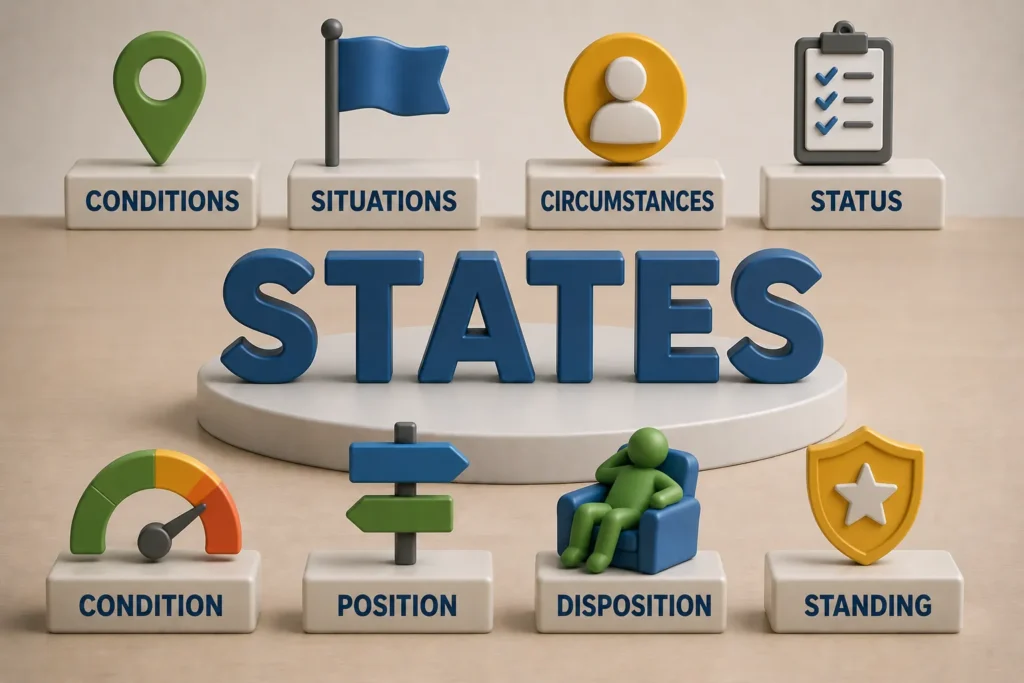
Synonyms for states help you express the idea of saying, declaring, explaining, or expressing information. The word states is the third-person singular form of the verb state, and it is commonly used in conversations, academic writing, legal documents, journalism, and business communication. For example, a report states an important fact, or a speaker states an opinion during a meeting. Since this word appears frequently in formal and everyday English, learning its synonyms helps you write more clearly and avoid repetition.
Understanding synonyms for states is valuable for English learners, students, bloggers, and content writers. A broader vocabulary improves writing, speaking, and professional communication while helping you choose the most suitable word for each context. In this article, you’ll learn the meaning of states, its definition, pronunciation, history, grammar, and 30 useful synonyms with meanings and examples. You’ll also explore semantic categories, antonyms, and common questions to strengthen your English vocabulary.
Meaning of Synonyms for States
Definition
States (Verb):
States means clearly says, expresses, declares, or presents information or an opinion.
Examples
- The report states that sales increased this year.
- She states her opinion with confidence.
Connotative Meaning
(Connotation: the emotional or cultural feeling a word suggests beyond its dictionary meaning.)
Positive tone: Suggests clarity, confidence, and honesty.
Negative tone: Can imply being overly formal or blunt in some situations.
Neutral tone: Simply means expressing or saying something.
Etymology
Old English (450–1100):
The exact verb state was not used in Old English.
Middle English (1100–1500):
It entered English through Old French estat and Latin influences.
Modern English (1500–Present):
Derived from Latin status, meaning “condition” or “position.” The verb state later developed the meaning “to express clearly.”
Pronunciation (IPA)
- IPA: /steɪts/
- Syllables: states
Affixation Pattern of States
- Root: state
- Prefix: None
- Suffix: -s (third-person singular verb ending)
Word Formations
- State (Verb) – to express clearly
- State (Noun) – a condition or political region
- States (Verb) – expresses clearly
- Stated (Verb) – expressed
- Stating (Verb) – expressing
- Statement (Noun) – something that is said
- Stateless (Adjective) – without citizenship
- Statehood (Noun) – status as a state
30 Synonyms of States With Meaning & Examples
1. Says (Verb)
Meaning: Expresses something in words.
Examples:
- She says hello every morning.
- The sign says “No Parking.”
2. Declares (Verb)
Meaning: Announces something clearly and officially.
Examples:
- The judge declares the decision.
- He declares his support openly.
3. Announces (Verb)
Meaning: Makes information known publicly.
Examples:
- The company announces new products.
- She announces the winners.
4. Explains (Verb)
Meaning: Makes something easy to understand.
Examples:
- The teacher explains the lesson.
- He explains the rules clearly.
5. Expresses (Verb)
Meaning: Shows thoughts or feelings.
Examples:
- She expresses her gratitude.
- He expresses concern.
6. Mentions (Verb)
Meaning: Refers to something briefly.
Examples:
- She mentions the meeting.
- He mentions your name.
7. Notes (Verb)
Meaning: Points out information.
Examples:
- The report notes the changes.
- She notes an important detail.
8. Reports (Verb)
Meaning: Gives information.
Examples:
- The newspaper reports the news.
- He reports the findings.
9. Affirms (Verb)
Meaning: States something confidently.
Examples:
- She affirms her commitment.
- He affirms the facts.
10. Confirms (Verb)
Meaning: Verifies that something is true.
Examples:
- She confirms the booking.
- The doctor confirms the diagnosis.
11. Asserts (Verb)
Meaning: States firmly.
Examples:
- He asserts his rights.
- She asserts her opinion.
12. Claims (Verb)
Meaning: Says something is true.
Examples:
- He claims innocence.
- The company claims success.
13. Maintains (Verb)
Meaning: Continues to state something.
Examples:
- She maintains her position.
- He maintains that he is right.
14. Declares Publicly (Verb Phrase)
Meaning: Announces openly.
Examples:
- The mayor declares publicly.
- She declares publicly her support.
15. Reveals (Verb)
Meaning: Makes something known.
Examples:
- The study reveals new facts.
- She reveals the surprise.
16. Indicates (Verb)
Meaning: Shows or points to something.
Examples:
- The report indicates growth.
- The sign indicates danger.
17. Specifies (Verb)
Meaning: Gives exact details.
Examples:
- The contract specifies the terms.
- He specifies the requirements.
18. Describes (Verb)
Meaning: Gives details about something.
Examples:
- She describes the event.
- He describes the problem.
19. Identifies (Verb)
Meaning: Recognizes or names.
Examples:
- The report identifies key issues.
- She identifies the winner.
20. Outlines (Verb)
Meaning: Gives the main points.
Examples:
- The guide outlines the process.
- He outlines his plan.
21. Proclaims (Verb)
Meaning: Announces officially.
Examples:
- The king proclaims peace.
- She proclaims her victory.
22. Voices (Verb)
Meaning: Expresses opinions aloud.
Examples:
- He voices concern.
- She voices her ideas.
23. Utters (Verb)
Meaning: Speaks words.
Examples:
- She utters a greeting.
- He utters no complaint.
24. Articulates (Verb)
Meaning: Expresses clearly.
Examples:
- She articulates her ideas well.
- He articulates every point.
25. Communicates (Verb)
Meaning: Shares information.
Examples:
- She communicates clearly.
- The manager communicates expectations.
26. Conveys (Verb)
Meaning: Passes information or meaning.
Examples:
- His smile conveys happiness.
- The article conveys hope.
27. Testifies (Verb)
Meaning: Gives evidence or confirms facts.
Examples:
- She testifies in court.
- He testifies honestly.
28. Declares Firmly (Verb Phrase)
Meaning: States with confidence.
Examples:
- She declares firmly her decision.
- He declares firmly his support.
29. Remarks (Verb)
Meaning: Says something briefly.
Examples:
- She remarks on the weather.
- He remarks that it is late.
30. Comments (Verb)
Meaning: Gives an opinion.
Examples:
- She comments politely.
- He comments on the article.
Prototype Meaning
The most common meaning of states is clearly expressing or saying information, facts, or opinions. When people hear the word states, they usually think of someone speaking or writing something in a clear and direct way.
Prototype Categorization
The 30 synonyms can be grouped into meaningful semantic categories:
- General Speaking: says, mentions, remarks, comments, voices, utters
- Formal Statements: declares, proclaims, affirms, asserts, maintains, confirms
- Giving Information: explains, describes, reports, communicates, conveys, outlines
- Providing Details: specifies, identifies, indicates, notes, articulates
- Official or Public Communication: announces, reveals, testifies, declares publicly, declares firmly, claims
These categories help writers choose the most accurate synonym depending on whether the context is formal, conversational, academic, or legal.
Read More:
Synonyms for Manage: 30 Powerful Alternatives
Antonyms of States
1. Denies (Verb)
Meaning: Says something is not true.
2. Conceals (Verb)
Meaning: Keeps something hidden.
3. Hides (Verb)
Meaning: Prevents something from being seen or known.
4. Suppresses (Verb)
Meaning: Prevents information from being shared.
5. Withholds (Verb)
Meaning: Refuses to give information.
6. Retracts (Verb)
Meaning: Takes back a statement.
7. Contradicts (Verb)
Meaning: Says the opposite.
8. Disputes (Verb)
Meaning: Questions or challenges a statement.
Short Questions and Answers
What does states mean?
States means clearly says, expresses, or presents information, facts, or opinions.
When should states be used?
Use states when describing someone or something that clearly expresses information in speech or writing.
Is states positive or negative?
States is a neutral word. Its tone depends on what is being said and the context in which it is used.
How is it different from similar words?
States usually implies a clear and direct expression of information. Explains gives more detail, declares is more formal, and mentions refers to something briefly.
Conclusion
Learning synonyms for states helps you communicate more effectively and avoid repeating the same word. Alternatives such as says, declares, explains, expresses, and confirms allow you to match the tone and purpose of your writing more accurately. A broader vocabulary improves academic, professional, and everyday communication while making your writing more engaging and precise. Whether you are an English learner, student, teacher, or content writer, practicing these synonyms regularly will strengthen your English skills and boost your confidence. Keep learning new words every day to become a more skilled and confident communicator.

I’m an English language writer with over 10 years of experience specializing in synonyms, vocabulary, and English usage. My articles are thoroughly researched, SEO-optimized, and written to deliver accurate, trustworthy, and easy-to-understand information. I’m passionate about helping students, writers, professionals, and ESL learners expand their vocabulary and improve their communication skills. Every guide is designed to provide practical value, clear explanations, and reliable language insights readers can trust.