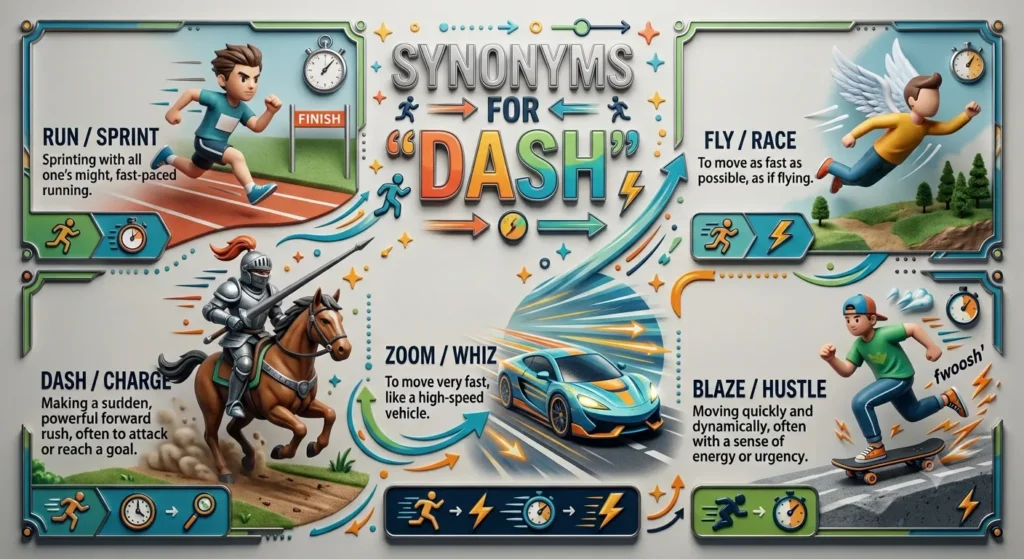
A dash is a quick, sudden run or a fast movement from one place to another. People also use the word to describe a small amount of something, a punctuation mark, or a bold, energetic style. Imagine seeing someone dash across the street to catch a bus before it leaves. The word is common in everyday conversations, books, sports, and writing.
Learning synonyms for dash helps English learners, students, and writers avoid repeating the same word while making their writing more natural and expressive. In this guide, you will discover the meaning of dash, its pronunciation, grammar, history, and word formation. You will also explore 30 useful synonyms with simple meanings, examples, semantic categories, antonyms, and common questions to improve your English vocabulary.
Meaning of Dash
Definition
Dash (Noun/Verb):
- Noun: A quick run, a small amount of something, or the punctuation mark (—).
- Verb: To move quickly or rush somewhere.
Examples
- She made a quick dash for the train.
- The children dashed across the playground.
Connotative Meaning
(Connotation: the emotional feeling or idea that a word suggests beyond its basic meaning.)
Positive tone:
Suggests speed, energy, confidence, and excitement.
Negative tone:
Can imply panic, carelessness, or rushing.
Neutral tone:
Simply describes fast movement or a punctuation mark.
Etymology
Old English (450–1100):
No direct Old English form. The idea comes from words meaning to strike or move forcefully.
Middle English (1100–1500):
Derived from Scandinavian influences meaning “to strike violently.”
Modern English (1500–Present):
Developed to mean striking, rushing quickly, and later the punctuation mark.
Pronunciation (IPA)
- IPA: /dæʃ/
- Syllables: dash (1 syllable)
Affixation Pattern of Dash
Root: dash
Prefix: None
Suffix: None
Word Formations
- dash (noun)
- dash (verb)
- dashed (adjective/verb)
- dashing (adjective)
- dashingly (adverb)
- dasher (noun)
30 Synonyms of Dash With Meaning & Examples
1. Sprint (Verb/Noun)
Meaning: To run very fast over a short distance.
Examples:
- He sprinted to the finish line.
- She won the 100-meter sprint.
2. Rush (Verb)
Meaning: To move very quickly.
Examples:
- We rushed to catch the bus.
- Don’t rush your work.
3. Race (Verb)
Meaning: To move very quickly toward a place.
Examples:
- They raced home.
- The dog raced across the yard.
4. Bolt (Verb)
Meaning: To run away suddenly and quickly.
Examples:
- The horse bolted.
- He bolted from the room.
5. Hurry (Verb)
Meaning: To move or act quickly.
Examples:
- Please hurry home.
- They hurried to school.
6. Scamper (Verb)
Meaning: To run with quick, light steps.
Examples:
- The squirrel scampered up the tree.
- Children scampered around the park.
7. Charge (Verb)
Meaning: To move forward with force.
Examples:
- The players charged onto the field.
- The bull charged ahead.
8. Gallop (Verb)
Meaning: To run fast like a horse.
Examples:
- The horse galloped across the field.
- The pony galloped away.
9. Dart (Verb)
Meaning: To move suddenly and quickly.
Examples:
- The rabbit darted into the bushes.
- She darted across the road.
10. Fly (Verb)
Meaning: To move extremely fast.
Examples:
- Time flies.
- The car flew down the highway.
11. Speed (Verb)
Meaning: To travel quickly.
Examples:
- The motorcycle sped away.
- Don’t speed in town.
12. Tear (Verb)
Meaning: To move very fast.
Examples:
- They tore down the street.
- The truck tore past us.
13. Bound (Verb)
Meaning: To move with long jumps.
Examples:
- The deer bounded away.
- The puppy bounded toward us.
14. Leap (Verb)
Meaning: To jump forward quickly.
Examples:
- The cat leaped onto the wall.
- He leaped over the fence.
15. Run (Verb)
Meaning: To move quickly on foot.
Examples:
- She ran home.
- They run every morning.
16. Hurry Along (Verb)
Meaning: To move quickly.
Examples:
- Let’s hurry along.
- They hurried along the path.
17. Zoom (Verb)
Meaning: To move very fast.
Examples:
- The bike zoomed past.
- Cars zoomed down the road.
18. Shoot (Verb)
Meaning: To move quickly in one direction.
Examples:
- The fish shot away.
- The child shot across the room.
19. Scurry (Verb)
Meaning: To move quickly with short steps.
Examples:
- Mice scurried away.
- People scurried inside.
20. Flee (Verb)
Meaning: To run away from danger.
Examples:
- They fled the fire.
- Villagers fled the storm.
21. Escape (Verb)
Meaning: To get away quickly.
Examples:
- The prisoner escaped.
- The bird escaped the cage.
22. Bound Away (Verb)
Meaning: To move away with large jumps.
Examples:
- The kangaroo bounded away.
- The dog bounded away happily.
23. Hustle (Verb)
Meaning: To move quickly and actively.
Examples:
- Workers hustled to finish.
- She hustled across the station.
24. Whiz (Verb)
Meaning: To move very fast with a buzzing sound.
Examples:
- The train whizzed past.
- A bird whizzed overhead.
25. Zip (Verb)
Meaning: To move very quickly.
Examples:
- The boat zipped across the lake.
- He zipped into the office.
26. Barrel (Verb)
Meaning: To move forward quickly with force.
Examples:
- The truck barreled down the road.
- He barreled through the crowd.
27. Scoot (Verb)
Meaning: To move quickly.
Examples:
- Please scoot over.
- The child scooted away.
28. Scuttle (Verb)
Meaning: To move quickly with small steps.
Examples:
- The crab scuttled across the sand.
- They scuttled indoors.
29. Rush Off (Verb)
Meaning: To leave quickly.
Examples:
- She rushed off to work.
- They rushed off after lunch.
30. Make a Beeline (Verb Phrase)
Meaning: To go directly and quickly toward something.
Examples:
- He made a beeline for the exit.
- She made a beeline to her seat.
Prototype Meaning
When people hear the word dash, they usually imagine someone running quickly from one place to another. The word often suggests speed, urgency, and sudden movement, whether catching a bus, crossing a street, or escaping danger.
Read More:
Synonyms for Cliff: 30 Powerful Alternatives to Know
Prototype Categorization
Grouping synonyms into semantic categories helps writers choose the best word for different situations.
- Fast Running: sprint, race, run, gallop, dash
- Sudden Movement: dart, bolt, shoot, zip, zoom
- Urgent Movement: rush, hurry, hustle, rush off
- Escaping: flee, escape, bolt
- Animal Movement: scamper, scurry, scuttle, bound, bound away
- Forceful Movement: charge, barrel, tear, fly, whiz, leap, scoot, make a beeline
This categorization helps writers pick precise words based on speed, urgency, force, or direction.
Antonyms of Dash
Walk (Verb)
To move at a normal pace.
Stroll (Verb)
To walk slowly and comfortably.
Amble (Verb)
To walk in a relaxed way.
Crawl (Verb)
To move very slowly.
Linger (Verb)
To stay or move slowly.
Pause (Verb)
To stop briefly.
Short Questions and Answers
What does dash mean?
A dash means to move or run very quickly. It can also refer to a punctuation mark or a small amount of something.
When should dash be used?
Use dash when describing fast movement, sudden action, or quick travel.
Is dash positive or negative?
It depends on the context. It can describe exciting speed or careless rushing.
How is it different from similar words?
Dash usually suggests a quick, sudden movement. Sprint focuses on athletic running, while rush often emphasizes urgency.
Conclusion
Learning synonyms for dash helps you write and speak with greater variety and precision. Instead of repeating dash, you can use words like sprint, rush, dart, bolt, or zoom depending on the context. Understanding these alternatives improves vocabulary, strengthens communication, and makes your writing more engaging. Whether you are an English learner, student, or professional writer, practicing these synonyms daily will help you express ideas more naturally and confidently. Expanding your vocabulary is one of the best ways to become a better English speaker and writer.

I’m an English language writer with over 10 years of experience specializing in synonyms, vocabulary, and English usage. My articles are thoroughly researched, SEO-optimized, and written to deliver accurate, trustworthy, and easy-to-understand information. I’m passionate about helping students, writers, professionals, and ESL learners expand their vocabulary and improve their communication skills. Every guide is designed to provide practical value, clear explanations, and reliable language insights readers can trust.