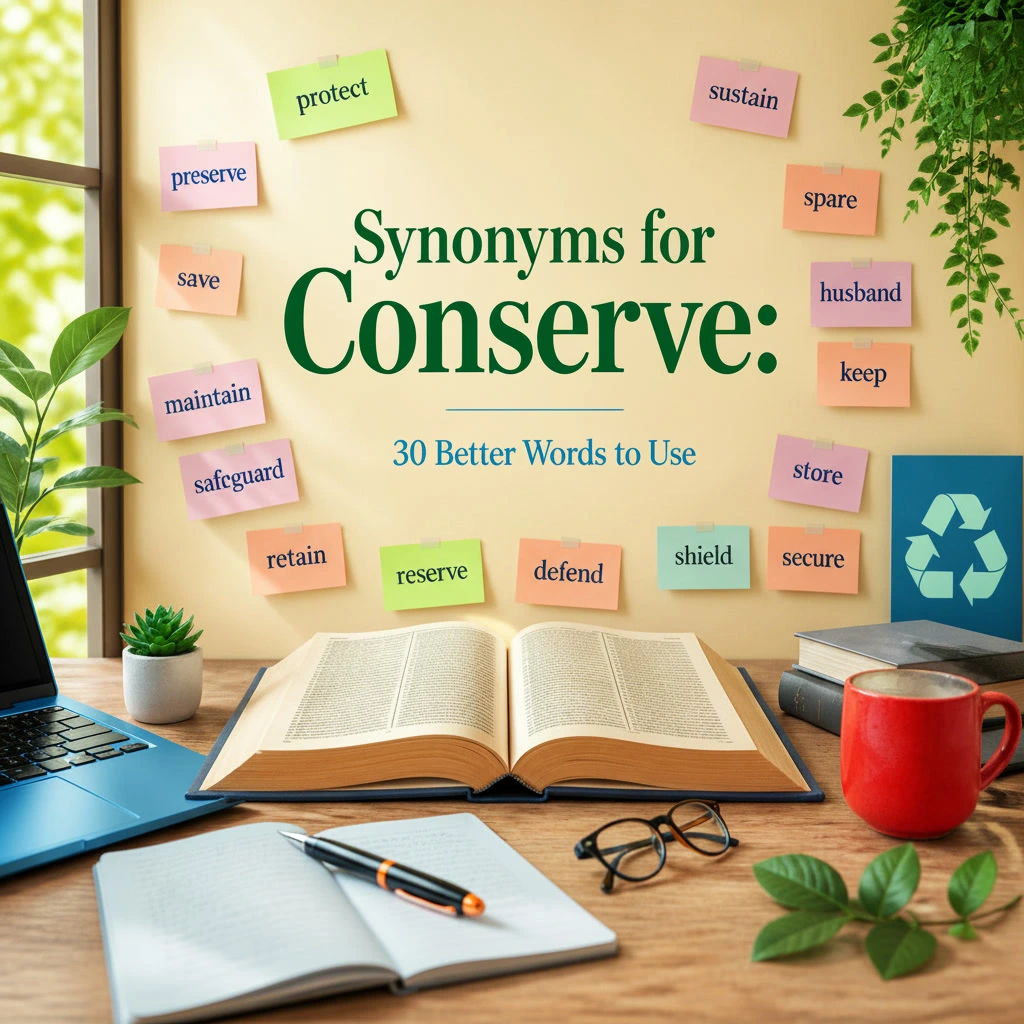
The word conserve means to protect, save, or use something carefully so it lasts longer.
Imagine turning off the tap while brushing your teeth. That simple habit helps conserve water and protects a valuable resource. People often use this word when talking about nature, energy, money, food, and other important things.
Learning synonyms for conserve helps English learners, students, writers, and professionals express ideas more clearly and avoid repeating the same word. Different synonyms fit different situations, making both writing and speaking stronger. In this guide, you will learn the meaning of conserve, its pronunciation, history, grammar, word forms, and 30 useful synonyms with simple meanings and examples. You will also discover antonyms, semantic categories, and common questions to build your vocabulary with confidence.
Meaning of Synonyms for Conserve
Definition
Conserve (Verb):
To protect, save, or use something carefully so that it is not wasted or damaged.
Examples
- We should conserve water during the dry season.
- The museum works hard to conserve ancient paintings.
Connotative Meaning
(Connotation: the emotional feeling or idea that a word suggests beyond its basic meaning.)
Positive tone:
Shows care, responsibility, protection, and wise use of resources.
Negative tone:
Sometimes suggests being overly careful or unwilling to spend or use something.
Neutral tone:
Simply means to preserve or save something without expressing emotion.
Etymology
Old English (450–1100):
The exact word conserve did not exist in Old English. Similar ideas were expressed with words meaning “keep” or “protect.”
Middle English (1100–1500):
The word entered English through Old French conserver, meaning “to preserve” or “to keep safe.”
Modern English (1500–Present):
It comes from the Latin conservare, meaning “to keep safe,” “preserve,” or “maintain.” Today, it commonly refers to protecting natural resources, energy, wildlife, money, and valuable objects.
Pronunciation (IPA)
- IPA (UK): /kənˈsɜːv/
- IPA (US): /kənˈsɝːv/
- Syllables: con·serve
Affixation Pattern of Conserve
- Root: serve (from Latin servare, meaning “to keep” or “protect”)
- Prefix: con- (meaning “together” or “completely”)
- Suffix: None
Word Formations
- conserve (verb) — to protect or save
- conserved (verb, past tense/past participle) — protected or saved
- conserving (verb, present participle) — protecting or saving
- conservation (noun) — the act of protecting resources
- conservationist (noun) — a person who works to protect nature
- conservative (adjective) — careful about change; also related to preserving traditions
- conservatively (adverb) — in a careful or cautious way
- conservatism (noun) — the belief in preserving traditional values
30 Synonyms for Conserve With Meaning & Examples
1. Preserve (Verb)
Meaning: To keep something safe from harm or damage.
Examples:
- We should preserve clean water for future generations.
- The museum helps preserve old paintings.
2. Protect (Verb)
Meaning: To keep someone or something safe.
Examples:
- Trees protect the soil from erosion.
- Wear a helmet to protect your head.
3. Save (Verb)
Meaning: To keep something from being wasted or lost.
Examples:
- Turn off the lights to save energy.
- She wants to save money for college.
4. Maintain (Verb)
Meaning: To keep something in good condition.
Examples:
- They maintain the park every week.
- Good habits help maintain your health.
5. Sustain (Verb)
Meaning: To keep something going over time.
Examples:
- Healthy forests sustain wildlife.
- Exercise helps sustain good health.
6. Safeguard (Verb)
Meaning: To protect from danger or loss.
Examples:
- Laws safeguard children’s rights.
- We must safeguard our personal data.
7. Retain (Verb)
Meaning: To keep or continue to have something.
Examples:
- Plants retain water in their leaves.
- She retained her old photographs.
8. Reserve (Verb)
Meaning: To keep something for future use.
Examples:
- We reserve this room for meetings.
- Save some food and reserve it for later.
9. Store (Verb)
Meaning: To keep something in a safe place.
Examples:
- We store grain in large containers.
- Please store these files carefully.
10. Keep (Verb)
Meaning: To continue having or holding something.
Examples:
- Please keep your ticket.
- Keep the documents in a safe place.
11. Guard (Verb)
Meaning: To watch over and protect.
Examples:
- Soldiers guard the border.
- Dogs guard the house at night.
12. Shield (Verb)
Meaning: To protect from harm.
Examples:
- Trees shield the house from strong winds.
- Sunglasses shield your eyes from sunlight.
13. Defend (Verb)
Meaning: To protect against attack or harm.
Examples:
- The lawyer will defend her client.
- Birds defend their nests.
14. Shelter (Verb)
Meaning: To give protection from danger or bad weather.
Examples:
- The cave sheltered the travelers.
- Trees shelter many animals.
15. Secure (Verb)
Meaning: To make something safe.
Examples:
- Please secure the gate.
- They secured important documents.
16. Spare (Verb)
Meaning: To avoid using or harming something.
Examples:
- This machine helps spare water.
- Please spare a few minutes.
17. Hoard (Verb)
Meaning: To collect and keep too much of something.
Examples:
- Some people hoard food during emergencies.
- He hoarded old newspapers.
18. Stockpile (Verb)
Meaning: To gather and store a large supply.
Examples:
- Farmers stockpile animal feed.
- The town stockpiled medical supplies.
19. Husband (Verb)
Meaning: To use resources carefully.
Examples:
- We must husband our water supply.
- She husbanded every dollar.
20. Manage (Verb)
Meaning: To use something wisely.
Examples:
- We should manage natural resources carefully.
- She managed her budget well.
21. Economize (Verb)
Meaning: To spend or use less.
Examples:
- Families economize during hard times.
- We should economize on electricity.
22. Reduce (Verb)
Meaning: To make less in amount.
Examples:
- We should reduce plastic waste.
- Walking can reduce pollution.
23. Recycle (Verb)
Meaning: To process used materials so they can be used again.
Examples:
- Many families recycle paper.
- Schools encourage students to recycle bottles.
24. Reuse (Verb)
Meaning: To use something again.
Examples:
- We can reuse shopping bags.
- She reused old boxes.
25. Restore (Verb)
Meaning: To return something to a good condition.
Examples:
- Workers restored the old bridge.
- They restored the damaged forest.
26. Care for (Verb)
Meaning: To look after something carefully.
Examples:
- We should care for nature.
- She cares for the family garden.
27. Foster (Verb)
Meaning: To support growth or development.
Examples:
- Parks foster wildlife.
- Good teachers foster learning.
28. Uphold (Verb)
Meaning: To support and maintain.
Examples:
- We must uphold our values.
- The team upheld safety standards.
29. Perpetuate (Verb)
Meaning: To make something continue for a long time.
Examples:
- Good traditions perpetuate culture.
- Stories perpetuate history.
30. Cherish (Verb)
Meaning: To value and care for deeply.
Examples:
- We should cherish our natural resources.
- She cherishes family memories.
Prototype Meaning
The most common meaning of conserve is to protect, save, or use something carefully so it lasts longer and is not wasted. When people hear the word, they often think about conserving water, electricity, forests, wildlife, food, or money. It usually suggests responsible and thoughtful use of valuable resources.
Prototype Categorization
The 30 synonyms can be grouped by their meanings. This makes it easier to choose the right word for different situations.
- Protection and Safety: preserve, protect, safeguard, guard, shield, defend, shelter, secure — These words focus on keeping people, places, or things safe from harm or damage.
- Careful Use of Resources: save, conserve, husband, manage, economize, reduce, spare — These emphasize using resources wisely and avoiding waste.
- Keeping or Holding: retain, reserve, store, keep, maintain — These refer to keeping something in good condition or available for future use.
- Environmental Conservation: recycle, reuse, restore, foster — These are commonly used when talking about protecting nature and supporting sustainability.
- Long-Term Continuation: sustain, uphold, perpetuate — These describe helping something continue over time.
- Valuing and Appreciation: cherish, care for — These express emotional care and respect for something valuable.
- Large-Scale Storage: stockpile, hoard — These mean collecting and keeping supplies, although hoard often has a negative meaning because it suggests keeping too much.
Understanding these categories helps writers and speakers choose the most accurate synonym for each context instead of using the same word repeatedly.
Antonyms of Conserve
Waste (Verb)
- To use carelessly or unnecessarily.
Squander (Verb)
- To waste something valuable in a reckless way.
Consume (Verb)
- To use up a resource.
Destroy (Verb)
- To damage something beyond repair.
Deplete (Verb)
- To reduce or use up most of a resource.
Exhaust (Verb)
- To use something until none is left.
Spend (Verb)
- To use money or resources.
Misuse (Verb)
- To use something in the wrong or harmful way.
Neglect (Verb)
- To fail to care for or protect something.
Discard (Verb)
- To throw something away.
Short Questions and Answers
What does conserve mean?
Conserve means to protect, preserve, or use something carefully so it is not wasted or damaged.
When should conserve be used?
Use conserve when talking about saving natural resources, energy, water, money, food, wildlife, or valuable objects for future use.
Is conserve positive or negative?
Conserve is generally a positive word because it suggests responsibility, protection, and wise use of resources.
How is it different from similar words?
Conserve focuses on careful use and protection. Preserve emphasizes keeping something in its original condition, while save usually means preventing waste or keeping something for later use.
Conclusion
Learning synonyms for conserve helps you express ideas more clearly and naturally. Instead of repeating the same word, you can choose the best synonym for each situation, whether you are writing about protecting nature, saving money, preserving history, or using resources wisely. A stronger vocabulary also improves your writing, speaking, and reading skills. The more words you know, the easier it becomes to communicate with confidence. Practice using these synonyms in daily conversations and writing to build lasting English fluency and make your language richer and more precise.

An English language writer with expertise in grammar, spelling, vocabulary, and word usage. Committed to publishing accurate, well-researched, and easy-to-understand content that helps readers improve their English with confidence.