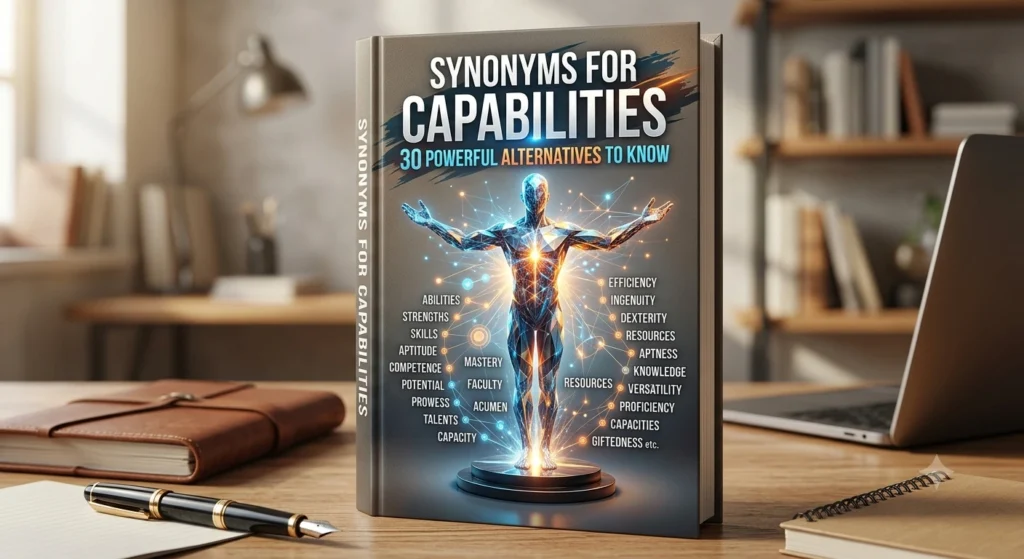
The word capabilities mean the skills, abilities, or qualities that allow a person, group, or thing to perform a task successfully.
Imagine a company hiring a new employee. Instead of asking only about experience, the manager also wants to know the person’s capabilities, such as problem-solving, teamwork, and communication. The word is common in education, business, technology, and daily conversations. Learning synonyms for capabilities helps English learners, students, and content writers avoid repeating the same word and express ideas more clearly. In this guide, you will learn the meaning of capabilities, its pronunciation, history, grammar, and 30 useful synonyms with easy examples. You will also discover semantic categories, antonyms, and simple questions that make the word easier to understand and use correctly.
Meaning of Synonyms for Capabilities
Definition
Capabilities (Noun):
The skills, talents, knowledge, or power to do something successfully.
Examples
- Her capabilities impressed the interview panel.
- The software has many advanced capabilities.
Connotative Meaning
(Connotation: the emotional feeling or idea a word suggests beyond its basic meaning.)
Positive tone: Suggests talent, strength, and competence.
Negative tone: May sound limited when used as “lack of capabilities.”
Neutral tone: Simply describes what someone or something can do.
Etymology
Old English (450–1100):
No direct Old English form. The idea came from words meaning “to be able.”
Middle English (1100–1500):
Influenced by Anglo-French and Latin words related to capacity and ability.
Modern English (1500–Present):
Derived from capable, which comes from Latin capabilis, meaning “able to hold or receive.” The noun capability became common in the 16th century, and capabilities refers to multiple abilities or powers.
Pronunciation (IPA)
- IPA: /ˌkeɪ.pəˈbɪl.ə.tiz/
- Syllables: ca-pa-bil-i-ties
Affixation Pattern of Capabilities
- Root: capable
- Prefix: None
- Suffix: -ity (forms the noun capability), -ies (plural ending)
Word Formations
- Capable (Adjective)
- Capability (Noun)
- Capabilities (Plural Noun)
- Capably (Adverb)
- Incapable (Adjective)
- Incapability (Noun)
30 Synonyms of Capabilities With Meaning & Examples
1. Ability (Noun)
Meaning: The power or skill to do something.
Examples:
- She has the ability to lead a team.
- His ability improved with practice.
2. Skill (Noun)
Meaning: A learned talent for doing something well.
Examples:
- Writing is an important skill.
- She developed cooking skills quickly.
3. Talent (Noun)
Meaning: A natural gift or special ability.
Examples:
- He has a talent for music.
- Her talent amazed everyone.
4. Competence (Noun)
Meaning: The ability to perform a task well.
Examples:
- His competence earned respect.
- Competence is important at work.
5. Competency (Noun)
Meaning: A specific skill or area of expertise.
Examples:
- Communication is a key competency.
- Leadership competency grows with experience.
6. Capacity (Noun)
Meaning: The ability or potential to do something.
Examples:
- She has the capacity to learn fast.
- The machine has great capacity.
7. Aptitude (Noun)
Meaning: Natural ability to learn or perform.
Examples:
- He has an aptitude for math.
- Her aptitude helped her succeed.
8. Proficiency (Noun)
Meaning: A high level of skill.
Examples:
- She showed English proficiency.
- His proficiency impressed the teacher.
9. Expertise (Noun)
Meaning: Expert knowledge or skill.
Examples:
- She shared her expertise.
- His expertise solved the problem.
10. Mastery (Noun)
Meaning: Complete control or excellent skill.
Examples:
- Mastery takes time.
- She achieved mastery in chess.
11. Strength (Noun)
Meaning: A strong quality or advantage.
Examples:
- Patience is her strength.
- Teamwork is our greatest strength.
12. Power (Noun)
Meaning: The ability to influence or achieve results.
Examples:
- Knowledge gives power.
- The engine has great power.
13. Potential (Noun)
Meaning: Hidden ability that can grow.
Examples:
- She has great potential.
- The child reached his potential.
14. Gift (Noun)
Meaning: A natural talent.
Examples:
- He has a gift for languages.
- Her gift inspired others.
15. Knack (Noun)
Meaning: A special way of doing something easily.
Examples:
- She has a knack for teaching.
- He has a knack for fixing things.
16. Faculty (Noun)
Meaning: A natural mental or physical ability.
Examples:
- Memory is an important faculty.
- Age may affect mental faculties.
17. Resourcefulness (Noun)
Meaning: The ability to solve problems creatively.
Examples:
- Her resourcefulness saved the project.
- We admired his resourcefulness.
18. Dexterity (Noun)
Meaning: Skill with the hands or body.
Examples:
- Dexterity helps surgeons.
- Her finger dexterity is impressive.
19. Efficiency (Noun)
Meaning: The ability to work well with little waste.
Examples:
- Efficiency saves time.
- The new system improved efficiency.
20. Effectiveness (Noun)
Meaning: The ability to produce good results.
Examples:
- The campaign showed effectiveness.
- Training increased effectiveness.
21. Know-how (Noun)
Meaning: Practical knowledge gained through experience.
Examples:
- She has technical know-how.
- Experience brings know-how.
22. Qualification (Noun)
Meaning: A skill or achievement that makes someone suitable.
Examples:
- She has the right qualifications.
- His qualifications matched the job.
23. Accomplishment (Noun)
Meaning: A developed skill or achievement.
Examples:
- Painting is her accomplishment.
- His accomplishments inspired others.
24. Endowment (Noun)
Meaning: A natural quality or ability.
Examples:
- Intelligence is a valuable endowment.
- She has artistic endowments.
25. Finesse (Noun)
Meaning: Great skill and delicate handling.
Examples:
- She handled it with finesse.
- His finesse impressed everyone.
26. Genius (Noun)
Meaning: Exceptional natural ability.
Examples:
- She is a musical genius.
- His genius changed science.
27. Versatility (Noun)
Meaning: The ability to perform many different tasks.
Examples:
- Versatility makes employees valuable.
- Her versatility impressed the judges.
28. Efficiency Level (Noun)
Meaning: The degree of effective performance.
Examples:
- Efficiency levels improved.
- High efficiency matters.
29. Qualification Set (Noun)
Meaning: A group of skills and credentials.
Examples:
- His qualification set is impressive.
- The role needs a strong qualification set.
30. Fitness (Noun)
Meaning: Suitability or readiness for a purpose.
Examples:
- Her fitness for the role was clear.
- The test measured fitness.
Prototype Meaning
When people hear capabilities, they usually think about what a person, machine, or organization is able to do well. It often refers to skills, talents, knowledge, or technical features that help achieve goals or complete tasks successfully.
Prototype Categorization
- Natural Abilities: Talent, Gift, Genius, Aptitude, Endowment — describe abilities people are born with.
- Learned Skills: Skill, Competence, Competency, Expertise, Mastery, Proficiency, Know-how — focus on knowledge gained through learning and practice.
- Performance Qualities: Efficiency, Effectiveness, Resourcefulness, Dexterity, Finesse, Versatility — describe how well someone performs tasks.
- General Power and Potential: Ability, Capacity, Potential, Power, Strength, Faculty, Fitness — express overall capability or possibility.
- Professional Readiness: Qualification, Qualification Set, Accomplishment — relate to work, education, and career success.
These categories help writers choose the most accurate synonym depending on whether they want to describe natural talent, learned skills, workplace qualifications, or overall potential.
Antonyms of Capabilities
Inability (Noun)
Meaning: Lack of power or skill.
Weakness (Noun)
Meaning: A lack of strength or ability.
Incapacity (Noun)
Meaning: The inability to perform tasks.
Incompetence (Noun)
Meaning: Lack of skill or competence.
Inefficiency (Noun)
Meaning: Poor performance or wasted effort.
Limitation (Noun)
Meaning: A restriction on ability.
Helplessness (Noun)
Meaning: Being unable to help oneself.
Disability (Noun)
Meaning: A condition that limits certain abilities.
Read more: Synonyms of Mother: 30 Beautiful Alternatives to Know
Short Questions and Answers
What does capabilities mean?
Capabilities are the skills, talents, or abilities that help someone or something perform tasks successfully.
When should capabilities be used?
Use capabilities when talking about what a person, machine, team, or organization can do.
Is capabilities positive or negative?
It is usually positive or neutral because it highlights strengths or abilities.
How is it different from similar words?
Capabilities is a broad word that includes many skills or powers, while words like talent often describe natural ability and skill usually refers to something learned.
Conclusion
Learning synonyms for capabilities helps you express ideas more clearly and naturally in both writing and speaking. Instead of repeating the same word, you can choose alternatives like ability, expertise, competence, or potential based on the situation. This makes your communication more interesting and professional. Expanding your vocabulary also improves reading comprehension, boosts confidence, and helps you sound more fluent in English. Whether you are a student, teacher, content writer, or English learner, practicing these synonyms every day will strengthen your language skills. Keep using new words in conversations and writing to make them part of your everyday vocabulary.

An English language writer with expertise in grammar, spelling, vocabulary, and word usage. Committed to publishing accurate, well-researched, and easy-to-understand content that helps readers improve their English with confidence.