Snippet Answer:
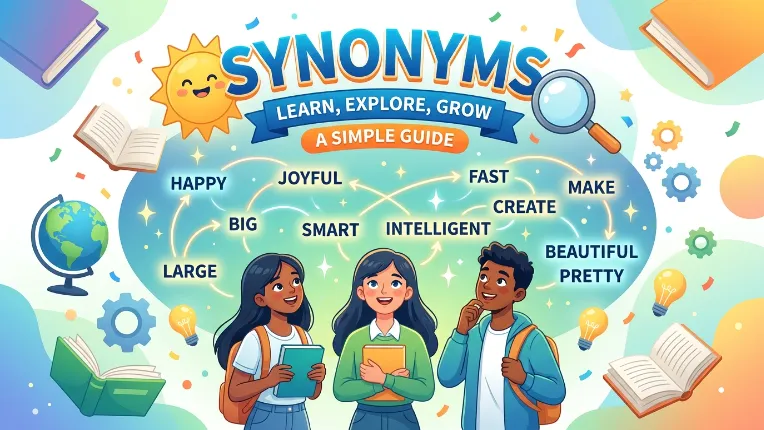
Synonyms are words that have the same or nearly the same meaning as another word, such as big and large, and they help improve vocabulary and writing.
What Are Synonyms? (Meaning and Definition)
A synonym is a word or phrase that has the same or nearly the same meaning as another word in the same language.
In simple terms, synonyms are different words that express a similar idea.
For example, the words big, large, and huge all describe something that has a great size. Because they share a similar meaning, they are considered synonyms.
Synonyms are widely used in everyday communication, academic writing, and digital content in both the United States (USA) and the United Kingdom (UK).
Why Synonyms Are Important
Synonyms are an important part of the English language because they help people communicate more effectively.
1. Avoid Repetition
Using the same word repeatedly can make writing sound boring. Synonyms allow writers to express the same idea in different ways.
2. Improve Writing Quality
Writers, bloggers, and students often use synonyms to make their content more interesting and professional.
3. Expand Vocabulary
Learning synonyms helps people build a stronger English vocabulary.
4. Adjust Tone and Style
Some synonyms are more formal, while others are more casual, allowing writers to match the tone of their message.
Common Synonym Examples With Meaning and Sentences
Below are some common synonyms along with their meanings and example sentences.
1. Happy – Joyful
Meaning: Feeling pleasure, happiness, or delight.
Example Sentence:
- She felt happy after receiving the good news.
- She felt joyful after receiving the good news.
2. Big – Large
Meaning: Something that has great size or importance.
Example Sentence:
- They bought a big house in the city.
- They bought a large house in the city.
3. Fast – Quick
Meaning: Moving or happening at a high speed.
Example Sentence:
- He runs very fast during the race.
- He runs very quick during the race.
4. Smart – Intelligent
Meaning: Having strong thinking ability or knowledge.
Example Sentence:
- She is a smart student in her class.
- She is an intelligent student in her class.
5. Begin – Start
Meaning: To begin or initiate something.
Example Sentence:
- The meeting will begin at 9 AM.
- The meeting will start at 9 AM.
6. Small – Tiny
Meaning: Something that has little size.
Example Sentence:
- The puppy is very small.
- The puppy is very tiny.
7. Angry – Mad
Meaning: Feeling strong displeasure or irritation.
Example Sentence:
- He became angry after hearing the news.
- He became mad after hearing the news.
8. Easy – Simple
Meaning: Something that is not difficult to do or understand.
Example Sentence:
- This math problem is easy.
- This math problem is simple.
Types of Synonyms
Synonyms can be divided into different types depending on how closely their meanings match.
Absolute Synonyms
These words have nearly identical meanings and can often be used interchangeably.
Example:
- Begin – Start
- End – Finish
Partial Synonyms
These words have similar meanings but may differ slightly in tone or usage.
Example:
- Big – Huge
- Small – Tiny
Contextual Synonyms
Some words act as synonyms only in certain contexts.
Example:
- Bright can mean intelligent or full of light depending on the sentence.
Synonyms in American and British English
Most synonyms are used the same way in American English and British English, but some words differ depending on the region.
| American English | British English | Meaning |
| Apartment | Flat | A place to live |
| Truck | Lorry | A large vehicle for transporting goods |
| Vacation | Holiday | Time away from work |
| Cookie | Biscuit | A sweet baked snack |
| Elevator | Lift | A machine that moves between floors |
These words refer to the same thing but are commonly used in different countries.
How to Find Synonyms
There are several easy ways to find synonyms when writing.
Use a Thesaurus
A thesaurus is a tool that lists synonyms and related words.
Use Online Dictionaries
Many digital dictionaries provide synonym suggestions for common words.
Use Writing Tools
Modern writing tools often recommend synonyms to improve readability.
Synonyms vs Antonyms
Synonyms are often compared with antonyms.
| Term | Meaning | Example |
| Synonyms | Words with similar meanings | Big – Large |
| Antonyms | Words with opposite meanings | Big – Small |
Understanding both helps learners improve their vocabulary and language skills.
Key Points About Synonyms
Here are the most important things to remember:
- Synonyms are words with similar meanings.
- They help avoid repetition in writing.
- They improve vocabulary and language skills.
- Writers use them to create better and more engaging content.
- Synonyms are widely used in education, blogging, and professional writing.
FAQs
What are synonyms in simple words?
Synonyms are words that have the same or nearly the same meaning as another word.
Example: Big and Large.
What are 10 examples of synonyms?
Here are ten common examples:
- Happy – Joyful
- Big – Large
- Small – Tiny
- Fast – Quick
- Smart – Intelligent
- Begin – Start
- Easy – Simple
- Angry – Mad
- Strong – Powerful
- Rich – Wealthy
Why are synonyms important in English?
Synonyms help improve vocabulary, make writing more interesting, and prevent repeating the same words too often.
Conclusion
Synonyms are words that have the same or nearly the same meaning as another word. They are essential for improving vocabulary, writing quality, and communication.
Students, writers, and professionals in the USA and the UK regularly use synonyms to make their language clearer and more engaging. Learning synonyms is one of the best ways to strengthen English skills and become a better communicator.
Synonyms for Pollution: 50 Words Related to Environmental Contamination

Hello I am Emily Carter.I focus on English vocabulary, synonyms, and clear explanations. Writing helps me turn complex language rules into easy lessons for readers.