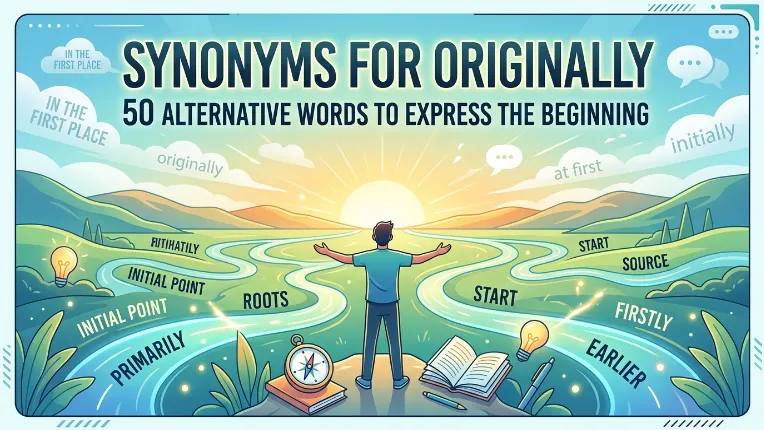
“Originally” means at the beginning or in the first stage before any changes happened.
Have you ever heard someone say, “I originally planned to study medicine, but later I chose engineering”? Many plans, ideas, and stories begin one way but change over time. I once met a student who originally wanted to become a pilot. Later, he discovered a love for writing and became a journalist. His first plan changed, but that starting point was still important.
The word originally means something that happened at the beginning or first stage. It helps explain the starting point of a plan, idea, place, or situation. Students, bloggers, content writers, and everyday English users often need different ways to say this word. Learning synonyms for originally helps avoid repetition and makes writing clearer and more natural in essays, blogs, emails, and conversations.
Initially
Meaning: At the beginning of something.
Examples:
- Initially, the project seemed difficult.
- She initially planned to travel alone.
At First
Meaning: In the beginning before changes happened.
Examples:
- At first, the task looked easy.
- He was nervous at first.
In the Beginning
Meaning: At the earliest stage of something.
Examples:
- In the beginning, the team struggled.
- The story was simple in the beginning.
From the Start
Meaning: From the very beginning.
Examples:
- She trusted him from the start.
- The plan was clear from the start.
To Begin With
Meaning: At the first point in time.
Examples:
- To begin with, we discussed the idea.
- He was unsure to begin with.
At the Outset
Meaning: At the start of an event or process.
Examples:
- At the outset, the goal was simple.
- The company faced challenges at the outset.
Primarily
Meaning: In the first or main way.
Examples:
- The school was primarily for science students.
- The meeting was primarily about planning.
Fundamentally
Meaning: At the basic or original level.
Examples:
- The idea was fundamentally simple.
- Their goals were fundamentally the same.
At the Start
Meaning: At the first moment of something.
Examples:
- At the start, nobody understood the plan.
- She felt confident at the start.
In the First Place
Meaning: At the original moment or reason.
Examples:
- Why did you choose this job in the first place?
- The idea sounded strange in the first place.
From the Beginning
Meaning: From the very first moment.
Examples:
- He supported the idea from the beginning.
- She loved music from the beginning.
In the Early Stage
Meaning: During the first phase.
Examples:
- In the early stage, the project moved slowly.
- The company grew fast in the early stage.
At the Beginning
Meaning: At the first part of something.
Examples:
- At the beginning, the movie was calm.
- She felt confused at the beginning.
At the Initial Stage
Meaning: At the very first stage.
Examples:
- At the initial stage, planning was important.
- The problem appeared small at the initial stage.
Beforehand
Meaning: Earlier or before something happens.
Examples:
- I prepared beforehand.
- She finished the work beforehand.
First
Meaning: At the earliest moment.
Examples:
- First, we studied the problem.
- He first noticed the mistake.
Early On
Meaning: At an early time.
Examples:
- Early on, the project looked promising.
- She realized the truth early on.
To Start
Meaning: At the start of something.
Examples:
- To start, we reviewed the plan.
- The idea seemed simple to start.
At the Very Beginning
Meaning: At the earliest possible moment.
Examples:
- At the very beginning, they had little money.
- She felt excited at the very beginning.
At the First Stage
Meaning: During the first phase.
Examples:
- At the first stage, learning was slow.
- The plan changed after the first stage.
First of All
Meaning: Before anything else.
Examples:
- First of all, we need a clear goal.
- First of all, thank you for coming.
Primordially
Meaning: In the earliest or original time.
Examples:
- The land was primordially covered with forest.
- The river flowed primordially through the valley.
In Earlier Times
Meaning: At an earlier period.
Examples:
- In earlier times, people traveled slowly.
- The city looked different in earlier times.
Formerly
Meaning: In the past before changes.
Examples:
- He formerly worked as a teacher.
- The building was formerly a school.
Previously
Meaning: Before the present time.
Examples:
- She previously lived in another city.
- The company previously sold only books.
In the Past
Meaning: At an earlier time.
Examples:
- In the past, the river was clean.
- He worked abroad in the past.
Before
Meaning: Earlier than something else.
Examples:
- I had seen the movie before.
- She arrived before the meeting.
Earlier
Meaning: At a time before now.
Examples:
- He called earlier today.
- She finished the task earlier.
Once
Meaning: At a time in the past.
Examples:
- Once, this place was a forest.
- He once dreamed of traveling.
Long Ago
Meaning: A very long time in the past.
Examples:
- Long ago, people lived differently.
- The castle was built long ago.
At the Dawn
Meaning: At the very beginning of something.
Examples:
- At the dawn of the project, ideas were simple.
- The company started small at the dawn.
From Day One
Meaning: From the very first day.
Examples:
- She believed in the project from day one.
- He worked hard from day one.
In Its Early Days
Meaning: During the first period.
Examples:
- In its early days, the company was small.
- The club struggled in its early days.
At the Initial Point
Meaning: At the starting point.
Examples:
- At the initial point, the idea looked simple.
- The plan changed after the initial point.
At the Commencement
Meaning: At the beginning of something.
Examples:
- At the commencement, the team was small.
- The event was quiet at the commencement.
At the Genesis
Meaning: At the origin or start.
Examples:
- At the genesis of the project, only two people worked.
- The idea appeared at the genesis of the meeting.
At the Origin
Meaning: At the first source or beginning.
Examples:
- At the origin, the company sold books.
- The story changed from its origin.
From the Outset
Meaning: From the start of something.
Examples:
- She supported the idea from the outset.
- The plan was clear from the outset.
At the Inception
Meaning: At the start of an idea or project.
Examples:
- At the inception, the business was small.
- The plan looked promising at the inception.
At the Launch
Meaning: At the first release or start.
Examples:
- At the launch, many people joined.
- The product succeeded at the launch.
Initially Speaking
Meaning: Referring to the beginning stage.
Examples:
- Initially speaking, the plan seemed simple.
- Initially speaking, the idea was small.
First and Foremost
Meaning: Before everything else.
Examples:
- First and foremost, safety matters.
- First and foremost, we need planning.
In the First Stage
Meaning: During the earliest phase.
Examples:
- In the first stage, learning is slow.
- The project struggled in the first stage.
From the Very Start
Meaning: From the absolute beginning.
Examples:
- He trusted the team from the very start.
- She loved writing from the very start.
From the First Moment
Meaning: From the first instant.
Examples:
- I believed him from the first moment.
- She felt happy from the first moment.
In the Early Period
Meaning: During the early time.
Examples:
- In the early period, growth was slow.
- The city expanded in the early period.
Back Then
Meaning: At that earlier time.
Examples:
- Back then, life was simpler.
- Back then, the town was quiet.
At the Starting Point
Meaning: At the first stage of something.
Examples:
- At the starting point, the task was easy.
- The idea looked simple at the starting point.
At the Earliest Stage
Meaning: At the very first stage.
Examples:
- At the earliest stage, planning is important.
- The company struggled at the earliest stage.
In the Original Plan
Meaning: In the first version of the plan.
Examples:
- In the original plan, the trip was shorter.
- The building looked different in the original plan.
Conclusion
Learning synonyms for originally helps writers explain the starting point of ideas, plans, or events more clearly. These alternatives improve essays, blog posts, and everyday communication by reducing repetition and adding variety. Students, bloggers, and professionals can use these words to describe how things began before changes happened. Practicing these synonyms will strengthen vocabulary and make writing more natural, engaging, and effective.

I am Daniel Whitmore.I write about everyday English, common grammar mistakes, and word meanings. My goal is to make learning English simple, clear, and practical for everyone.